Showing posts with label Pre-Raphaelites. Show all posts

04 July 2012

Unexpected Communists in Books


The John Masefield collection I acquired Saturday at the McKay bookshop in Tennessee features a delightful little preface by the poet himself. Among other things, Masefield tells an interesting anecdote about one of his early influences, Pre-Raphaelite poet, Algernon Charles Swinburne (1837-1909): 

...Afterwards, while I was still playing with words and measures, I met with the work of A.C. Swinburne. Like most young writers of ath time I at once succumbed to his talent. He could do easily and supremely all those tricks with words and measures which the young craftsman longed to be able to perform. In my enthusiasm for him I paid pilgrimages to Putney and watched outside ‘The Pines’ until the little figure of the Master appeared and went trotting up the hill. 
I never spoke with him. A few years later, when he had ceased to seem the miraculous Master of the art, it was my fortune for many days together to sit at the same table with him in the reading-room of the British Museum. He was then very old, frail, and deaf. The magnificent head was all that remained of the prophet and seer; the rest was a little shrunken stalk. The late Mr Watts-Dunton [critic and poet who rescued Swinburne from alcoholism] used to bring him there, see him to his chair, and order his books for him; he would then bellow in his ear that he would return at one o’clock and take him out to lunch. This message had to be repeated several times before the old man could grasp it, and by that time the reading-room was aroused. Grave heads from every table turned to watch. Presently, after Mr Watts-Dunton had gone, Swinburne would turn to his books. I know not what they were, but imagine that they were of a merry impropriety, for the old man used to roar with laughter over them and, being deaf, never knew what disturbance he was causing. An Anglican Bishop and an Abbot of the Roman Church haunted the same table, and from time to time in that room a little, smiling, erect, cynical man, with a face which none could forget, would pass. This was Lenin, then studying, I believe, the psychology of revolution. [1] 
The collection of personalities at the British Museum at any given time is positively staggering. One wonders who the Bishop and Abbot might have been. But the big surprise of course was Lenin. Not that I’d never heard of him visiting London or the library (on which visits there is an interesting article here), but simply because Masefield and Swinburne, especially when followed swiftly by clerics bearing mediaeval titles, don’t naturally lead one to expect the next figure to be the leader of the Russian Revolution.

But this was not my only encounter with communism this week. Looking through Fr John Romanides’s Patristic Theology during the work on my last post, I came across once again the Greek theologian’s interesting comments about communism there. In a lecture entitled ‘Metaphysics & Empiricism’, he writes:

Today all the Marxists who live in Greece are empiricists. Of course, they do not realize this, because Greek ideological Marxists are not familiar with the Marxist family tree like their counterparts in Europe and America are. Overe here they just mechanically memorize their lessons in Marxism like a Jehovah’s Witness would. 

I think it is a real tragedy—and I am not talking about a tragedy fo Aeschylus, but about something shameful [Trans. note—‘Here, Father John is making a play on the words Aischylos and aischos.’]—that there are not any intellectually compelling Marxists in Greece. OF course, their absence is a windfall for the police, the political Right, and Modern Greek theologians, but it is a misfortune for the pursuit of the truth. Marxism started out with principles taken from experience and ended up where it ended up. From a scholarly point of view, Marxism and Patristic theology share the same foundation, so that if Marxists and Patristic theologians would come together, they would be able to communicate with each other. 

Although it is true that Marxism came into conflict with religion, we need to ask ourselves, with what kind of religion did it come into conflict? It did not come into conflict with revelation, but with religion that is identified with metaphysics.... [2] 
Make of that what you will. Although they have much nostalgia for Byzantium, in my experience, Greeks seem to remember so strongly the tyranny of the Turkish Yoke, followed by the tyranny of the German kings imposed on the country after the Revolution in 1832, followed later by the Military Junta in 1967-1974, that even devoutly Orthodox Greeks are much more sympathetic to leftist politics than their counterparts have been in, say, Russia.

It is of course ironic, though I do not plan it this way, that I have posted this on the Fourth of July. On one level, there are those who would argue that communism is unpatriotic, and they are probably right. But on another level, there is the fact that today Americans are celebrating a Revolution. True, the American Revolution was not as radical as those traditionally advocated by communism, but still I fancy I see some irony in the fact that many who would condemn communist revolution will nevertheless celebrate a violent rebellion against a traditional government in order to end oppression and set up a new and experimental form of government.


[1] John Masefield, ‘Preface’, Poems (NY: Macmillan, 1941), pp. v-vi.

[2] Protopresbyter John S. Romanides, Patristic Theology: The University Lectures of Fr John Romanides, tr. Hieromonk Alexios (Trader), ed. Monk Damaskinos Agioreitis (Thessaloniki: Uncut Mountain, 2008), pp. 178-9.

11 May 2010

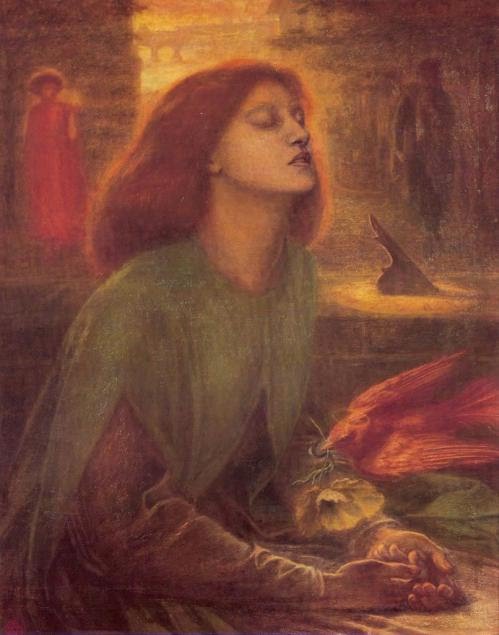
'The Mournfulness of Ancient Life'—Dante Gabriel Rossetti


So, thank you to all who said prayers for me. Thanks to God, I am doing much, much better already. I have been taking into account the advice I received in the comments on the last post, and I intend to slow down significantly my rate of posting on Logismoi. I’m not sure yet if I will set a new goal—I’ve been posting every day for quite some time—but for the time being I’ll just see how it goes and post as the mood strikes me. I may also try to keep the posts a bit simpler, so as not to overdo it.

Today, 12 May, is the birthday of the English Pre-Raphaelite painter and poet, Dante Gabriel Rossetti (1828-1882), named for but not to be confused with the Florentine poet and author of the Divine Comedy, Dante Alighieri (1265-1321). [1] While W.H. Auden has included Rossetti in his anthology of British minor poets, in the introduction to Rossetti in Lionel Trilling’s and Harold Bloom’s Victorian Prose & Poetry, it is argued that the Pre-Raphaelite, ‘though out of favor in our time, seems to this editor the best poet of the Victorian period, after Browning and Tennyson, surpassing Arnold and even Hopkins and Swinburne (greatly undervalued as Swinburne now is).’ [2] According to Benét’s Reader’s Encyclopedia, Rossetti’s ‘lyric poems are distinguished by richness and vividness of detail, mysticism and fantasy, and the frequent use of modified ballad form.’ [3]

Concerning Rossetti’s origin, Joseph Knight tells us that his family came from the city of ‘Vasto d’Ammone, the ancient Histonium’. His father, Gabriele Rossetti, was ‘distinguished as a patriot and a man of letters’, but was persecuted by Ferdinand, the King of the Two Sicilies, and forced to flee to England. [4] Once in England, Rossetti’s father married Frances Mary Lavinia Polidori, whose father was Gaetano Polidori, a translator of Milton into Italian, and whose brother was Dr John William Polidori, physician to Lord Byron, participant in the famous ghost-story game which spawned Frankenstein, and author, as a result, of the first vampire story in English, The Vampyre. A few years after Rossetti’s birth, his father took up the post of Professor of Italian Literature at King’s College, a post he held until 1845. Gabriele and Frances Rossetti had four children, who were ‘all honourably known in connection with literature’: [5] Maria Francesca, author of A Shadow of Dante, Dante Gabriel, William Michael, and Christina, the latter three of whom were all associated with the Pre-Raphaelite Brotherhood. According to George Creeger’s account of the eldest son’s work:

Rossetti possessed the talents of painter and poet alike: at the age of six he was already writing verses, and when he was fifteen there appeared a privately printed volume entitled Hugh the Heron. But he devoted much of his energy to mastering the craft of painting; and the Pre-Raphaelite Brotherhood founded in 1848 by him (together with [William Holman] Hunt, [John Everett] Millais, and [Thomas] Woolner) was at first only incidentally concerned with literary principles. But even as Rossetti’s fame as a painter grew, he wrote a good deal of poetry, much of which was printed in The Germ, a periodical started by the Brotherhood in 1850. Many of his later MSS. he buried, however, in the coffin of his wife and beautiful model, Elizabeth (née Siddal), who, already ill with tuberculosis, died of an overdose of laudanum in 1862. Seven years later the MSS. were recovered [6] and formed the basis of the volume of poems published in 1869. Rossetti’s last years were marked by increasing morbidity, quasi-paranoia, and addiction to drugs; but in 1881 he published a second volume of poetry, Ballads & Sonnets, in which the signs of his genius were still clear. [7]

James Merritt has quoted Rossetti’s brother, William Michael, as saying of one of his own poems that ‘the informing idea of the poem was to apply to verse-writing the same principles . . . which the Pre-Raphaelites upheld in their pictures’. [8] Similarly, Dante Gabriel actually has lyrics which are meant to accompany his paintings. His subject matter and symbolism are of course frequently Christian, as are those of his paintings, though we mustn’t conclude too much from this. While Rossetti was raised in his mother’s Anglican faith, unlike his sister Christina he seems not to have been a traditional believer. George Landow quotes William Holman Hunt as saying that Rossetti spoke ‘in a very patronising way about the “poor man” Jesus, and . . . ridiculed the promises about coming again’. [9] John Ruskin writes, ‘To Rossetti, the Old and New Testaments were only the greatest poems he knew; and he painted scenes from them with no more actual belief in their relation to the present life and business of men than he gave also to the “Morte d’Arthur” and the “Vita Nuova”.’ [10]

But Landow also points out in some detail Rossetti’s use of Christian typology in his poetry, particularly in one sonnet he composed to accompany a painting entitled ‘Passover in the Holy Family’:

Here meet together the prefiguring day
And day prefigured. ‘Eating, thou shalt stand,
Feet shod, loins girt, thy road-staff in thine hand,
With blood-stained door and lintel,’ – did God say
By Moses’ mouth in ages passed away.
And now, where this poor household doth comprise
At Paschal-Feast two kindred families,
Lo! the slain lamb confronts the Lamb to slay.
The pyre is piled. What agony’s crown attained,
What shadow of Death the Boy’s fair brow subdues
Who holds that blood wherewith the porch is stained
By Zachary the priest? John binds the shoes
He deemed himself not worthy to unloose;
And Mary culls the bitter herbs ordained.

In Landow’s words, Rossetti ‘was intrigued by the fact that prefigurative symbolism provides a means of redeeming human time, of perceiving an order and causality in human events.’ He goes on to observe, ‘It is precisely this aspect of typological symbolism with which Rossetti concerns himself in his sonnet, which . . . proceeds by setting forth the series of details—the types—which prefigure Christ’s ultimate self-sacrifice.’ Interestingly, this actually suggests a very good reason for the direct linking of painting and poetry for Rossetti. As Landow writes:

Ever since Lessing had reiterated the ancient truth that paintings were limited to a single moment in time, artists had increasingly concerned themselves with dramatically climactic moments. But this new form of symbolism offered a means of inserting the scene in several different times, as it were, and thus enriching the picture’s effect. Paradoxically, this potential also emphasizes the limited nature of the visual image, because it makes it depend heavily for its effect upon linguistic, extra-visual sources for meaning and drama.

Rossetti’s fascination with typological symbolism also appears in the poems he composed about other artists’ works, for in these he is adding the typological dimension on his own authority. [11]

In conclusion, I suggest all have a look at some of Rossetti’s other work, here for instance, as well as this stirring post on the Pre-Raphaelites by Kevin Edgecomb of biblicalia. There is also another interesting take on Rossetti’s religious symbolism here. I leave you with ‘The Sea-Limits’ (1849-50), anthologised by Auden as well as Trilling and Bloom:

Consider the sea’s listless chime:
Time’s self it is, made audible,—
The murmur of the earth’s own shell.
Secret continuance sublime
Is the sea’s end: our sight may pass
No furlong further. Since time was,
This sound hath told the lapse of time.

No quiet, which is death’s,—it hath
The mournfulness of ancient life,
Enduring always at dull strife.
As the world’s heart of rest and wrath,
Its painful pulse is in the sands.
Last utterly, the whole sky stands,
Grey and not known, along its path.

Listen alone beside the sea,
Listen alone among the woods;
Those voices of twin solitudes
Shall have one sound alike to thee:
Hark where the murmurs of thronged men
Surge and sink back and surge again,—
Still the one voice of wave and tree.

Gather a shell from the strown beach
And listen at its lips: they sigh
The same desire and mystery,
The echo of the whole sea’s speech.
And all mankind is thus at heart
Not anything but what thou art:
And Earth, Sea, Man, are all in each. [12]


[1] It is worth pointing out, however, that in their note on Rossetti’s ‘Sestina (after Dante)’, Lionel Trilling and Harold Bloom write, ‘No more successful version of anything by Dante exists in English . . .’ (Victorian Prose & Poetry (NY: Oxford U, 1973), p. 624).

[2] Ibid., p. 616.

[3] Katherine Baker Siepmann, ed., Benét’s Reader’s Encyclopedia, 3rd ed. (NY: HarperCollins, 1987), p. 846.

[4] Joseph Knight, Life of Dante Gabriel Rossetti (London: Walter Scott, 1887), p. 11.

[5] Ibid., p. 13.

[6] On the subject of the ‘recovery’ of the manuscript, which as is noted occurred seven years after the woman’s burial, Knight insists that the idea was suggested by various friends, culminating in an offer on the part of one Mr Charles Augustus Howell to actually ‘take charge of the execution of the task’, to which Rossetti ‘was still averse’. Finally, ‘All was found as it was left, but the book, though not in any way destroyed, was soaked through and through, and had to undergo a long process of ablution in the hand of the medical man who assisted Mr Howell. By his care also the whole was dried leaf by leaf’ (Knight, p. 106).

[7] George R. Creeger, ‘Notes’, 19th-Century British Minor Poets, ed. W.H. Auden (NY: Delacorte, 1966), p. 368.

[8] James D. Merritt, ed., The Pre-Raphaelite Poem (NY: E.P. Dutton & Co., 1966), p. 20.

[9] Qtd. in George P. Landow, Replete with Meaning: William Holman Hunt & Typological Symbolism, here.

[10] Ibid.

[11] Ibid.

[12] Trilling & Bloom, pp. 625-6.

18 March 2009

'Three Enemies'—A Pre-Raphaelite Poem for Lent


I’ve been meaning to post something by one of the Pre-Raphaelites at some point, and I settled on the following poem as one most appropriate for Lent. Unlike her brother, Dante Gabriel Rossetti, and several of the other members of the Pre-Raphaelite Brotherhood, Christina Rossetti (1830-1894) did not experiment with painting, but chose to hone her craft as a poet alone. This is her poem, ‘Three Enemies’ (Christina Rossetti, The Complete Poems, ed. R.W. Crump [NY: Penguin, 2001], p. 64):

THE FLESH

‘Sweet, thou art pale.’
‘More pale to see,
Christ hung upon the cruel tree
And bore His Father's wrath for me.’

‘Sweet, thou art sad.’
‘Beneath a rod
More heavy, Christ for my sake trod
The winepress of the wrath of God.’

‘Sweet, thou art weary.’
‘Not so Christ:
Whose mighty love of me suffic'd
For Strength, Salvation, Eucharist.’

‘Sweet, thou art footsore.’
‘If I bleed,
His feet have bled; yea in my need
His Heart once bled for mine indeed.’

THE WORLD

‘Sweet, thou art young.’
‘So He was young
Who for my sake in silence hung
Upon the Cross with Passion wrung.’

‘Look, thou art fair.’
‘He was more fair
Than men, Who deign'd for me to wear
A visage marr'd beyond compare.’

‘And thou hast riches.’
‘Daily bread:
All else is His: Who, living, dead,
For me lack'd where to lay His Head.’

‘And life is sweet.’
‘It was not so
To Him, Whose Cup did overflow
With mine unutterable woe.’

THE DEVIL

‘Thou drinkest deep.’
‘When Christ would sup
He drain'd the dregs from out my cup:
So how should I be lifted up?’

‘Thou shalt win Glory.’
‘In the skies,
Lord Jesus, cover up mine eyes
Lest they should look on vanities.’

‘Thou shalt have Knowledge.’
‘Helpless dust!
In Thee, O Lord, I put my trust:
Answer Thou for me, Wise and Just.’

‘And Might.’—
‘Get thee behind me. Lord,
Who hast redeem'd and not abhorr'd
My soul, oh keep it by Thy Word.’

As one can see, ‘Three Enemies’ is a dialogue between an unnamed speaker, another ‘resolved soul’, and ‘the Flesh’, ‘the World’, and ‘the Devil’. It is composed of triplets, the second line of each stanza actually forming a second hemistich of the first line, set apart (it is traditionally indented in addition to starting a new line) so as to visually begin the speaker’s response to the particular ‘enemy’. Each of the speaker’s responses in Rossetti’s poem serve to redirect her attention from the proffered temptations to the love and saving work—particularly, the suffering—of Christ (interestingly, in one of the speaker’s responses to the Flesh a specific reference to the Eucharist is made—see Rossetti, p. 64, ll. 7-8). Thus, the single-minded turning away from the multiform things of the world is an essential characteristic of the Christian’s struggle for Rossetti. Like St Mary the sister of St Lazarus, Rossetti’s speaker τὴν ἀγαθήν μερίδα ἐξελέξατο, that is, ‘the one thing needful’, ἥτις οὐκ ἀφαιρεθήσεται ἀπ᾽ αὐτῆς (Luke 10:42).

03 February 2009

Pro Arte Beuronensis


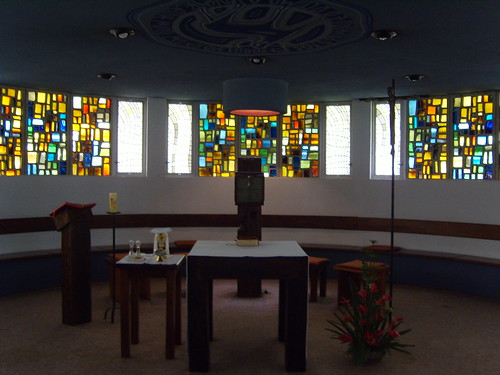
After reading Fr John Meyendorff’s article on the Orthodox Church in Funk & Wagnall’s Encyclopedia, the very first thing that I read about Orthodoxy was Photios Kontoglou’s hard-hitting, but, I felt, persuasive apologia for traditional Byzantine iconography, ‘The Hopelessness of Death in Western Religious Art and the Peace-Bestowing and Profoundly Hopeful Orthodox Iconography’ (printed in English, in, I believe, The True Vine—my own copy is buried in a box somewhere in my house). I very quickly wrote off Western religious art. If it wasn’t the fleshy naturalism of the Renaissance and Baroque eras (made for churches like this), it was the tacky, quickly dated, and hopelessly subjective modernism of the post-Vatican II years (made for churches like this). Neither one seemed right to me.

But then I was surprised to make a discovery. It was about two and a half years ago, when I was first looking into the history of the St Benedict medal. I learned somewhere (most likely here) that the medal as it’s typically produced now had been designed in something called ‘the Beuronese style of sacred art’, at the (I found here) ‘St Martin's Archabbey, Beuron, Germany’. Now, this name, ‘Beuron’, was familiar to me. In his wonderful conversion-to-Orthodoxy story, Fr Placide (Deseille) made a passing reference to this place, saying of his aunts that ‘the great abbeys of Beuron, Maredsous, and Solemnes were the high places of their Christianity’ (Archimandrite Placide [Deseille], ‘Stages of a Pilgrimage’, The Living Witness of the Holy Mountain: Contemporary Voices from Mt Athos, trans. and ed. Hieromonk Alexander [Golitzin] [South Canaan, PA: St Tikhon’s Seminary, 1999], p. 63). It was precisely this passage that sprang to mind when I came across that reference to the design of the medal. It sparked my curiosity as much as the expression ‘the great abbeys’ had fired my imagination.

The story I discovered is a long one, and I haven’t been able to work out all of the precise details. What I do know, is that the main figures in the development of Beuronese art were a group of German artists named Peter Lenz (1832-1928), Jakob Würger (1829-92), and Fridolin Steiner (1849-1906). The three young men went to Rome to work with some members of what had been the ‘Nazarene’ movement, a brotherhood of German artists devoted to St Luke the Evangelist (the first iconographer, according to tradition) who had lived a semi-monastic existence painting religious and neomediæval subjects in a simple, serene style. One critic in 1820 ascribed to the Nazarenes’ work the qualities of ‘simplicity, holiness, and purity’ (Fr Kenneth Novak, ‘The Art of Beuron’, Angelus Online). George Eliot referred to the Nazarenes as ‘the chief renovators of Christian art, . . . who had not only revived but expanded that grant conception of supreme events as mysteries at which the successive agess were spectators, and in relation to which the great souls of all periods became as it were contemporaries’ (George Eliot, Middlemarch I, Vol. VI in Works of George Eliot [NY: The Century, 1910], p. 310). James D. Merritt notes the Nazarenes’ influence upon and anticipation of the Pre-Raphaelite Brotherhood in England (Introduction, The Pre-Raphaelite Poem [NY: Dutton, 1966], pp. 9-10). A meeting with one of the Nazarenes, Peter von Cornelius, had a tremendous influence on the art of Ford Maddox Brown (1821-93), who subsequently was a mentor to Dante Gabriel Rossetti and a contributor to the Pre-Raphaelite periodical, The Germ (in a letter to Maddox Brown, Rossetti apparently writes ‘that if he ever does anything on his own account, it will be under the influence of such inspiration’—Joseph Knight, Life of Dante Gabriel Rossetti [London: Walter Scott, 1887], p. 22).

So, to return to Lenz, Würger, and Steiner, they were highly influenced by the Nazarene movement. But, in addition, they became fascinated with the ancient Egyptian art that had poured into Europe in the wake of Napoleon’s Egyptian campaign. According to Novak:

Lenz [the primary theorist among them] thought sacred art should reflect the natural laws of aesthetics through formulae he believed were forgotten after the Greeks and Egyptians. Geometrical proportions determine ideal forms, and the result is an innate harmony comparable to the mathematical relationships in musical composition.

Believing a monastic brotherhood to be the ideal context in which to put their ideas into practice, the three talked about forming a monastery. But in 1868 they met Fr Maurus Wolter, abbot of the new Benedictine monastery of Beuron. Wolter had initiated a close relationship with the centre of the Gregorian chant revival, Solemnes, corresponding with the abbot, Dom Prosper Guéranger, and even going so far as to model Beuron on the Solemnes Congregation. The cultivation of traditional Gregorian chant at Beuron dovetailed nicely with the approach to the visual and plastic arts of Lenz, Würger, and Steiner. The three were tonsured as monks of Beuron, taking the names Desiderius, Gabriel, and Lukas. They began an art school at Beuron that—besides designing the St Benedict medal—built churches, painted murals, created mosaics, and even hand-crafted church furnishings and altar vessels in Europe and later in America, based on the principles developed by Desiderius Lenz. Novak lists a few of these (apparently taken from Lenz’s writings):

The art speaks to the mind of the viewer. The art is itself worshipful and invites the viewer to worship. It does not stand out boldly of itself but is part of an environment of worship.

Works are anonymous, done by group effort, and not for the glory of the artist, but of God.

As in icons, the Beuronese style favors imitation over originality, with freehand copying revealing an artist's true genius.

There is full integration of art and architecture. Painting and sculpture are not ‘stick-ons’ to an architectural plan but an integral part of it. Beuronese art encompasses painting, architecture, altar vessels, and furnishings.

One can see some examples of these principles in practice at the Archabbey of Beuron itself here, in the crypt of the monastery church at Monte Cassino here, at the Mauruskapelle here, in the Basilica at Conception Abbey in Missouri, at the Abbey of St Hildegard here, at Maria Laach Abbey in Germany here, and at the chapel of the Gymnázia Teplice in the Czech Republic here. There is a beautiful photo of a Beuronese chapel at Daniel Mitsui’s blog here, and a few images at ‘History and Sources’ here. The photo above is of the 'Great Hall' at St John's University in Collegeville, MN, which was apparently restored some years ago.