Showing posts with label J.R.R. Tolkien. Show all posts

22 December 2013

'the lady in mind had?' - Tolkien's Sir Gawain Translation

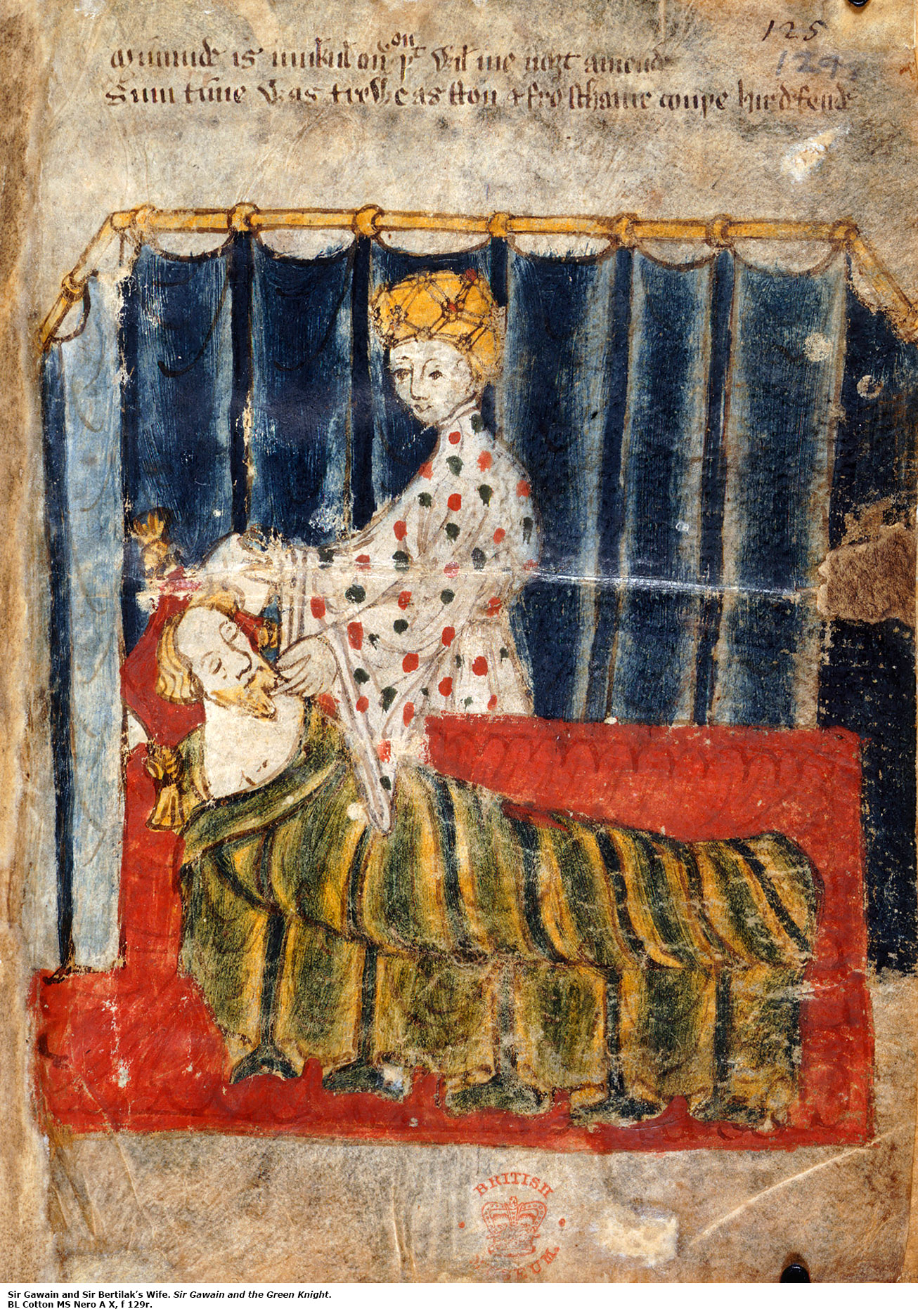
So I was recently rereading Tolkien’s translation of Sir Gawain & the Green Knight with my students, and I noticed an odd passage that I didn’t remember noticing when I’ve read it before (keep in mind that I’ve never read the poem all the way through in Middle English, and I’ve never read any translations but Tolkien’s). In the long third part, concerned with the alternating scenes of Bertilak’s hunting and his wife’s attempts to seduce Gawain, in stanza 51, at the conclusion of the first of these seduction attempts we read (lines 1283-1289): ‘Though I were lady most lovely,’ thought the lady to herself, ‘the less love would he bring here,’ since he looked for his bane, that blow, that him so soon should grieve, and needs it must be so. Then the lady asked for leave and at once he let her go. [1]

Now, this was odd, partly because it’s the only instance of a report of the lady’s point of view in the entire poem, but partly because even though it is not included within the quotations of the lady’s thoughts, that ‘since’ seems to suggest that she knows the nature of his appointment. Of course, she does know it, but we readers are not to know that until Part IV. It would seem like an uncharacteristic slip on the poet’s part.

Having noticed this, I immediately determined to check out the Middle English text as well as the other translation I possess--that by Marie Borroff (if I remember correctly, this was strongly recommended somewhere or other by David Lyle Jeffrey). I was of course fascinated to no end to discover that Borroff’s rendering of this passage was quite different indeed to Tolkien’s. Here are the same lines in her translation: For were she never so winsome, the warrior had The less will to woo, for the wound that his bane must be, He must bear the blinding blow, For such is fate’s decree; The lady asks leave to go;
He grants it full and free. [2]

Clearly, this was a more satisfying way of writing it. It avoids the switch in perspective of Tolkien’s, and it avoids the possible implication that the lady knows what Sir Gawain has come to do. But why are the two so different? And which one is correct?

Fortunately, I possess two editions of the Middle English text: Sir Israel Gollancz’s edition for the Early English Text Society, and the much newer one in Malcolm Andrew’s and Ronald Waldron’s invaluable The Poems of the Pearl Manuscript. Since there were no notes--apart from one indicating that in l. 1283, the manuscript has burde instead of the editor’s bur[n]e]--Gollancz’s alone did not tell me much that was helpful, lacking as I do a sound knowledge of the Middle English lexicon. [3]

Andrew and Waldron were quite helpful indeed, however. They follow the same reading that Gollancz does, with the ‘d’ of the MS replaced by an ‘n’. But they also have a longish note on the line. First, the lines in question: Þaʒ ho were burde bryʒtest þe burne in mynde hade, Þe lasse luf in his lode for lur þat he soʒt Boute hone-- [4]

And now, here is the editors’ note for ll. 1283-6::

‘though she may have been the loveliest lady the warrior had ever known (lit. remembered--cf. 943ff), he had brought with him so much the less love because of the penalty he was going to meet forthwith’. Morris’s emendations to 1283, which are adopted here (though with different punctuation), avoid the difficulty of the repeated burde as well as the momentary inconsistency of narrative point of view. The error could have arisen through misunderstanding of in mynde hade. G. Sanderlin (ChR, 8 [1973], 60-4) argues for retention of the MS reading despite the change of point of view. [5]

So, now I could see that the difference between Tolkien’s and Borroff’s translations definitely hinged on this question about the reading burne versus burde. According to Andrew’s and Waldron’s ‘Select Bibliography’, (Richard) Morris edited Sir Gawayne & the Green Knight for the Early English Text Society in 1864, and Sir Israel Gollancz revised this edition in 1897 and 1912 before producing his own edition in 1940. [6]

But I needed the editors’ handy glossary to be clear on precisely why such a small emendation made such a big difference. It turns out that while burde means ‘maiden, lady, woman’, burne on the other hand--listed under bu(u)rne, bourne, buyrne--means ‘man, warrior, knight’. [7] So the discrepancy stems from whether the MS is correct in reading ‘the lady in mind had’ or whether it should be ‘the knight in mind had’. Tolkien’s translation--made well after Richard Morris proposed the emendation followed by Gollancz, Andrew and Waldron, and Borroff--suggests that for some reason not mentioned in any of his comments on the poem that I have seen, the Professor sided with Sanderlin’s arguments for retaining the MS reading. [8] I for one don’t care for it much, but what do I know?


[1] Sir Gawain & the Green Knight, Pearl, and Sir Orfeo, tr. J.R.R. Tolkien (NY: Ballantine, 1980), p. 58.

[2] Sir Gawain & the Green Knight, Patience, and Pearl: Verse Translations, tr. Marie Borroff (NY: Norton, 2001), p. 45.

[3] Sir Gawain & the Green Knight, ed. Sir Israel Gollancz, intro. Mabel Day & Mary S. Serjeantson (London: Oxford U, 1940, repr. 1957), p. 47.

[4] The Poems of the Pearl Manuscript: Pearl, Cleanness, Patience, Sir Gawain & the Green Knight, 4th ed., ed. Malcolm Andrew & Ronald Waldron (Exeter, UK: U of Exeter, 2006), p. 255.

[5] Ibid., p. 255, n. on ll. 1283-6.

[6] Ibid., p. 5.

[7] Ibid., p. 308.

[8] Methinks I need to consult the edition of the poem Tolkien himself did in the 1920s with E.V. Gordon: Sir Gawain & the Green Knight, tr. J.R.R. Tolkien & E.V. Gordon (Oxford, 1925).

09 July 2012

'A Perfect House'—Elves, Monasticism, & Leisure

In this post I mentioned John Senior’s comparison of his first experience in the refectory of Fontgombault abbey to Odysseus’s words about the banquet in Book IX of The Odyssey

When Odysseus begins the recitation of his wanderings, addressing the lords and ladies at the palace of Alcinous in Phaecia, he says (in E.V. Rieu’s Penguin edition): 
'I myself feel that there is nothing more delightful than when the festive mood reigns in a whole people’s hearts and the banqueters listen to a minstrel from their seats in the hall, while the tables before them are laden with bread and meat, and a steward carries round the wine he has drawn from the bowl and fills their cups. This, to my way of thinking, is something very like perfection.' 
Such a banquet in the Odyssey is in the secular order the pale reflection of an evening meal in the religious order here, which is not something like, but the life of perfection itself. [1] 

Well, I was recently reminded afresh of monastic-Homeric connections when reading James Taylor’s Poetic Knowledge. Taylor quotes from a fascinating essay by John Henry Newman, ‘The Mission of St Benedict’, of which I shall give slightly more than he does: 

And therefore have I called the monastic state the most poetical of religious disciplines. It was a return to that primitive age of the world, of which poets have so often sung, the simple life of Arcadia or the reign of Saturn, when fraud and violence were unknown. It was a bringing back of those real, not fabulous, scenes of innocence and miracle, when Adam delved, or Abel kept sheep, or Noe planted the vine, and Angels visited them. [2] 

Newman’s examples are, of course, appropriately biblical. But everything he says here tends to remind me of the passage I quoted here from Dame Rebecca West’s Black Lamb, Grey Falcon

Exactly similar movements must have been made a million million million times since the world began, yet the thrust of her arm seemed absolutely fresh. Well, it is so in the Iliad. When one reads of a man drawing a bow or raising a shield it is as if the dew of the world’s morning lay undisturbed on what he did. The primal stuff of humanity is very attractive. [3] 

I think this is part of what attracts me about monasticism. It attracts me about Homer, children, trees, beer, and music. It’s the festal, the contemplative, the wonderful, the poetic. 

But to Senior’s analogy in Homer I can add another, fuller one, which will take some time to expound. As I was rereading Tolkien with my students last year, I had a realisation. In The Hobbit, the narrator says of Rivendell—‘His [Elrond’s] house was perfect, whether you liked food, or sleep, or work, or story-telling, or singing, or just sitting and thinking best, or a pleasant mixture of them all.’ [4] But when Frodo arrives there in Book 2, Chapter 1 of The Lord of the Rings, the quotation, now attributed to Bilbo as the feigned narrator of The Hobbit, is slightly different: ‘That house was, as Bilbo had long ago reported, “a perfect house, whether you like food or sleep or story-telling or singing, or just sitting and thinking best, or a pleasant mixture of them all”. Merely to be there was a cure for weariness, fear, and sadness.’ [5] 

First of all, note that ‘work’, which was included in the original comment, is now missing from the list of activities. I find this significant for Tolkien’s portrayal of Rivendell in LOTR. But this is not the only reference to the kind of activities typically engaged in at Rivendell (I shall add italics for emphasis in the next several quotes). In the very next sentence after the quoted passage, we read, ‘As the evening drew on, Frodo woke up again, and he found that he no longer felt in need of rest or sleep, but had a mind for food and drink, and probably for singing and story-telling afterwards.’ So here, we find a repetition of a few of precisely the same activities as Frodo tries to choose among them. 

But there is more. Shortly after awaking, Frodo is visited by Sam, who expresses an interest in the singing, to which Frodo replies, ‘But you shall be merry tonight, and listen to your heart’s content.’ A little later, Gandalf is pointing out the Hall of Fire with the comment: ‘Here you will hear many songs and tales—if you can keep awake. But except on high days it usually stands empty and quiet, and people come here who wish for peace, and thought. There is always a fire here, all the year round, but there is little other light.’ [6] When Frodo finally discovers Bilbo in the Hall, he asks, ‘What were you doing?’, to which the old hobbit replies, ‘Why, sitting and thinking. I do a lot of that nowadays, and this is the best place to do it in, as a rule.’ [7] A little further on, Bilbo says, ‘And I listen and I think. Time doesn’t seem to pass here: it just is. A remarkable place altogether.’ [8] 

As I reread these passages, it dawned on me that with the exclusion of work from the list, all of the activities associated with Rivendell become ‘leisure’ activities, that is, they are all fundamentally contrasted with work in the sense of ‘hustle and bustle’ but also in the more particular sense of activity directed toward some utilitarian end. [9] Furthermore, while the hobbits seem to be prone to falling asleep, and everyone knows they love their food and drink, the remaining activities are precisely contemplative ones, whether listening to song or story, or thinking. In other words, like philosophy itself according to Josef Pieper, these activities are forms of ‘theorein, or speculari (to observe, behold, contemplate), consisting in a purely receptive gaze on reality...untouched by anything practical’. [10] 

Of course, ‘leisure is the condition of considering things in a celebrating spirit’, [11] and there is a feast at Rivendell. But Tolkien concentrates on the qualities and appearance of the persons present rather than the elements, as in Odysseus’s praise of the feast, contenting himself with ‘The feast was merry and the food all that his hunger could desire.’ [12] On the other hand, Tolkien’s description of the music which, in this case, follows the eating, is striking indeed. It is not only an example of what my friend Michael Milburn points out is one of Tolkien’s definitions of Faery—‘Enchantment’ [13]—but also evidence that, in Pieper’s words, ‘music may be nothing but a secret philosophizing of the soul, an Exercitium Metaphysice Occultum.’ [14] Here is Tolkien’s description of this part of the feast: 

Frodo was left to himself for a while, for Sam had fallen asleep....But those near him were silent, intent upon the music of the voices and the instruments, and they gave no heed to anything else. Frodo began to listen. 
At first the beauty of the melodies and of the interwoven words in elven-tongues, even though he understood them little, held him in a spell, as soon as he began to attend to them. Almost it seemed that the words took shape, and visions of far lands and bright things that he had never yet imagined opened out before him; and the firelit hall become like a golden mist above seas of foam that sighed upon the margins of the world. Then the enchantment became more and more dreamlike, until he felt that an endless river of swelling gold and silver was flowing over him, too multitudinous for its pattern to be comprehended; it became part of the throbbing air about him, and it drenched and drowned him. Swiftly he sank under its shining weight into a deep realm of sleep. [15] 

This experience of falling asleep in a dark hall lit only by flames, while beautiful voices sing beautiful melodies fit to words that one understands little, is familiar to me, and likely to many other Orthodox, from the monastic vigils of the Holy Mountain. [16] The connection becomes clearer when Bilbo points out that the music is a sacred song, a hymn to the ‘archangel’ Elbereth, remarking, ‘They will sing that, and other songs of the Blessed Realm, many times tonight.’ [17] Compare Frodo’s experience with that of Elder Porphyrios at his first vigil on the Holy Mountain: 

One night there was a vigil service at the Kyriakon, the church of the Holy Trinity. This was very shortly after I had arrived, during the first few days. Our skete was celebrating its feast day. My elders left in the early evening for the church and left me in the hermitage to sleep. I was young and they thought I might not be able to stay awake until the morning when the vigil would end. 
After midnight Father Ionnikios came and woke me up. ‘Wake up and get dressed,’ he said, ‘and we’ll go to the church.’ 
I jumped up at once and in three minutes we had arrived at the Holy Trinity church. He ushered me into the church first. It was the first time I had been inside. I was overwhelmed! The church was filled with monks standing upright in an attitude of reverence and attentiveness. The chandeliers shed their light everywhere, lighting up the icons on the walls and on the icon stands. Everything was bright and shining. The little oil lamps were lit, the incense exuded fragrance and the singing resonated devoutly in the otherworldly beauty of the night. I was overcome with awe, but also with fear. I felt that I was no longer on earth, but that I had been transported to heaven. [18] 

Notice that the setting and experience are quite similar, down to the details, and just as Frodo is transported into a realm of ‘visions of far lands and bright things that he had never yet imagined’, so the young Elder Porphyrios was ‘transported to heaven’. There is even the concern with sleepiness. Sam is already asleep and Frodo himself falls asleep. Bilbo observes: ‘It is difficult to keep awake here, until you get used to it,...Not that hobbits would ever acquire quite the elvish appetite for music and poetry and tales. They seem to like them as much as food, or more. They will be going on for a long time yet....’ [19] 

Why do the hobbits become so sleepy? Because Rivendell is a monastery, and the elves are monks. The hobbits, like Elder Porphyrios at his first vigil, are fresh from the world. They are not able to enter fully into the contemplative experience of festal celebration. They are still fixated on the lower activities of Rivendell—food and drink and sleep—and are not able to stand through so many hymns. But in Pieper’s words, ‘the heart of leisure consists in “festival”’, and ‘if celebration and festival is the heart of leisure, then leisure would derive its innermost possibility and justification from the very source whence festival and celebration derive theirs. And this is worship.’ [20] The elves, like monks, enter fully into this experience—they can ‘run and not be weary’: 

And so since you will thirst for the words of the poetic canons, of the Psalter and of all the church service books, and since you will desire to read, hear and take them to heart, as soon as the simantron sounds, you will run at once with love and eagerness to hear the first words of the daily cycle of prayer...Our soul is gladdened and our hearing is sweetened as we hear the hymns and something happens within us. [21] 


[1] John Senior, The Restoration of Christian Culture (Norfolk, VA: IHS, 2008), p. 102. In the original post, I quoted the translation of Robert Fitzgerald.

[2] John Henry Newman, Rise & Progress of Universities and Benedictine Essays, Vol. 3 of The Works of Cardinal John Henry Newman, Birmingham Oratory, Millennium Edition (Notre Dame, IN: U of Notre Dame, 2001), pp. 385; qtd. in James Taylor, Poetic Knowledge: The Recovery of Education (Albany, NY: SUNY, 1998), p. 35. 

[3] Dame Rebecca West, Black Lamb, Grey Falcon: A Journey Through Yugoslavia (NY: Viking, 1943), p. 1044. 

[4] J.R.R. Tolkien, The Hobbit, or There & Back Again (Boston: Houghton Mifflin, 1997), p. 48. 

[5] J.R.R. Tolkien, The Lord of the Rings (Boston: Houghton Mifflin, 1994), p. 219. While making extensive use of the Lord of the Rings Companion this year, I began to realise acutely that I need a copy of the new edition of LOTR, which has been carefully corrected and emended in many places. 

[6] Tolkien, LOTR, p. 224. 

[7] Tolkien, LOTR, p. 224. 

[8] Tolkien, LOTR, p. 225. 

[9] Eating and drinking of course, can be seen as serving the utilitarian end of nourishing our bodies, but we do not choose to eat primarily for such an end, but more for the enjoyment of it. 

[10] Josef Pieper, Leisure, the Basis of Culture, tr. Gerald Malsbary (South Bend, IN: St Augustine’s, 1998), p. 77. 

[11] Pieper, Leisure, p. 33. 

[12] Tolkien, LOTR, p. 221. 

[13] In his terrific article, ‘Coleridge’s Definition of Imagination & Tolkien’s Definition(s) of Faery’, Tolkien Studies, Vol. VII, ed. Douglas A. Anderson, Michael D.C. Drout, & Verlyn Flieger (Morgantown, WV: West Virginia U, 2010) pp. 55-66, Michael writes: 

For when Tolkien expresses regret at having used the word ‘Magic’ to define Faery (since it ‘should be reserved for the operations of the Magician’), he offers another words instead: ‘Enchantment’, a term he uses to refer to the ‘elvish craft’ of ‘“Faerian Drama”—those plays which according to abundant records’, i.e. fairy-stories, ‘the elves have often presented to men...’ (On Fairy Stories 63-64). Tolkien explains, ‘Enchantment produces a Secondary World into which both designer and spectator can enter, to the satisfaction of their senses while they are inside...’ (64). This means that if you are present at a Faerian drama you yourself are, or think that you are, bodily inside its Secondary World. The experience may be very similar to Dreaming and has (it would seem) sometimes (by men) been confounded with it’ (63). (pp. 59-60.) 

[14] Josef Pieper, Only the Lover Sings: Art & Contemplation, tr. Lothar Krauth (SF: Ignatius, 1990), p. 39. 

[15] Tolkien, LOTR, p. 227. 

[16] I have also experienced in a monastic setting—the women’s monastery of the Archangel Michael on the island of Thasos—precisely what Tolkien describes when he writes, ‘[S]uddenly it seemed to Frodo that Arwen turned towards him, and the light of her eyes fell on him from afar and pierced his heart’ (232). 

[17] Tolkien, LOTR, p. 232. 

[18] Elder Porphyrios, Wounded by Love: The Life & the Wisdom of Elder Porphyrios, ed. Sisters of the Holy Convent of Chrysopigi (Limni, Evia, Greece: Denise Harvey, 2005), p. 11. 

[19] Tolkien, LOTR, p. 231. 

[20] Pieper, Leisure, p. 50. 

[21] Elder Porphyrios, p. 164.

08 April 2012

The 'Problem of Problems' or 'No Problem at All': The Grace & Free Will Post


Although it's the only blow-by-blow theological commentary on Lord of the Rings that I'm aware of, I find myself constantly annoyed by Fleming Rutledge's The Battle for Middle-earth: Tolkien's Divine Design in The Lord of the Rings. There are the constant comparisons with the films (Rutledge seems unusually concerned about the casting, and even in one case, the costumes), there are the constant references to things that seem foreign to Tolkien (the CEO of the Herman Miller Company, Protestant hymns and prayers), and, most of all, the heavy-handed predestinationalism that is Rutledge's fundamental interpretive lens. He even has the gall to pen the following footnote:


There are technical names for these two differing interpretations of humanity's relation to God. In oversimplified terms, the position emphasizing the human decision ('free will') is called Pelagianism or Arminianism (semi-Pelagianism), after a British monk named Pelagius and a seventeenth-century Protestant called Jacobus Arminius. The other position, which gives priority to the divine will, was held by the apostle Paul. It is called Augustinianism after its defender Augustine of Hippo. Pelagianism is officially a heresy, but it has always been pervasive in the Church, never more so than in America where Free Will is a sacred doctrine. [1]


Of course, anticipating that it will be pointed out that Tolkien himself speaks of 'free will', Rutledge has already told us that the author 'underestimates the consistency of his own narrative', and 'has illustrated the dilemma of the bound will much more powerfully than he himself realized', managing to 'seem more "Protestant" than most Protestants'. [2] It would be wonderful to hear Tolkien's reaction to this!

But I'm afraid that to the extent that all of this is the case, that is, to the extent Tolkien really does illustrate 'the dilemma of the bound will' (nevermind the extent to which he realises it), it is likely because there is nothing specifically Protestant about the will being 'bound' or specifically Catholic about it being 'free'. Is it not both? Does any traditional Christian really believe that fallen human beings act without any sort of constraint or influence upon their wills? Does any believe that human beings are merely robots, being saved or damned merely due to God's 'programming' and without any personal moral responsibility whatsoever?

I recall last summer how much I appreciated it when I read the following passage in N.T. Wright's What Saint Paul Really Said:


Classically, this doctrine [of justification] ever since Augustine has been concerned with warding off some version or other of the Pelagian heresy. Different people have meant different things by that heresy, and the sharp-eyed have spotted it, sometimes, even in those who thought they were opposing it root and branch. I must insist, right away, that if you come upon anyone who genuinely thinks that they can fulfill Pelagius' programme, in whichever form or variation you like, you should gently but firmly set them right. There is simply no way that human beings can make themselves fit for the presence or salvation of God. What is more, I know of no serious theologian, Protestant, Catholic or Orthodox, who thinks otherwise; indeed, one of the best expositions of the Augustinian or Lutheran or Calvinist doctrine of justification I have ever heard was given by a Jesuit, Father Edward Yarnold, in an ecumenical meeting. If Pelagius survives at all today, it is at the level of popular secular moralism, which is in any case becoming harder and harder to find in the Western world. [3]


In this light, surely any reasonable person can see how much it begs the question simply to assert that St Paul is the firm opponent of anything that might be called 'Pelagianism', 'semi-Pelagianism', or 'Arminianism', or that St Augustine was purely and simply the defender of St Paul's theology. Nevertheless, this claim continues to be asserted–even the editor of the Ancient Christian Commentary on Scripture volume on Romans insists that of the Fathers, 'Only Augustine (354-430) was prepared to accept the logical consequences of Paul's teaching on this matter [of grace and free ​will], and this led to his famous quarrel with Pelagius.' [4]

Really? Only St Augustine actually accepted St Paul's teaching? Or perhaps only St Augustine, in his zeal to correct Pelagius, levelled out the paradox of grace and free will that all of the other Fathers saw, even in St Paul himself? Fr Georges Florovsky, for instance, has quoted one of my favourite passages from Romans–chapter 12, verse 2: 'Be not conformed to this age but be transformed by the renewing of the mind in order to prove [that you may prove] what [is] that good and well-pleasing and perfect will of God' (words in brackets are Florovsky's)–commenting:


Taken by itself and out of context this language could be misinterpreted as Pelagian, for here it is man who is transforming the mind, man who is commanded to activate the spiritual life. Such an interpretation is, of course, incorrect but it reveals what one can do to the totality of the theological thought of St Paul if one does not understand the balance, if one does not understand that his view is profoundly synergistic. Synergism does not mean that two energies are equal. Rather it means that there are two wills–one, the will of God which precedes, accompanies, and completes all that is good, positive, spiritual and redemptive, one that has willed that man have a spiritual will, a spiritual participation in the redemptive process; the other is the will of man which must respond, cooperate, 'co-suffer'. [5]


The funny thing is, of course, that even the demons understand this. As Screwtape writes:


Why [God] leaves room for their free will is the problem of problems, the secret behind the Enemy's nonsense about "Love". How it does so is no problem at all; for the Enemy does not foresee the humans making their free contributions in a future, but sees them doing so in His unbounded Now. And obviously to watch a man doing something is not to make him do it. [6]


Addendum: As it has been some time since I read Ralph Wood's excellent The Gospel According to Tolkien: Visions of the Kingdom in Middle-earth, I had forgotten that Wood too mentions this issue in Tolkien's work. He writes:


Tolkien is close to Paul and Augustine and their long train of followers who argue that real freedom is the liberty to choose and do the good, and that to do evil is to act unfreely, to exercise an enslaved will. These theologians all insist that God's grace enables our right response to it. For this venerable theological tradition, it is better to say that we are the product of the gifts we have graciously received rather than the sum of the decisions we have bravely made. [7]


It certainly sounds here as though Wood is trying to make the same point that Fleming Rutledge has so strongly emphasised. But perhaps it's just because I've met him a couple of times, read some of his other work, seen him speak, and just generally like the guy, but I'm inclined to note that Wood has put all of this much more carefully than Rutledge has. While he refers to the Augustinian approach as a 'venerable theological tradition', he does not say that all else is heresy, or that all of the other Fathers have balked at following St Paul. He says 'it is better to say' rather than 'we must say'.

This is not surprising when one considers, of course, that the context of Wood's comments is an analysis of the moral conflict between vices and virtues in the work. How can one speak of virtue at all if our choices are not really ours at all? Thus, notably, we find Wood later on striking a rather different chord:


God is utterly unlike Melkor and Sauron because he never coerces. We are never forced but always drawn to faith, as God grants us freedom from sin's compulsion. We are invited and persuaded to this act of total entrustment through the witness to the Gospel made by the church. [8]


Furthermore, I note later on that Wood strikes a very un-Augustinian chord indeed when he actually uses the word 'synergism' (à la Fr Florovsky) to describe the relationship between the divine will and those of the characters: 'The synergism of the holy and the human–as the divine and the hobbitic prove to be complimentary rather than contradictory–is disclosed most plainly when Frodo first encounters the Ring-wraiths.' [9] So, naturally, I find Wood to be an ally rather than an opponent on this question.


[1] Fleming Rutledge, The Battle for Middle-earth: Tolkien's Divine Design in The Lord of the Rings (Grand Rapids, MI: Eerdmans, 2004), pp. 67-8, n. 28.

[2] Ibid., p. 11.

[3] N.T. Wright, What Saint Paul Really Said: Was Paul of Tarsus the Real Founder of Christianity? (Grand Rapids, MI: Eerdmans, 1997), p. 116.

[4] Gerald Bray, 'Introduction to Romans', Romans, Vol. VI of Ancient Christian Commentary on Scripture: New Testament, ed. Gerald Bray (Downers Grove, IL: IVP, 1998), p. xix.

[5] Protopresbyter Georges Florovsky, 'The Ascetic Ideal & the New Testament: Reflections on the Critique of the Theology of the Reformation', Byzantine Ascetic & Spiritual Fathers, Vol. 10 in The Collected Works of Georges Florovsky, ed. Richard S. Haugh, tr. Raymond Miller, Anne-Marie Dollinger-Labriolle, & Helmut Wilhelm Schmiedel (Vaduz, Liechtenstein: Büchervertriebsanstalt, 1987), p. 34.

[6] C.S. Lewis, The Screwtape Letters with Screwtape Proposes a Toast (NY: Harper, 2001), p. 150.

[7] Ralph C. Wood, The Gospel According to Tolkien: Visions of the Kingdom in Middle-earth (Louisville, KY: Westminster John Knox, 2003), p. 70.

[8] Ibid., p. 119.

[9] Ibid., p. 122-3.

23 February 2012

Coleridge's 'Imagination' Revisited


Two and a half years ago I posted an excerpt from my master's thesis in which I tried to show that the 'imagination' that the Fathers have tried to warn us about and the 'imagination' that the Romantic poets have made into a divine faculty are not, as I have heard and seen argued, two totally different things. In other words, some would follow Samuel Taylor Coleridge's (and subsequently, Wordsworth's) distinction between 'Imagination' conceived as this divine power, and 'Fancy', the mere ability to form 'mental images of things not actually present', offering the latter as the proper object of the patristic warning.


The linking point for me on this issue was J.R.R. Tolkien's essay 'On Fairy-stories'. Tolkien has a very great esteem for the power of the imagination, but without naming Coleridge, the great philologist finds 'the verbal distinction philologically inappropriate, and the analysis inaccurate': 'The perception of the image, the grasp of its implications, and the control which are necessary to a successful expression, may vary in vividness and strength: but this is a difference of degree in Imagination, not a difference in kind.' [1]


At one point since the original post, I heard a lecture by a Coleridge buff in which it was claimed that Coleridge's 'primary Imagination' was actually more akin to the 'nous' of patristic psychology, and was thus very much higher indeed than the image-making faculty. When I raised the question of Tolkien's dismissal of the Imagination/Fancy distinction, my question was not really addressed. (To be fair, I later heard the lecturer admit that he was prone to be a bit sloppy in his identifications of such things.)


So then, just last Monday, I was reading Shadows of Ecstasy, the first attempt at a novel by oddball Inkling, Charles Williams. I had the impression that Williams was likely much more of a Coleridgean than Tolkien, and my lecturer friend even suggested that 'Ecstasy' might be a reference to 'STC'. Well, imagine my astonishment when I read the following exchange:


'I hope they'll use imagination [in their government propaganda],' Sir Bernard said. '[Acknowledging] One or two planes destroyed on our side would make the bulletins credible.'


'I do wish you wouldn't say "imagination",' Roger complained. 'It isn't, you know; only the lowest kind of cunning fancy.'


'I've never been clear that Coleridge was right there,' Caithness said meditatively. 'Surely it's the same faculty--the adaptation of the world to an idea of the world.' [2]


Naturally, this got me very excited once again about the whole issue. I even recalled that I had recently purchased the critical edition of Tolkien's essay that came out four years ago. Rushing to consult that to see whether there was any discussion of Coleridge's place in Tolkien's thoughts on imagination, I was disappointed to find no mention of the Romantic in the notes on that passage of the essay (surely an oversight, one would think!). I did however find the two very interesting notes which follow:


--Fancy...the older word Fantasy. Tolkien's discussion here and in the succeeding paragraphs is essentially an expanded paraphrase of definition 4 under the entry for 'Fancy' (a contraction of 'Fantasy' as noun and adjective) in the first edition of The Oxford English Dictionary. Since he drew on it so heavily, the entire definition merits inclusion here: 'In early use synonymous with Imagination: the process and faculty of forming mental representations of things not present to the senses; chiefly ​applied to the so-called creative or productive imagination, which frames images of objects, events, or conditions that have not occurred in actual experience. In later use the words "fantasy" and "imagination" (esp. as denoting attributes manifested in poetical or literary composition) are commonly distinguished: "fancy" being used to express aptitude for the invention of illustrative or decorative imagery, while "imagination" is the power of giving to ideal creations the inner consistency of realities.'


--'the power of giving to ideal creations the inner consistency of reality'. See the preceeding entry. It is worthy of note that Tolkien changes the final word from 'realities' to 'reality', thus shifting the reference from plural phenomena to a singular concept, an abstraction. The phrase 'inner consistency' is used by Aristotle in his Poetics, but not in relation to 'ideal creations'.


--a cancelled early version of Tolkien's discussion from MS C reads: I propose to use Fantasy phantasia a making visible to the mind of the operation whereby mental images 'of things not actually present' are expressed, shown forth, created. The faculty of conceiving the images is properly called Imagination. But in recent times (in technical not normal language) Imagination has often been held to be something higher than Fantasy (or the reduced and depreciatory form Fancy); to be 'the power of giving to ideal creations the inner consistency of reality'. That distinction seems to me confused. The mental part of image-making is one thing, and should naturally be called Imagination. The grasp, and vivid perception of the image, a necessary preliminary to its successful expression, is a difference not of kind but of degree. The achievement of that expression which gives, or seems to give, 'the inner consistency of reality'--that is, commands Secondary Belief--is indeed another thing: the gift of Art, the link between Imagination and the final marvel of Subcreation: Fantasy, the showing forth, that power which the Elves have to the highest degree. (Bodleian MS.Tolkien 14, folio 160 verso) [3]


On a final note, since I wrote the passage of my thesis found in the original post on Coleridge and the imagination, I've had a look at C.M. Bowra's 1948-1949 Harvard lectures, The Romantic Imagination. Although he is more concerned with the poetry itself than with analysing works like the Biographia, Bowra makes the striking point that 'Coleridge does not go so far as Blake in the claims which he makes for the imagination.' [4] To wit, 'For Blake the imagination is nothing less than God as He operates in the human soul. It follows that any act of creation performed by the imagination is divine and that in the imagination man's spiritual nature is fully and finally realized.' For Coleridge on the other hand, the imagination, while 'of first importance', merely 'partakes of the creative activity of God.' [5]


[1] J.R.R. Tolkien, Tolkien On Fairy-stories: Expanded Edition, with Commentary & Notes, ed. Verlyn Flieger & Douglas A. Anderson (London: HarperCollins, 2008), p. 59.


[2] Charles Williams, Shadows of Ecstasy (Vancouver: Regent College, 2003), p. 167.


[3] Tolkien, pp. 110-1, n. 65.


[4] Bowra, C.M., The Romantic Imagination (London: Oxford U, 1969), p. 17.


[5] Ibid., pp. 3-4.

09 January 2012

Ad blogges!


A number of factors have combined recently to convince me that I should return to the practice of crafting the occasional post for this blog. Not the least of these was this stirring post at Reading the Maps, discovered via the very medium the author denigrates and in which so many of us guiltily indulge: Facebook. How can I continue to neglect Logismoi after reading the following?

Blogging may have been superseded by new and inferior innovations, but the medium need not die. Indeed, bloggers should treat the rise of alternative forms of online communication as a liberation, rather than a disaster. Freed from the curse of coolness, blogging can now develop as a literary and artistic genre, or set of genres. Blogging may have lost some of its old practitioners, but it should be able to attract writers, artists, and political thinkers dissatisfied with the short attention span of twitter and the ritualised onanism of facebook. Blogging may become an act of resistance against the dumbing down of culture and political discourse in the twenty-first century.

I am not so certain, however, that this first new post since last summer can aspire to the lofty heights called for here. Instead, I intend to ease back into the practice beginning with a simple and, for me at least, enjoyable genre: the newly acquired books overview. In my household, we exchanged gifts for the Nativity according to the Church's calendar four nights ago, and I had already previously come by a few other titles, either received as gifts or purchased with gift cards and/or money. Having forgotten the order in which I acquired them, I'll settle for the alphabetical order of the authors' last names.

1) Ibrahim S. Amin, The Monster Hunter's Handbook: The Ultimate Guide to Saving Mankind from Vampires, Zombies, Hellhounds, & Other Mythical Beasts (NY: Bloomsbury, 2007). An unexpected gift from a friend, this one is a sheer delight. For a small taste, consider the author's response to the question, 'Why would anyone want to hunt monsters?'

...A hunter kills to test himself against what nature has to offer, to see if his humble human mind and body can overcome the power, quickness, and savage cunning of the beasts. Thus a true hunter will wish to pit himself against the most challenging prey--creatures that will push him to the limit. Any fool with a gun can shoot a deer, but only the greatest of sportsmen will be able to overcome a Hydra.

However, even among the most dedicated sportsmen in the field there is also a second, and perhaps far more noble concern--no less lofty a goal than the protection and preservation of the human race.

The entry on each creature even includes a citation of early, often classical, sources. My only complaint is that, despite the appropriately arcane, antique-looking cover design, the illustrations are brightly coloured, modern-looking things. They just don't do justice to the subject matter.

2) G.K. Chesterton, Collected Works, Vol. 1: Heretics, Orthodoxy, The Blatchford Controversies, ed. David Dooley (SF: Ignatius, 1986). I was excited finally to come across an inexpensive used copy of a volume of GKC's Collected Works, a set of handsomely designed, but rather pricey volumes from Ignatius Press. I hope to see more some day.

3) Charles Dickens, A Christmas Carol: The Original 1843 Manuscript (Delray Beach, FL: Levenger, 2011). A gift from my always thoughtful mother-in-law, this is the first-ever full-cover facsimile of Dickens's original manuscript of A Christmas Carol. It features a facing-page transcription, a beautiful red cloth Smythe-sewn binding gold-stamped with a design from the 1st edition, a silk ribbon marker, and, it seems, 'Archival paper selected to match the color of Dickens’s manuscript paper'. It also has an introduction by the curator of Literary & Historical Manuscripts at the Dickens MS owner: The Morgan Library & Museum. See the photo above. Now I can, just barely, read my favourite lines in Dickens's own handwriting:

'Business!' cried the Ghost, wringing its hands again. 'Mankind was my business. The common welfare was my business; charity, mercy, forbearance, and benevolence, were, all, my business. The dealings of my trade were but a drop of water in the comprehensive Ocean of my business!' (p. 14)

4) David L. Edwards, OBE, Poets & God: Chaucer, Shakespeare, Herbert, Milton, WOrdsworth, Coleridge, Blake (London: Darton, Longman & Todd, 2005). I was off to Half Price Books to kill some time, hoping to find a copy of Gerald Basil Edwards's Book of Ebenezer Le Page. But while I saw no sign of the latter, I did discover this book by another Edwards, apparently a former Dean of King's College, Cambridge. The blurb on the back says this:

These great English poets are at the centre of a cultural heritage which goes along with the world-wide appeal of the English language, yet they have often become the object of study rather than of pleasure.

Scholarly, entertaining and often provocative, David Edwards's new book reveals their relevance to the current quest for an authentic spirituality in a mostly church-less society. Poets & God will excite the reader to rediscover and enjoy their work.

5) Thomas C. Oden, Early Libyan Christianity: Uncovering a North African Tradition (Downers Grove, IL: IVP, 2011). Although Tom Oden's niece, Amy Oden, was my Church history professor in college, and I myself briefly met the old fellow at a lecture about the Green Collection of Biblical artifacts here in OKC a few months ago, I've managed never to read any of his work. My father gave me this one with the explanation that he never knows what I have, and it was new enough that he could be pretty certain I didn't have it. I fully intend to read it through. I already glanced at the conclusion and found it profoundly moving. Oden is explaining how and why he is passionate about the subject, and apologising in advance for the tentative nature of his conclusions:

Why, then, have I continued to pursue this difficult task to the very end, when I had other urgent projects sitting on the shelf awaiting my attention at a late date in my life? Because so few know about this obscure area; because its role in early Christianity was so significant; because it has been so neglected as a subject of historical inquiry by Western academic colleages. These motives have been the engines of desire.

Now that I am at last ready to offer its results for scholarly and public examination, I am all the more aware that many of its conclusions may seem at first hard to defend and easy targets for academics who are working out of very different premises about reliable knowledge. I hope that someday someone will do more justice to this subject than I. But my time to do anything in this world is limited and growing more so. Hence I offer it for the reader's consideration, hoping for clemency.

6) Rob Pope, How to Study Chaucer, 2nd ed. (London: Macmillan, 2001). I do of course enjoy reading Chaucer, but my primary motive in buying this one was that I am going to be teaching Chaucer to my 8th-grade students this Spring. As I do not know him nearly as well as most of the other books we have been reading, I need all the help I can get.

7) David Simay, Swordfishtrombones: 33 1/3 (NY: Continuum, 2008). Some of you may recall that I posted briefly about Tom Waits a few years ago (here), but if you're not aware, I am an enormous fan. My sister gave me this little book (apparently the 33 1/3 series of books about albums is all the same size), a 'study' of sorts of Waits's groundbreaking album, 1983's Swordfishtrombones. Again, the back blurb says it best:

At the end of the seventies, Tom Waits felt trapped in a stalled career: his musical persona an artistic straightjacket. At a dark, desperate time in his life he got the phone call that offered a way out and met the woman who would change his life. What followed was Swordfishtrombones, one of the most daring transformations in pop music history.

Tom Waits is an elusive subject, sly and evasive. Through extensive research and a close, playful reading of his work, David Smay unwraps the vinegar pleasures of Swordfishtrombones and creates a freewheeling portrait of an American genius. This is the album where Tom Waits beats the blues with a hammer, drags his piano into the rain and burrows deep underground. This is the story of a man who reinvented himself and changed the musical landscape forever, a love story built on exotic percussion and phantom landscapes. This is a story about crows and mules.

8) J.R.R. Tolkien, Smith of Wootton Major & Farmer Giles of Ham (NY: Del Rey, 1986). I bought this with a HP Books gift card after I had the disconcerting realisation that I didn't own a single copy of 'Smith of Wootton Major' (I had 'Farmer Giles' in the Tolkien Reader). It's such a beautiful story, and the descriptions of Smith's journeys oddly reminded me a little bit of Lovecraft's dream stories (another Tolkien/Lovecraft connection).

9) Leo Tolstoy, The Bear Hunt & Other Stories (NY: Little Leather Library Co., n.d.). I received this curious little volume only just tonight from an old family friend. I'd never seen or heard anything of this series, but according to this description the 'Little Leather Libary' books were a series of small classics bound in what was once brownish green imitation leather (mine is decidedly brown) in the early 1920's, apparently inspired by the Arts & Crafts-related Roycroft Press. The Tolstoy volume (Box 2 Volume 91 of the series) contains the stories 'The Bear Hunt', 'What Men Live By', and 'A Fairy Tale'.

14 July 2010

Disenchantment with Modernity: Tolkien, Lovecraft, & G.H. Dorr, Ph.D.


At the Mythopoeic Society conference I attended last weekend, the Inklings—and it seemed Tolkien especially—were naturally first and foremost in the attendees’ thoughts, writings, and conversation. But at least once or twice, perhaps largely at my instigation, the name of H.P. Lovecraft was also mentioned. In a paper I heard on the to me previously unknown works of our Author Guest of Honour, Tim Powers, a plot description at one point reminded me slightly of Lovecraft’s masterpiece, ‘The Call of Cthulhu’. When I ventured later to ask the author himself about this, receiving confirmation of the accuracy of my ‘Lovecraft antennae’, I also asked his opinion whether Powers thought that Charles Williams might have been able to convert the notorious atheist Lovecraft to Christianity. An affirmative reply led to more discussion later in the evening.

At any rate, all of this is merely to preface an extraordinary discovery I made just today. Amy Sturgis, whose name I thought I recalled coming across at MythCon and who edited the book Past Watchful Dragons: Fantasy & Faith in the World of C.S. Lewis, published by The Mythopoeic Press, has a fascinating article on her website entitled, ‘The New Shoggoth Chic: Why H.P. Lovecraft Now?’. [1] Although it does not mention him in the title, Tolkien is also a major subject of the article, which is essentially a comparison and contrasting of the two authors.

To get to the point, the most interesting point of comparison to me was the basically anti-modern posture they shared. Sturgis writes:


Modernity, that nebulous and abstract force of the dawning 20th century, meant various things to Lovecraft and Tolkien at different times in their lives. One thing remained constant: both were against it. To Lovecraft, modernity primarily meant entropy, the gradual decay of time-honored habits, traditions, and even people into confusion and decrepitude. . . . His racial and nationalistic assumptions fueled his disgust with the way in which industrialization and urbanization threw unlike people together in the most squalid conditions, ensuring (to his mind at least) that their most negative traits would come to the fore. He found an example of his worst fears realized when he lived, for a short time only, in New York City.

On this subject, Sturgis then quotes the semi-autobiographical story ‘He’:


But success and happiness were not to be. Garish daylight showed only squalor and alienage and the noxious elephantiasis of climbing, spreading stone where the moon had hinted of loveliness and elder magic; and the throngs of people that seethed through the flumelike streets were squat, swarthy strangers with hardened faces and narrow eyes, shrewd strangers without dreams and without kinship to the scenes around them, who could never mean aught to a blue-eyed man of the old folk, with the love of fair green lanes and white New England village steeples in his heart. [2]

Sturgis then comments:


Though charged with what we today would call racism and xenophobia, Lovecraft’s description implies more than simple fear or dislike of the Other: these others are overcrowded, literally ‘teeming’, unattached to their setting or community, isolated and atomistic, uncommunicative and ‘hardened’. Lovecraft contrasted such scenes with his native Providence, Rhode Island, where generations remained in the same place and were known by their family name and traits, and where the community as a whole tended to share what Augustine called ‘loved things held in common’. [3] Lovecraft feared a humanity cut adrift from such grounding tradition and identity, left vulnerable to outside forces of superior power and unwholesome design.

For Tolkien, modernity primarily meant technology—‘The Machine’, as he called it—and its triumph at the expense of nature. Where Lovecraft idealized his hometown of Providence, Tolkien revered the English countryside, and believed the growth of cities and factories to be a direct threat to its survival. By creating the fictional Shire and the Hobbits who populate it, Tolkien praised the rural values of decentralization, artisanship, stability, and familiarity over the urban qualities of centralization, mass production, disposability, and anonymity.

Sturgis then quotes ‘On Fairy-Stories’, calling it ‘as anti-modern’ as Lovecraft:


Not long ago—incredible though it may seem—I heard a clerk at Oxenford declare that he ‘welcomed’ the proximity of mass-production robot factories, and the roar of self-obstructive mechanical traffic, because it brought his university into ‘contact with real life.’ He may have meant that the way men were living in the twentieth century was increasing in barbarity at an alarming rate, and that the loud demonstration of this in the streets of Oxford might serve as a warning that it is not possible to preserve for long an oasis of sanity in a desert of unreason by mere fences, without actual offensive action (practical and intellectual). I fear he did not. [4]

Sturgis continues:


Both authors’ anti-modernism, as well as other intellectual ideas and personal traits, led them to feel out of place in a world of tremendous change and upheaval, economic depression and world war. For his part, H.P. Lovecraft felt himself to be an old man in a young man’s body, and, to use his words from ‘The Outsider’, ‘a stranger in this century’. Tolkien’s similar certainty that he was not at home came as much from his religious perspective as his disgust with all things ‘progressive’. . . .

. . .

It would be a mistake to assume that the two men were similar only in their dislikes and disappointments. Although they looked to the future with no little trepidation, they looked to the past with real fascination and affection. Lovecraft and Tolkien shared a fervent kind of antiquarianism. Lovecraft’s self-confessed ‘love of the ancient and permanent’ can best be seen in his absorption with and knowledge of early American architecture, which he used to great effect in his precise and evocative descriptions. . . . Tolkien nurtured his own love of ancient texts and national epics from Beowulf and the Kalevala to the Icelandic Eddas and family sagas. He studied the original languages of the stories and incorporated ingredients of the tales into his own work. . . .

In short, both Lovecraft and Tolkien were on a quest for something permanent, meaningful, and binding in a changing modern world, fueled by a desire for identity and community in a time in which they felt displaced and marginalized, and a thirst for structure and civilization in the face of what they saw as entropy and barbarism. Paradoxically, these concerns, while isolating each author to a certain degree, also made Lovecraft and Tolkien exemplars of their age, men of remarkable insight and sensitivity who articulated the concerns of an entire era with unusual eloquence and urgency.

Reading these comments today, I am also curiously reminded of Tom Hanks’s charactre in the Coen Brothers remake of The Ladykillers: the Southern dandy, Goldthwaite Higginson Dorr, Ph.D. One evening, Dorr’s black landlady, Mrs Munson, says to him, ‘You are a readin’ fool, aren’t you, Mr Dorr?’ Dorr responds:


Yes, I must confess I often find myself more at home in these ancient volumes than I do in the hustle-bustle of the modern world. To me, paradoxically, the literature of the so-called ‘dead tongues’ holds more currency than this morning’s newspaper. In these books, in these volumes, there is the accumulated wisdom of mankind which succours me when the day is hard and the night lonely and long.

Things take a closer turn toward the Lovecraftian when Mrs Munson remarks, ‘Wisdom of mankind, huh? What about the wisdom of the Lord?’, and Dorr replies:


Oh yes, the ‘Good Book’, hm? I have found reward in its pages. But to me there are other ‘good books’ as well: heavy volumes of antiquity, freighted with the insights of man’s glorious age. And then, of course, I just love love love the works of Mr Edgard Allan Poe.

Mrs Munson says, ‘Oh, I know who he was—kinda spooky!’ But Dorr laughs and ‘corrects’ her, in words reminiscent of Lovecraft’s ‘Randolph Carter’ stories: ‘No, my, no, no! Not of this world, it is true. He lived in a dream, an ancient dream.’ Dorr then quotes the first two stanzas of ‘To Helen’:


Helen, thy beauty is to me
Like those Nicean barks of yore,
That gently, o’er a perfumed sea,
The weary, way-worn wanderer bore
To his own native shore.

On desperate seas long wont to roam,
Thy hyacinth hair, thy classic face,
Thy Naiad airs have brought me home
To the glory that was Greece
And the grandeur that was Rome. [5]

Somewhat alarmed at Dorr’s enraptured delivery of these lines, Mrs Munson asks, ‘Who was Helen? Some kind of whore of Babylon?’ To which, slightly angered, Dorr replies, ‘One does not know who Helen was! But I picture her as very very . . . extremely . . . pale.’


[1] Originally published in Apex Science Fiction & Horror Digest, 1.4 (December 2005).

[2] H.P. Lovecraft, ‘He’, The Tomb & Other Tales (NY: Del Rey, 1987), pp. 58-9. I was astonished how much this last line reminded me of Tolkien!

[3] St Augustine, de civ. Dei XIX, 24; cf. The City of God, tr. Marcus Dods (NY: Modern Library, 1950), p. 706: ‘But if we discard this definition of a people, and, assuming another, say that a people is an assemblage of reasonable beings bound together by a common agreement as to the objects of their love, then, in order to discover the character of any people, we have only to observe what they love.’

[4] J.R.R. Tolkien, ‘On Fairy-Stories’, The Tolkien Reader (NY: Ballantine, 1966), pp. 80-1.

[5] Edgar Allan Poe, ‘To Helen’, The Complete Tales & Poems of Edgar Allan Poe (NY: Modern Library, 1965), p. 1017.

06 April 2010

Embodying Christian Truth—On Gandalf's Resurrection


In honour of Bright Week, and since the C.S. Lewis & Inklings Society conference will be going on this weekend here in Oklahoma City (see here for four lectures open to the public, including those of Michael Ward!), I was toying with the idea of posting something on the theme of resurrection in Tolkien’s works. Then I remembered that I’d already written something that touches on this—in my thesis. In context it was meant as an illustration of how literature can be used to ‘embody’ Christian truth (the illustration above is by Peter Xavier Price):

The clearest manifestation of this ‘religious element’ lies in what Tolkien, in his essay ‘On Fairy-stories’, has famously called ‘eucatastrophe’, [1] ‘the sudden joyous “turn”’:

[Eucatastrophe] is a sudden and miraculous grace: never to be counted on to recur. It does not deny the existence of dyscatastrophe, of sorrow and failure: the possibility of these is necessary to the joy of deliverance; it denies (in the face of much evidence, if you will) universal final defeat and in so far is evangelium, giving a fleeting glimpse of Joy, Joy beyond the walls of the world, poignant as grief. [2]

Tolkien goes on to say that the Gospels tell the story of ‘the greatest and most complete conceivable eucatastrophe’: ‘The Birth of Christ is the eucatastrophe of Man’s history. The Resurrection is the eucatastrophe of the Incarnation.’ [3]

The Lord of the Rings contains a number of eucatastrophes, which occur at various magnitudes at different parts of the story. Perhaps the most obvious example of the eucatastrophe as an embodiment of Christian truth, however, occurs in The Two Towers, Book III, Chapter 5, ‘The White Rider’. The Fellowship of the Ring have been split up: two of the nine are dead, two taken captive, and two have gone East with the Ring, into the dark land of Mordor. Of the two who have perished, one is the wise and powerful wizard Gandalf (aka ‘Mithrandir’), who in Tolkien’s mythology is one of the Istari [4]—members of an angelic order who have appeared in ‘the likeness of Men’ and come to Middle-earth ‘to contest the power of [the evil fallen angel] Sauron . . . and to move Elves and Men and all living things of good will to valiant deeds.’ [5]

The three who remain free and without the Ring have gone into the forest of Fangorn, tracking their captive friends there. In the forest, they encounter an old man in a grey cloak, and, suspecting that he is the evil wizard Saruman, speak to him cautiously. When Gimli the dwarf threatens him, we read:

The old man was too quick for him. He sprang to his feet and leaped to the top of a large rock. There he stood, grown suddenly tall, towering above them. His hood and grey rags were flung away. His white garments shone. . . .

They all gazed at him. His hair was white as snow in the sunshine; and gleaming white was his robe; the eyes under his deep brows were bright, piercing as the rays of the sun; power was in his hand. Between wonder, joy, and fear they stood and found no words to say.

At last Aragorn stirred. ‘Gandalf!’ he said. ‘Beyond all hope you return to us in our need! What veil was over my sight? Gandalf!’ Gimli said nothing, but sank to his knees, shading his eyes. . . .

He stepped down from the rock, and picking up his grey cloak wrapped it about him: it seemed as if the sun had been shining, but now was hid in cloud again. . . . ‘Get up, my good Gimli! . . . Be merry! We meet again. At the turn of the tide. The great storm is coming, but the tide has turned.’ [6]

There are several obvious parallels to Christ here, conflated from different passages in Scripture. To take them in the chronological order that we find them in Tolkien: 1) the encounter in the woods where the three do not recognise their resurrected leader is of course strikingly similar to the story of the appearance of Christ to the two disciples on the road to Emmaus in Lk 24:13-35, where ‘their eyes were holden that they should not know Him’ (Lk 24:16); 2) the description of Gandalf standing on the rock, shining ‘as the rays of the sun’ so that Gimli is forced to his knees, ‘shading his eyes’, cannot help but recall the accounts of the Transfiguration in the Synoptic Gospels (Mt 17:1-9, Mk 9:2-10, and Lk 9:28-36), where three disciples see ‘the kingdom of God come with power’ (Mk 9:1); 3) Gandalf’s appearance is also quite similar to the appearance of Christ to St John the Theologian on Patmos (as recorded in Rev 1:12-18), where we read:

His head and His hairs were white like wool, as white as snow; and His eyes were as a flame of fire . . . and His countenance was as the sun shineth in his strength. And when I saw Him, I fell at His feet as dead. And He laid His right Hand upon me, saying unto me, ‘Fear not; I am the first and the last: I am He that liveth, and was dead; and, behold, I am alive for evermore, Amen; and have the keys of hell and of death.’ (Rev 1:14, 16-18)

Finally, 4) the entire encounter is dependent upon the great eucatastrophe which has taken place offstage, as it were: the resurrection of Gandalf from the dead. [7] Pressed by the awe-struck company, he tells them of how he fought with a terrible fiery demon called a Balrog, plunging into a deep abyss. ‘We fought far under the living earth, where time is not counted.’ [8] Emerging from a cave, he says ‘I threw down my enemy’ and then ‘darkness took me, and I strayed out of thought and time, and I wandered far on roads that I will not tell. Naked I was sent back—for a brief time, until my task is done.’ [9]

Although the order of these events in Tolkien does not quite match up to the events of Holy Saturday and Pascha, it is clear that the battle with the demon in the abyss ‘far under the living earth’ is a parallel with Christ’s descent into Hades, that the emerging from the cave corresponds to Christ’s coming forth from the tomb, and that Gandalf’s death and resurrection ‘for a brief time’, although separate from the abyss and the cave, are the most obvious (though not necessarily the most important) type of Christ in the entire novel. [10] The light with which Gandalf shines, while framed by that of the Transfiguration and that of the eschaton, is most immediately ‘the unapproachable light of the Resurrection’. [11] Gandalf’s ‘Be merry!’ reminds us that ‘we shall clearly hear Him say: Rejoice!’ [12] His appearance is ‘as the rays of the sun’ to remind us that ‘from the grave the beautiful Sun of Righteousness shone forth again upon us.’ [13]

It is important to note that Gandalf is only a type of Christ, not, like C.S. Lewis’s Aslan, an appearance of Christ Himself, nor an allegory of Christ, like Pan in English pastoral poetry such as Edmund Spenser’s ‘Shepheardes Calendar’ or Andrew Marvell’s ‘Clorinda and Damon’. Ralph Wood astutely observes, ‘Neither are we meant to identify Gandalf as Christ . . . Nor does Gandalf alone possess Christ-like qualities.’ [14] But as I have suggested, Gandalf is part of the whole embodiment of Christian truth in the novel, the truth of the eucatastrophe of our salvation in Christ.

The effect of this embodiment of Christian truth on readers has been very real, and Tolkien himself was quite conscious of and delighted by it. Richard Purtill has pointed out [15] a letter of Tolkien to a Miss Carole Batten-Phelps (Letter 328) where he writes concerning precisely this effect:

You speak of ‘a sanity and sanctity’ in the L.R. ‘which is a power in itself’. I was deeply moved. Nothing of the kind had been said to me before. But by a strange chance, just as I was beginning this letter, I had one from a man, who classified himself as ‘an unbeliever, or at best a man of belatedly and dimly dawning religious feeling . . . but you’, he said, ‘create a world in which some sort of faith seems to be everywhere without a visible source, like light from an invisible lamp’. I can only answer: ‘Of his own sanity no man can securely judge. If sanctity inhabits his work or as a pervading light illumines it then it does not come from him but through him. And neither of you would perceive it in these terms unless it was with you also. Otherwise you would see and feel nothing, or (if some other spirit was present) you would be filled with contempt, nausea, hatred. ‘Leaves out of the elf-country, gah!’ ‘Lembas—dust and ashes, we don’t eat that.’ [16]

The occasional presence of this ‘sanity and sanctity’ is one of the most important potential benefits of reading imaginative literature.


[1] For Tolkien, the eucatastrophe is closely bound up with the genre of the fairy-tale (‘Fairy-stories’, The Monsters and the Critics and Other Essays, ed. Christopher Tolkien [London: HarperCollins, 1997], pp. 85-6). But while I have consulted an article on Greek fairy-tales, the author says nothing about a feature that would correspond with this notion (Angeliki Lalou, ‘Παραμύθι, Ταξίδι στον κόσμο της Φαντασίας’ [Fairy-tale: A Journey to the world of the Imagination], Πεμπτουσία 7, Dec.-Mar. 2002, pp. 62-5). It would be an interesting subject for a study to look for examples of Tolkienian eucatastrophe in Greek fairy-tales.

[2] Tolkien, ‘Fairy-stories’, p. 86.

[3] Tolkien, ‘Fairy-stories’, pp. 88-9. T.A. Shippey has noted that the Fellowship leaves Rivendell on its quest on 25 December, the feast of the Nativity, and the Ring is destroyed on 25 March, the feast of the Annunciation, but also, ‘in old English tradition . . . the date of the Crucifixion . . . . The main action of The Lord of the Rings takes place, then, in the mythic space between Christmas, Christ’s birth, and the crucifixion, Christ’s death’ (J.R.R. Tolkien: Author of the Century [Boston: Houghton Mifflin, 2001], pp. 208-9).

[4] Tolkien, The Silmarillion, ed. Christopher Tolkien (Boston: Houghton Mifflin, 1983), p. 300.

[5] Tolkien, Silmarillion, p. 299.

[6] Tolkien, The Lord of the Rings, collector’s edition (Boston: Houghton Mifflin, 1994), pp. 97-8.

[7] Though Gandalf has obviously risen prior to the encounter with him in the woods, the story is not told by the narrator at the time that it happens, but by Gandalf himself after he has again covered the brilliant light of his appearance.

[8] Tolkien, LOTR, p. 105.

[9] Tolkien, LOTR, pp. 105-6.

[10] While I am here treating Gandalf’s resurrection as an embodiment of ‘the True’, meaning the truth of the Gospel, Mark Eddy Smith has written an enlightening moral account of this event, reading it as an embodiment of ‘the Good’, in his inspiring, Tolkien’s Ordinary Virtues: Exploring the Spiritual Themes of The Lord of the Rings (Downers Grove, IL: IVP, 2002), pp. 70-3.

[11] Paschal canon, Ode I, first troparion, in A Prayer Book for Orthodox Christians, trans. Holy Transfiguration Monastery (Boston: HTM, 1995), p. 164.

[ 2] Ibid., pp. 164-5.

[ 3] Paschal canon, Ode 4, second troparion, in ibid., p. 167.

[14] Ralph C. Wood, The Gospel According to Tolkien: Visions of the Kingdom in Middle-earth (Lousiville, KY: Westminster John Knox, 2003), pp. 5, 6.

[15] Richard Purtill, J.R.R. Tolkien: Myth, Morality, & Religion (SF: Ignatius, 2003), p. 188.

[16] Tolkien, The Letters of J.R.R. Tolkien, selected & ed. Humphrey Carpenter, asst. Christopher Tolkien (Boston: Houghton Mifflin, 1981), p. 413.