Showing posts sorted by relevance for query loudovikos. Sort by date Show all posts

16 April 2009

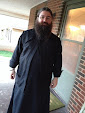
'Christ Is All in All'—Protopresbyter Nicholas Loudovikos


I have made one previous reference on this blog to the modern Greek theologian, Protopresbyter Nicholas Loudovikos, a very warm and brilliant man whom I had the tremendous blessing to meet and speak with at some length a couple of years ago. I shall always cherish the memory of walking with him through a small park near the ecclesiastical school where he teaches in Thessaloniki, as he told me about his extraordinary experiences with Elder Porphyrios and urged me to continue my theological studies. As none of Fr Loudovikos’s work has, to my knowledge, yet been published in English (with, as we shall see, one slight exception), I thought it worth giving him a brief introduction to readers of Logismoi.

As well as being a spiritual son of Elder Porphyrios, Fr Loudovikos was also a student of Fr John Romanides and of Metropolitan John (Zizioulas) of Pergamon. Here is my translation of the brief bio on this page, where one can also find three of Fr Loudovikos’s articles in Greek:

Protopresbyter Nicholas Loudovikos was born in Volos in 1959. He studied psychology, pedagogy, theology, and philosophy in Athens, Thessaloniki, Paris (Sorbonne [Paris IV] and the Institut Catholique de Paris), and at Cambridge. He is a doctor of theology of the University of Thessaloniki (1990). He worked at the research centre for Early Christianity, Tyndale House, Cambridge, and taught or gave seminars at the Centre for Advanced Religious & Theological Studies (C.A.R.T.S.) at the Theology School of the University of Cambridge, at the University of Durham, also giving lectures at other universities or research centres.

Today he is Professor of Dogmatics and Philosophy at the Higher Ecclesiastical School of Thessaloniki, a scientific associate—writer at the postgraduate theology program of the Open Greek University and part-time lecturer at the Orthodox Institute of the University of Cambridge.

When I met Fr Loudovikos back in 2007, after much harassment he gave me copies of three of his books:

1) Θεολογική Ηστορία της Αρχαίας Ελληνικής Φιλοσοφίας, Βιβλίο Πρώτο. Οι Προσωκρατικοί—ο Σωκράτης—ο Πλάτων [A Theological History of Ancient Greek Philosophy, Book One: The Pre-Socratics, Socrates, Plato] (Thessaloniki: Pournaras, 2003).

2) Ορθοδοξία και Εκσυγχρονισμός. Βυζαντινή Εξατομίκευση, Κράτος και Ιστορία, στην προοπτική του ευρωπαϊκού μέλλοντος [Orthodoxy and Modernisation: Byzantine Individualisation, Empire, and History, in the outlook of the European future] (Athens: Armos, 2006).

3) Η Αποφατική Εκκλησιολογία του Ομοουσίου—Η αρχέγονη Εκκλησία σύμερα [The Apophatic Ecclesiology of the One Essence: The Early Church Today] (Athens: Armos, 2002).

If I remember correctly, an English translation of another book, Η Ευχαριστιακή Οντολογία (Athens: Domos, 1992), is in the works, but none of the above titles have been rendered into our Anglo-Saxon tongue as of yet. Now, if I had the time just now, I would translate the synopsis from the back cover of the first book and the titles of a few of the essays collected in the second (just to give a hint of its quite varied contents, it contains essays on Kierkegaard, ecclesiology, the nature of the soul, the Byzantine empire, Feuerbach, the poet Kavafy, and Photios Kontoglou). But I’m afraid that shall have to wait.

On the other hand, as I mentioned, there is a slight exception to my statement that Fr Loudovikos’s work has not been translated into English yet. The third chapter of Part I (pp. 68-93) of the last book, Η Αποφατική Εκκλησιολογία του Ομοουσίου, has already been Englished (though not without mistakes) by Fr Deacon Chrysostom Nassis and included as an appendix to that work (pp. 359-84). Obviously, this saves me some time, but even still, it’s a long chapter and I don’t want to make the necessary sacrifice of sleep to transcribe all, or even much of it for this post. I’ll give you the last paragraph as a taste of what Fr Loudovikos has to offer. Fortuitously, this paragraph focuses on the Eucharist, making it rather aproppriate for Holy Thursday:

Thus, we learn in the Divine Eucharist the mode of the fulfillment of our charismata. Moreover, the Divine Eucharist is that which sustains but also judges this fulfillment as a manifestation of Christ in each charisma and in their communion. Naturally, we speak here of the Eucharist as the ontological pre-modeling of the eschatological coming of Christ, which vivifies and transforms but also judges. This is why eucharistic participation is primarily an ascetic action, an action of a crucified prohairesis (disposition), an action marked by pain in searching out the grace of the consubstantial conjoining of all beings in the image of the Trinitarian consubstantiality, precisely through the ecclesiastical charismata and hierarchies. Thus, prohairesis (disposition) and sacraments, hierarchical structures and charismata, ascetic struggles and institutions confess together that ‘Christ is all in all’. (p. 384)

Finally, for those who know Modern Greek, in addition to the site I linked to above, there are mp3s, a video, and an article of Fr Loudovikos’s here.

Addendum: Please see this post for an update on Fr Loudovikos's work in English.

24 November 2010

Eucharistic Ontology: An Addendum on Fr Nicholas Loudovikos in English


In this post from the Spring of 2009, I strongly recommended the theology of Protopresbyter Nicholas Loudovikos of the University Ecclesiastical Academy of Thessaloniki. At that time, I wrote that ‘none of Fr Loudovikos’s work has, to my knowledge, yet been published in English’, but added, ‘If I remember correctly, an English translation of another book, Η Ευχαριστιακή Οντολογία (Athens: Domos, 1992), is in the works...’ I’m afraid I must admit that around the time that I wrote the original post, at least one of Fr Nicholas’s articles—a fine critique of some of the theological positions of his former teacher, the renowned Metropolitan John (Zizioulas) of Pergamon—was already being published in English under the title, ‘Person Instead of Grace & Dictated Otherness: John Zizioulas’ Final Theological Position’, The Heythrop Journal XLVIII (2009), pp. 1-16. I should have noted this and at least written an addendum to the original post some time ago.

Well, as many of you may know already, the second statement has proved to be correct, and the said translation having been completed, the first statement is now doubly if not triply untrue. Holy Cross Press has published this book, which when I talked with him in 2007 Fr Nicholas spoke of often as one of his more important, under the title, A Eucharistic Ontology: Maximus the Confessor’s Eschatological Ontology of Being as Dialogical Reciprocity (Brookline, MA: Holy Cross, 2010). Here is Fr Andrew Louth’s blurb about the book as posted on Amazon:

In this remarkable book, Fr Nikolaos Loudovikos brings his profound knowledge of the greatest of Byzantine theologians, St Maximus the Confessor, into dialogue with the recent currents of philosophy and theology in the West. This in itself is rare enough, but his central claim—that who we really are is disclosed in our final destiny in God—is one that he shows is rooted in our participation in the Eucharist. This is an intellectually demanding work, but in it Fr Loudovikos never loses sight of the fact that what he has to say bears directly on how we understand what it is to live as a Christian in the twenty-first century.

I myself have not yet read the book in Greek, much less English (though if there remain any generous readers out there willing to help a brother out, I would be delighted to find a copy in the mail!), but I have little doubt that it will prove to be very much worthwhile. The title may sound a bit unwieldy and pretentious, though it doesn’t strike me as nearly so bad in Greek, but Fr Loudovikos is a theologian who really must become better known in the English-speaking world. Order this book now!

03 February 2009

'The Mystical Silence of Inspired Experience'—St Maximus the Confessor


St Anastasius the Apocrisiarios—who is commemorated today along with his elder—begins his Life of St Maximus the Confessor with the proclamation, ‘Great not only in name (for in the Latin tongue, the word maximus means ‘greatest’), but also in his life, St Maximus was born in the great, reigning city of Constantinople’ (The Life of our Holy Father Maximus the Confessor, trans. Fr Dcn Christopher Birchall [Boston: Holy Transfiguration Monastery, 1982], p. 1). It is an assessment that modern patristics scholars and even some theologians have come to share in the last few decades. Fr Andrew Louth calls him a ‘theologian of genius’ (Maximus the Confessor [London: Routledge, 1999], p. 21), and George Berthold writes in the ‘Foreword’ to his translation of a few of St Maximus’s works (Selected Writings, by St Maximus the Confessor, trans. George C. Berthold [Mahwah, NJ: 1985], p. xv):

The increasing recognition of the importance of Maximus the Confessor in the history of Christian thought has far outstripped the availability of his writings in English translation. It is astonishing that despite the lofty prestige of this great theologian over thirteen centuries no English version of any complete work of his was available until 1955, when Dom Polycarp Sherwood published his translation of The Ascetic Life and The Four Centuries on Charity.


Jaroslav Pelikan calls St Maximus the ‘dominant figure in the development of Christian doctrine in the East during the seventh century’ and quotes H.G. Beck’s assessment of him as ‘the most universal spirit of the 7th century and perhaps the last independent thinker among the theologians of the Byzantine church’, although he astutely observes that ‘the very title of confessor implied anything but being independent, original, or productive’ (The Spirit of Eastern Christendom [600-1700], Vol. 2 in The Christian Tradition: A History of the Development of Doctrine [Chicago: U of Chicago, 1977], p. 8).

St Maximus ‘made a thorough study of philosophy and theology, he was renowned for his wisdom, and was respected even in the royal palace’ (St Anastasius, p. 1). Fr Georges Florovsky (in The Byzantine Fathers of the Sixth to Eighth Century, trans. Raymond Miller, et al., Vol. 9 in The Collected Works of Georges Florovsky [Vaduz, Europa: Büchervertriebsanstalt, 1987], p. 208) notes that he ‘received the ἐγκύκλιος παίδευσις’, quoting Sherwood that this entails about 14 or 15 years of training in—


grammar, classical literature, rhetoric and philosophy (including arithmetic, music, geometry, astronomy, logic, ethics, dogmatics and metaphysics), and also that it must have included his first contact with Aristotle and the Neo-Platonists (through the commentaries of Proclus and Iamblichus).

St Maximus was an imperial courtier, an example among monks, a fighter of heresy, a brilliant theologian of both dogma and the spiritual life, and a sufferer for the Faith, having his ‘divinely-speaking’ tongue cut out and his right hand cut off (St Anastasius, p. 46). There is an excellent overview of St Maximus’s life at Orrologion. For this reason, rather than rehashing everything, I will close with a typically profound passage from the Saint’s own words, forged, as Fr Florovsky has written, ‘in silent meditation, in the mystical silence of inspired experience’ (p. 215). I choose from among these a passage that I consider an excellent illustration of Fr Nicholas Loudovikos’s characterisation of St Maximus as ‘the greatest ecclesiologist among Church Fathers’ (Η Αποφατική Εκκλησιολογία του Ομοουσίου: Η αρχέγονη Εκκλησία σήμερα [Athens: Armos, 2002], p. 359):

For by plucking out self-love, which is, as they say, the beginning and mother of all evils, everything that comes from it and after it is plucked out as well. Once this is no more, absolutely no form or trace of evil can any longer subsist. All the forms of virtue are introduced, fulfilling the power of love, which gather together what has been separated, once again fashioning the human being in accordance with a single meaning and mode. It levels off and makes equal any inequality or difference inclination in anything, or rather binds it to that praiseworthy inequality, by which each is so drawn to his neighbour in preference to himself and so honours him before himself, that he is eager to spurn any obstacle in his desire to excel. And for this reason each one willingly frees himself from himself, by separating himself from any thoughts or properties to which he is privately inclined, and is gathered to the one singleness and sameness, in accordance with which nothing is in anyway separated from what is common to all, so that each is in each, and all in all, or rather in God and in others, and they are radiantly established as one, having the one logos of being in themselves, utterly single in nature and inclination. And in this God is understood: in him they are all beheld together and they are bound together and raised to him, as the source and maker. The logos of being of all beings by nature preserves itself pure and inviolate for our attention, who, with conscious zeal through the virtues and the toils that accompany them, have been purified from the passions that rebel against it. (Fr Louth, pp. 88-9)

07 January 2011

At Last, a Short Book Update


While some of my recent book acquisitions have inspired me to write a good old-fashioned ‘book update’, it has been so long since the last ‘update’, that I scarcely know where to begin and am certainly unable to cover everything. I shall confine myself therefore to a few of the most recent and most significant acquisitions.

Today, for example, a trip to Half Price Books yielded the first volume (containing Books I-VIII) of the Loeb Classical edition of St Augustine’s Confessions, tr. William Watts [1] (Cambridge, MA: Harvard U, 1999)—a steal at $5.38. A look inside the mailbox revealed William A. Graham’s Beyond the Written Word: Oral Aspects of Scripture in the History of Religion (Cambridge: Cambridge U, 1993). [2]

On another HPB trip a few weeks ago, I discovered William Griffin’s [3] fascinatingly colloquial translations of St Augustine—Sermons to the People: Advent, Christmas, New Year’s, Epiphany, tr. & ed. William Griffin (NY: Image, 2002). On the first day of the new year, I used a 50%-off coupon from Borders to purchase The Classical Tradition, ed. Anthony Grafton, Glenn W. Most, & Salvatore Settis (Cambridge, MA: Harvard U, 2010), a fascinating reference work on the continuity of the classical tradition in Western civilisation. At some point, I also received via post a copy of St Gregory Palamas’s Homilies, ed. & tr. Christopher Veniamin with the Monastery of St John the Baptist (Waymart, PA: Mount Thabor, 2009). The latter is a review copy sent to me by one of the editors of Orthodox Life, the former blogger known as ‘Felix Culpa’. Look for my review to be published, potentially, in the March-April issue.

Finally, and perhaps most interestingly, I’ve received a few books from a fellow by the name of Dennis Lackner. It’s a long story, but in this post back in 2009 I quoted from a fascinating paper of his on the Camaldolese that I had found in a limited preview on Google Books. He came across the post and we swapped a few e-mails, in one of which he sent me a pdf of the full paper. Fast-forward to Friday, 31 December 2010, and while randomly looking through old e-mails for unprinted pdfs, I discovered his and started rereading it, thinking that I might contact him with some thoughts I had about a few points. That very night, I received a mass New Year’s Eve greeting from the man himself—an interesting coincidence, I thought.

Well, the very next day, I received a personal e-mail from Dennis, asking whether I would be willing to read his entire doctoral dissertation on the Camaldolese, which he is hoping to publish, and to make editorial comments and suggestions on it. It turns out he has been keeping up with Logismoi, and had recently purchased Fr Nicholas Loudovikos’s Eucharistic Ontology at my behest. He therefore offered in return for my help to send me a copy of this book. Needless to say, I readily agreed, and was eagerly anticipating its arrival. I did not anticipate, however, the concomitant arrival of Charles Williams’s The Place of the Lion (Grand Rapids, MI: Eerdmans, 1972) and Hans Urs von Balthasar’s Cosmic Liturgy: The Universe According to Maximus the Confessor, tr. Brian Daley, SJ (SF: Ignatius, 2003). Rest assured, there was much rejoicing. Thank you sincerely, Den! С Рождеством Христовым!


[1] I’m not sure whether there is any relation to Victor Watts, translator of Boethius.

[2] I ordered this book myself to help prepare for a talk I plan to give at the Climacus Conference in Louisville, KY, next month, entitled ‘In Thy Law He Will Meditate Day & Night: The Study of Scripture & Classical Education’.

[3] Thus bringing the total of Williams to three in as many paragraphs.

23 January 2009

Books in the Mail!


There was a pleasant surprise in the Taylor household yesterday when I unexpectedly received two books in the mail—a gift from my friend, Fr Luke Hartung! The books were, to my knowledge, the two most recent books from Uncut Mountain Press, whose publications I have been pleased to follow ever since Fr Heers handed me a free copy of Truth of Our Faith from the unsellable reject stack in Thessaloniki back in 2001.

The first is the latest in UMP’s ongoing project of publishing the works of St Nicodemus the Hagiorite in English—Confession of Faith, trans. Fr George Dokos (Thessaloniki: Uncut Mountain, 2008). It is a translation of a book that was originally published in Venice in 1819, subtitled ‘That Is, a Most Just Apologia’. The translation begins with a ‘Preface’ by Fr George Bebis, Professor Emeritus of Patristics and currently Adjunct Professor, Holy Cross Greek Orthodox School of Theology, which is primarily devoted to summarising the contents. It ends with the following recommendation of the Saint’s work:

Every time I read the books of St Nikodemos I am inspired by his humility, his love, his steadfastness in the faith, his faithfulness to the Canons of the Church, and his unlimited love for Christ, for His Mother the holy Virgin Mary, and for the Mother Church of Christ. St Nikodemos, although he lived in the eighteenth century, still is contemporary, and I say this because even today there are people who do not like him and accuse him of being a westernizer and unbending. But we know that St Nikodemos can speak to our hearts today and give us direction for a truly Christian life. Amen. (p. 19)

The ‘confession’ proper appears in the Saint’s ‘Introduction’, followed by three chapters concerning the Kollyvades controversy, two defending claims or stories told about the Gospels in his Spiritual Exercises (not yet available in English), and finally, there is a defense of his beliefs concerning the Eucharist, and a brief Conclusion. It is clearly a polemical book—St Nicodemus writes:

We were motivated to write these things, not in order to cause a scandal in the Church of Christ—God forbid!—but chiefly and first of all to show that we are not guilty of any of the defamations and accusations which the good brethren allege against us, and especially because they called us heretics and unorthodox, and masons. (p. 110)

I am glad to see that UMP is continuing to publish these translations. The translator, Fr Dokos (Fr Bebis calls him ‘my beloved student’, p. 11), did his Ph.D. on St Nicodemus at Aristotle University of Thessaloniki, where he and his family took over the apartment my wife and I had occupied for about a year and a half. I had the good fortune to meet him there in 2005, and he graciously provided some assistance to me on St Nicodemus issues just several months ago. I look forward to reading this volume, and to seeing the next one!

The other volume was the recent translation, Patristic Theology: The University Lectures of Fr John Romanides, ed. Monk Damaskinos Agioreitis, trans. Hieromonk Alexios (Trader) (Thessaloniki: Uncut Mountain, 2008). It consists of 67 brief pieces on various and sundry theological and spiritual topics, taken from Fr Romanides’s lecture at Aristotle University of Thessaloniki in 1983. Fr Damaskinos has provided extraordinarily helpful chapter titles for these, as well as a Table of Contents that makes it quite simple to simply look up what Fr Romanides has to say about, for instance, ‘The Social Aims of Orthodoxy’, ‘Ecclesiastical Music’, or ‘The Distinction Between Essence and Energy’.

The tone and approach is very conversational and informal, which is nice, but it is also sometimes ‘caustic’ (as Fr Damaskinos notes, p. 15), and there is not much occasion for patristic quotes or discussion of specific Fathers. Thus, the title may be a little misleading to some, for while Fr Romanides’s theology may or may not be ‘patristic’ in content and spirit (and I think it largely is), it is certainly not ‘patristic’ in the sense of simply expounding the writings of the Holy Fathers. Fr George Metallinos, in his ‘Preface to the Greek Edition’, seems to acknowledge this when he says: ‘His lectures were not mere citations from Patristic texts, but an entrance into the Patristic spirit and experience through the Fathers’ relationship with our Triune God in their hearts. On this basis, he reformulated the Patristic teaching’ (p. 11).

One cannot deny, however, that Fr Romanides is controversial, both in the content per se of his writings, where he very much emphasises the differences between traditional Orthodox teaching and everything else, as well as in the way that his writings have been, and will continue to be, received. I myself am not, however, a sufficiently qualified dogmatic or historical theologian to be able to comment on these controversies, and they are not the sort of thing I wish to engage in on this blog. But I will second the judgement of Fr Heers that Fr Romanides ‘was a path-finder who opened the road for academic theology to return to Patristic theology and for pietism to be replaced with hesychasm’ (Preface to the English Edition, p. 9). Indeed, this is very close to the opinion of Fr Nicholas Loudovikos, a student of Fr Romanides and a notable critic of some of the latter’s teaching (for the relevant comments on Fr Romanides’s significance, see his brilliant Η Αποφατική Εκκλησιολογία του Ομοουσίου—Η αρχέγονη Εκκλησία σύμερα [Athens: Armos, 2002], p. 132).

This book was not new to me. In fact, I had purchased and read quite a bit of the Greek edition—Πατερική Θεολογία, ed. Monk Damaskinos Agioreitis (Thessaloniki: Parakatathiki, 2004)—back in 2005, and I actually prefer the design of the Greek edition, which was likely done on a greater budget than Uncut Mountain Press can manage! Interestingly, the two editions were prepared together in a very coordinated way if I remember correctly, with Fr Alexios making his translation even as Fr Damaskinos transcribed the recording of the lectures in Greek. Both, however, have exactly the same chapter titles, divisions, and order, and can be easily compared with one another. I thought I recalled there being a note about this cooperation between editor and translator (both Athonite monks), but I’m not finding it at the moment.

Anyway, I was also given a copy of the English translation back in September, by Fr Dositheos of Holy Archangels Monastery in Texas, so I intend to find a good home for the new one from Fr Hartung. One can read chapters 1 (‘What is the Human Nous?’—where Fr Romanides states in the opening sentence his governing thesis, ‘The chief concern of the Orthodox Church is the healing of the human soul’ [p. 19]), 24 (‘What is the Core of Orthodox Tradition’), and 29 (‘On Conservatives and Liberals’), at the Orthodox Information Center.

(Addendum: Here one can read another helpful, and shorter, discussion of the Kollyvades movement. HT to Fr Dcn Gregory Edwards.)

16 October 2009

'The Brightest Star in the Constellation of Mystics'—St Dionysius the Areopagite


Today, 3 October on the Church’s calendar, we celebrate the memory of our Holy Father Dionysius (Denis) the Areopagite (†96). A convert of the Apostle Paul, St Dionysius is mentioned briefly in the Acts of the Apostles 17:34 as one of the few who ‘believed’ in response to the Apostle’s speech on the Areopagus, ‘Mars Hill’. He is remembered by the Church as a Hieromartyr, having become Bishop of Athens and being martyred later for his faith. But he is most famous in connection with the writings attributed to him: four treatises and ten epistles, which taken together constitute the most important works of Patristic mystical theology, known today as the Corpus Dionysiacum. Thus, the French Benedictine Dom Prosper Guéranger calls him ‘the brightest star’ in the ‘constellation of mystics’ (The Liturgical Year: Time After Pentecost, Vol. V, trans. The Benedictines of Stanbrook [Worcester: Stanbrook Abbey, 1903], p. 376). Here is the Life of St Dionysius in the Prologue (St Nicholas [Velimirović], The Prologue from Ochrid, Vol. 4, trans. Mother Maria [Birmingham: Lazarica, 1986], p. 13):

He is counted among the seventy lesser apostles. This wonderful man was of a noble, pagan family in Athens. Finishing his education in Athens, he went to Egypt to learn more. One day while he was there, the Lord Christ breathed His last on the Cross, and the sun was darkened and it was dark in Egypt for the space of three hours. Then Dionysius cried out: ‘Either God the Creator of the world is suffering, or the world is ending.’ Returning to Athens, he married a woman called Damaris and had sons by her. He was a member of the highest court in Greece, the Areopagus, and was always thereafter known as the Areopagite. When the Apostle Paul preached the Gospel in Athens, Dionysius was baptised with his whole household (Acts 17:34). Paul consecrated him bishop of Athens (he having left his wife and children and status from love of Christ), and he travelled widely with Paul, coming to know all the other apostles. When his teacher, St Paul, suffered martyrdom, Dionysius desired to die such a death himself, so he went off to Gaul to preach the Gospel among the barbarians, accompanied by Rusticus, a priest, and a deacon called Eleutherius. They endured much but met with great success. By their labours, many were turned to the Christian faith and Dionysius built a small chapel in Paris (Author’s note: Some historians think that Dionysius of Paris was other than St Dionysius the Areopagite.) where he celebrated divine service. When he was ninety years old, he was seized and tortured for Christ, together with Rusticus and Eleutherius, until they were all three beheaded with the sword. The severed head of St Dionysius jumped a long way and fell in front of a Christian woman, Catula, who buried it with his body. He suffered in the time of Domitian, in the year 96. He wrote several famous works: on the names of God, on the heavenly and ecclesiastical hierarchies, on mystical theology and on the most holy Mother of God.

The identification with St Denis of Paris aside (while the inimitable Charles Coulombe considers the ‘pretensions’ of those who separate the Biblical, Athenian, Parisian, and literary Dionysii ‘exploded by the writings of such as Dom Guéranger and the martyred Archbishop Darboy’ I can’t figure out if he means these writings have made a convincing argument, or simply that he finds their pious opinion authoritative! See ‘Ultra-Realism FAQ’, Question 4.), it has become merely a commonplace in modern scholarship that the author of the Areopagitic writings was not St Paul’s convert, but, usually, ‘an unknown Syrian bishop or priest ascetic who was a leading theologian of the early sixth century’ (Fr John McGuckin, ‘Dionysius the Areopagite’, The SCM Press A-Z of Patristic Theology, 2nd ed. [London: SCM, 2005], p. 104). Ordinarily, this is not the sort of issue I would raise at Logismoi, but I’m afraid there is so much confusion out there that it must be done if this post is to be of any value. For it is clear that the Church’s Tradition identifies the convert, the Bishop of Athens, and the writer at least, and the endless debates over authorship are in the end merely sophisticated speculation based on slim evidence. For these reasons, it seems to me that as Orthodox Christians we should accept the Corpus as in some sense the work of St Dionysius, whether it represents a much later record of teachings passed down orally—Archbishop Chrysostomos of Etna points out that ‘many Fathers have understood that, perhaps being part of oral tradition, they were written and composed after his repose’ (‘Questions and Answer about the Orthodox Faith’, Orthodox Tradition, IV (2), p. 60)—or at the very least a later (holy) author’s understanding of what a ‘Dionysian’ tradition might be. The latter view has been expressed by Hieromonk Alexander (Golitzin) in his important study, 'Et introibo ad altare Dei': The Mystagogy of Dionysius Areopagita, with Special Reference to its Predecessors in the Eastern Christian Tradition (Thessaloniki: Patriarchikon Idryma Paterikon Meleton, 1994), pp. 416-7, and a similar view articulated by Olivier Clément when he observes, ‘if the real Dionysius was a Greek thinker converted to Christianity, the texts ascribed to his authorship may be said truly to convey his spirit’ (The Roots of Christian Mysticism: Text and Commentary, trans. Theodore Berkeley, OCSO, rev. Jeremy Hummerstone [London: New City, 1995], p. 326). I should note that the blogging traditionalist, John Sanidopoulos, has posted defences of the traditional attribution of the Corpus to the 1st-c. convert of St Paul by, first, the Rev. John Parker, whose arguments I read several years ago, and second, by Fr Dumitru Stăniloae, who I had no idea supported the traditional authorship. Although I'm afraid the whole issue requires a better patristics scholar than I to sort out, I personally welcome any arguments in favour of tradition.

Certainly, I am convinced that Orthodox Christians ought not to speak of a ‘Pseudo-Dionysius’, and that we should always use the conventional English title of ‘Saint’, or some equivalent to speak of the author of the Corpus, for this is how the other Fathers have referred to him. St Gregory Palamas calls him ‘Saint Dionysius’ (The Triads, trans. Nicholas Gendle [NY: Paulist, 1983], p. 63), and St Maximus the Confessor refers to him as ‘the great divine preacher’ and ‘the revealer of God’ (Fr Andrew Louth, Maximus the Confessor [London: Routledge, 1999], pp. 166, 188). But our bowing to Tradition must go beyond nomenclature and titles. We must also read the Corpus itself as a part of the Orthodox Tradition. Although Western scholars—among them C.S. Lewis in The Discarded Image: An Introduction to Medieval and Renaissance Literature (Cambridge: Cambridge U, 2002), pp. 70-5, and Dame Frances Yates in Giordano Bruno and the Hermetic Tradition (Chicago: U of Chicago, 1991), pp. 117-29—have shown how the Corpus has, in Vladimir Lossky’s words, ‘often become the vehicle for neo-Platonic influences’ in Western theology, Lossky also argues forcefully and persuasively that this is because St Dionysius has been ‘poorly assimilated’ in the West, and that from an Orthodox perspective ‘the tradition of Dionysius marks a definite triumph over Platonic Hellenism’ (The Vision of God, 2nd ed., trans. Ashleigh Moorhouse [Crestwood, NY: SVS, 1983], p. 128). In addition to pp. 121-8 of The Vision of God, Lossky has also done much to promote an Orthodox interpretation of the Corpus in The Mystical Theology of the Eastern Church, trans. Fellowship of St Alban and St Sergius (Crestwood, NY: St Vladimir’s, 1998), pp. 23-43, and his efforts have been followed by those of Fr Andrew Louth (see, for instance, The Origins of the Christian Mystical Tradition [Oxford: Oxford U, 1981], pp. 159-78, and this post by Sr Macrina on Fr Louth’s comments in the Afterword to the new edition of Origins, which I unfortunately still lack!), Fr Alexander Golitzin (see 'Et introibo', cited above, as well as articles here and here), and, in Greek, Fr Nicholas Loudovikos (Η Αποφατική Εκκλησιολογία του Ομοουσίου: Η αρχέγονη Εκκλησία σήμερα [The Apophatic Ecclesiology of the Same Substance: The Primitive Church Today] [Athens: Armos, 2002], pp. 54-68), as well as the Orthodox blogger known as Felix Culpa, in a series of posts responding mainly to the gross misunderstanding of St Dionysius by Fr John Meyendorff here, here, here, here, and here. Although such brilliant readings of St Dionysius as Fr Alexander’s were actually prompted by what he somewhere calls ‘the [later Syriac] monastic Sitz-im-leben’ of the Corpus, I see no reason why teaching that was articulated or made explicit only in later Tradition cannot be used to interpret an earlier expression of Christian theology, if we follow arguments like those of Parker or Stăniloae defending the traditional attribution to the 1st-c. convert of St Paul.

I will cite one example of the sort of reading these scholars have produced. Although in the works above, Lossky, Fr Alexander, and others deal with such weighty matters as St Dionysius’s Christology, his understanding of the divine energies, his angelic hierarchy, etc., one of the most interesting points of correction of the various misunderstandings of his teaching among scholars is a passage in Fr Louth’s Origins on St Dionysius’s teaching about the Mysteries:

Denys also makes use of the [‘Neoplatonic] distinction between theoria (contemplation) and theourgia (theurgy). The ecclesiastical hierarchy fulfils its functions by ‘intellectual contemplations and by diverse sensible symbols, and through these it is raised in a sacred manner to the divine’ (EH V.i.2:501 C). These sensible symbols—the sacraments (in a broad sense)—are sometimes referred to by the word theourgia and its derivatives. The oil of confirmation is called theourgikotatos—literally, ‘most theurgical’. The use of the word is interesting, for it indicates that Denys thinks of the sacraments as Christian theurgy—Christian magic, if you like—or, using less loaded words, a Christian use of material things to effect man’s relationship with the divine. Here we see the ‘Christian Proclus’ using neo-Platonic language to express his understanding of the Christian sacraments. But, though he uses similar language, his meaning is basically different. For a neo-Platonist, theurgy—magic—worked because of some occult sympathy between the material elements used and the constitution of the divine. Theurgy, to a neo-Platonist, is natural—even if rather odd. The use of material elements in the sacraments, however, is a matter of institution, not of occult fitness: they are vehicless of grace not because of what they are materially, but because of their use in a certain symbolic context. (pp. 163-4)

This is a point worth keeping in mind when reading of the rôle of the Corpus in the Western hermetic tradition as described by Yates (cited above).

As an aside, despite the consistent misunderstanding of St Dionysius in the West, his enormous prestige there (Thomas Aquinas quotes in 1,700 times, second only to the Scriptures) earned him a place in one of the great works of world literature. Dante, in Paradiso XXVIII.130-135, grants the Areopagite a greater authority than the Latin St Gregory the Great when, having given the Dionysian version of the angelic hierarchy rather than the latter’s, he writes (The Divine Comedy 3: Paradise, trans. Dorothy Sayers and Barbara Reynolds [NY: Penguin, 1962], p. 304):

When Dionysius with ardent zest
Pondered these orders of angelic bliss,
He named them in this way, the true and best;

But Gregory then differed over this,
And when his eyes were opened on this scene
He smiled to see how he had gone amiss.

It is unfortunate that so much space has had to be taken up treating these issues. But in order to make some small contribution to the appreciation and commemoration of the Saint himself on his feast, I offer a small selection from the Corpus: ‘The Celestial Hierarchy’ I.1.3 (Pseudo-Dionysius, The Complete Works, trans. Colm Luibheid and Paul Rorem [NY: Paulist, 1987], pp. 146-7). As Dom Guéranger writes, quoting St Benedict, ‘To-day the incomparable teacher Dionysius presides over the assembly of the faithful. With East and West let us keep silence; for it behoveth the master to speak and teach, and it beseemeth the disciple to hold his peace and listen [RB 6:6]’ (p. 377):

All this accounts for the fact that the sacred institution and source of perfection established our most pious hierarchy. He modeled it on the hierarchies of heaven, and clothed these immaterial hierarchies in numerous material figures and forms so that, in a way appropriate to our nature, we might be uplifted from these most venerable images to interpretations and assimilations which are simple and inexpressible. For it is quite impossible that we humans should, in any immaterial way, rise up to imitate and to contemplate the heavenly hierarchies without the aid of those material means capable of guiding us as our nature requires. Hence, any thinking person realizes that the appearances of beauty are signs of an invisible loveliness. The beautiful odors which strike the senses are representations of a conceptual diffusion. Material lights are images of the outpouring of an immaterial gift of light. The thoroughness of sacred discipleship indicates the immense contemplative capacity of the mind. Order and rank here below are a sign of the harmonious ordering toward the divine realm. The reception of the most divine Eucharist is a symbol of participation in Jesus. And so it goes for all the gifts transcendently received by the beings of heaven, gifts which are granted to us in a symbolic mode.

The source of spiritual perfection provided us with perceptible images of these heavenly minds. He did so out of concern for us and because he wanted us to be made godlike. He made the heavenly hierarchies known to us. He made our own hierarchy a ministerial colleague of these divine hierarchies by an assimilation, to the extent that is humanly feasible, to their godlike priesthood. He revealed all this to us in the sacred pictures of the scriptures so that he might lift us in spirit up through the perceptible to the conceptual, from sacred shapes and symbols to the simple peaks of the hierarchies of heaven.

Although he does not quote this passage in particular, Dom Guéranger is obviously inspired by such words when goes on to praise St Dionysius ever more elabourately:

Honour to thee on this day of thy triumph! Honour to the Apostle of the Gentiles, who comes to meet thee, as his noble conquest, on the threshold of eternity. From early youth how thy soul yearned for that unknown God, whom the Apostle at length revealed to the longing aspirations of thy grand, upright nature! To the darkness of polytheism, to the doubts of philosophy, to the vague glimmers of confused traditions, suddenly succeeded the light of truth; and its triumph was complete. Thou, O Christian Plato, didst enlarge the horizon of philosophy, and didst so rectify its formulas that in them truth could be fittingly clothed. Thou, in thy turn, didst become an apostle; the distinction of Greek and Barbarian, that law of the ancient world, was lost in the common origin assigned by St Paul to all peoples; to the eyes of thy faith, slaves and freemen were equal in that nobility which makes the human race the race of God; while the charity, which overflowed in thy heart, filled it with the immense pity of God himself for the long ages of ignorance in which mankind had been plunged. (p. 383)

In conclusion, I offer, first, the ‘Hymn of Praise’ for St Dionysius from the Prologue, and second, the Kontakion of the Hieromartyr in Tone 8 (The Great Horologion, trans. HTM [Boston: HTM, 1997], p. 268):

Glorious saint Dionysius,
Wondrous theologian and lucid scribe!
His mind, gathered in his heart, he directed to God;
He witnessed heavenly mysteries and revealed them to us.
He perceived the glory of the heavenly orders
And described the hierarchy of heaven:
Principalities, Dominions, Virtues, Powers,
Wondrous Thrones, Seraphim,
Cherubim and Archangels,
Golden-winged Angels of God,
And the Mother of God.
He beheld all with fear,
And also that which shines above the dust of the earth:
Heavenly powers of infinite strength,
Immortal suns and stars most brilliant!
All that he witnessed, Dionysius made clear
And told to the Church.
Thus he adorned and enriched the Church,
And his accomplishments were made golden
By his bloody death for his Christ.
Now he shines in heaven;
And the angelic hosts, blazing with the glory of God,
Call Dionysius ‘Brother’.

Kontakion, Plagal of Fourth Tone
To thee, the Champion Leader

In spirit, thou didst pass through Heaven’s gates, instructed by * the great Apostle who attained to the third Heaven’s heights, * and wast made rich in all knowledge of things beyond speech; * and then thou, O Dionysius, didst illuminate * them that slumbered in the darkness of their ignorance. * Hence, we all cry out: * Rejoice, O universal Father.