Showing posts with label art. Show all posts

28 January 2015

'In the beginning was the Act' - Goethe's Faust


I’m not sure when I first learned of Johann Wolfgang von Goethe’s dramatic masterpiece, Faust, although it was probably around 11 or 12. I’m fairly certain I already knew of it when I saw a copy depicted as part of a small bibliothèque infernale on a poster for the horror-punk band, The Misfits. I think I must have purchased my copy of Walter Kaufmann’s bilingual edition some time during my stint at Barnes & Noble, likely in 1998 or 1999. What finally made up my mind to read it some day, however, was Jaroslav Pelikan’s statement in his brief ‘Personal Memoir: Fragments of a Scholar’s Autobiography’ (here) that he had begun the habit in his teens of reading the whole thing through in German once a year without fail.

By the time I came across that fascinating fact, I already knew of Pelikan’s appreciation for the German Romantic, having heard him refer to Goethe at a lecture at the University of Oklahoma in 1999 (I think) as well as having read his quote from Faust at the beginning and end of his delightful Jefferson Lectures, The Vindication of Tradition:

An older contemporary of Emerson’s, whom Emerson rightly regarded as the wisest and most universal mind of the century (except, Emerson felt obliged to add, for ‘the velvet life he lived!’), Johann Wolfgang von Goethe, saw it all more deeply and said it all more clearly:
What you have as heritage,
Take now as task;
For thus you will make it your own! [1]


Nevertheless, despite this long awareness of the book and the inducements of Pelikan’s esteem for it, I only very recently began to read it for myself. When I did, I was very quickly reminded of the treatment of Faust in David Lyle Jeffery’s People of the Book: Christian Identity & Literary Culture, which I finished earlier this summer, so I went back and reread much of that chapter before proceeding further in Goethe.

Jeffrey draws some fascinating connections between Goethe’s depiction of Faust in his study and what DLJ calls ‘the symbolism of the faithful reader’ in the Christian artistic tradition. In this connection, I was particularly fascinated by Jeffrey’s references to the famous engravings of St Jerome by Albrecht Dürer (on which I have blogged a bit here). [2] Indeed, I would love to do some thinking through, or read someone else thinking through, the implications of Yates’s analysis of Dürer for an analysis of Faust.

The passage that carried me a little further outside Faust itself, however, was Jeffrey’s section on ‘Logos and Lector’, where he focuses on Faust 1224-37. I will quote in full Kaufmann’s translation of this passage, including in brackets the German for a few key terms:

(He opens a tome [of the New Testament] and begins.)
It says: ‘In the beginning was the Word [Wort].’

Already I am stopped. It seems absurd.

The Word does not deserve the highest prize,
I must translate it otherwise
If I am well inspired and not blind.

It says: In the beginning was the Mind [Sinn].

Ponder that first line, wait and see,

Lest you should write too hastily.

Is mind the all-creating source?
It ought to say: In the beginning there was Force [Kraft].
Yet something warns me as I grasp the pen,

That my translation must be changed again.

The spirit helps me. Now it is exact.

I write: In the beginning was the Act [Tat]. [3]

Now I admit that the import of all of this is most unclear to me. Why can Faust not accept the first verse of St John’s Gospel? Because all of this follows on his reference to attempting to translate the NT into German, I’m a little tempted to wonder if it’s more the German word Wort he’s objecting to, and not the Λόγος of the Gospel. But I admit that the successive attempts give me the chills, carrying as I’m afraid they can no longer help but do the crushing weight of German fascist association. [4] For his part, Jeffrey finds, ‘Faust rejects in this formulation the source of all Christian symbol, “the Law of the Lord”, but most specifically the Logos, the doctrine of the incarnate Word.’ [5]

My readiness to accept this reading, as undeveloped as it was, predisposed me to be a little shocked when I turned to another reference to this passage from Faust: the epigraph to Chapter Two, ‘Answerability & Ethics: Toward a Philosophy of Action’, in Alexandar Mihailovic’s remarkable monograph, Corporeal Words: Mikhail Bakhtin’s Theology of Discourse. It had been some time since I’d looked at this book, and I only went back to it on a hunch (since Johannine logology was such an important part of Mihailovic’s analysis). Sure enough, at the heading of Chapter 2, we see:

Im Anfang war die Tat.
--Goethe, Faust.


Now, this was intriguing enough by itself, but it was followed immediately by a second epigraph:

The Formalists are imprinted with the seal of overripe clericalism. They are Johannites. For them ‘in the beginning was the Word.’ But for us in the beginning was the act: the word appeared only after [the act], like a shadow made of sound.
--Leo Trotsky, Literature & Revolution (1924) [6]

At this point, of course, I was fully engaged. Unfortunately, a quick skim through the chapter failed to turn up any further references to Goethe or Trotsky until the very end. There we read: ‘In a very real sense, Bakhtin inverts the Johannine conception of the conception of the word: for him, as for Trotsky--and this is the only area in which the critic and the revolutionary would agree--the act comes first, the word proceeding from it as its concretized efflorescence.’ [7]

Of course, I am hardly inclined to take this at face value. First, note that ‘word’ is not capitalised, either in Trotsky’s statement about its appearance after the act, or at all in Mihailovic’s statement about Bakhtin. Indeed, Mihailovic’s whole point seems to be that Bakhtin’s use of theological language almost invariably replaces the theological content of that language with discursive content. He takes what Christians say about ‘the Word’, and applies it to what we say about ‘the word’, i.e., discourse. [8] Second, Mihailovic himself states that for Bakhtin it is precisely ‘Incarnational theology [that] provides a framework for understanding the formal and material dimensions of the human community; according to Bakhtin, it unites that which has been separated by contemporary approaches to ethics.’ [9] If the rejection of Wort for Tat is a rejection of ‘the doctrine of the Incarnate Word’, as I’m inclined to believe it is for Faust, for Bakhtin it must mean that he cannot follow Faust as easily as Mihailovic seems to suggest.

Since writing that last paragraph, I have read very carefully through an interesting article by a Goethe specialist all about the passage I’ve been considering. I can’t say I have perfectly understood all of Erik Eisel’s ‘“In the Beginning Was the Word...”: The Question of the Origin of Language in Goethe’s Faust’ (here). The gist of Eisel’s argument is that Goethe is making his own contribution to the question of the origin of language, a question memorably essayed by Johann Herder, whose contribution to the subject directly influenced Goethe. I admit I struggled a bit with this aspect of the paper, but I fancy I’ve detected one or two things that dovetail with some of my reflections here.

First, Eisel strikes a note of what Harold Bloom might call ‘anxiety of influence’ in Faust. He asks, ‘Will the appropriation of this primal sentence [i.e., John 1:1] into his own primal writing scene establish a  pattern of continued undifferentiation? Or a hoped-for self-differentiation?’ Comparing Faust’s efforts to translate Scripture into ‘mein geliebtes Deutsch’ to those of his historical contemporary, Martin Luther, Eisel notes, ‘Unlike Luther, he cannot decide whether his translation of “word” into “act” establishes a pattern for the emergence of culture that differentiates him from tradition--or from the former self that he wants to escape.’ Later on, he makes two more comments along these lines. First, he observes, ‘Instead of employing a technique of free translation, Goethe depicts Faust using the literary technique of appropriation in order to transform the “original text”(Grundtext) of the Bible into a personal response to the question of language origin.’ Second, Eisel notes that ‘Goethe prefaces the scene...by emphasizing that translation results from a “personal desire” (mich draengt’s) to make something one’s own, “in mein geliebtes Deutsch ze uebertragen”...’

The last comment reminds me disturbingly of Pelikan’s favourite quotation, from earlier in the poem--‘What you have as heritage, / Take now as task; / For thus you will make it your own!’ Is Faust’s translation attempt a perversion of this charge, or a fulfillment of it? Hoping to get some feel for an answer to this question, I paid very close attention to precisely what it was Eisel was alleging as the object of Faust’s anxiety. In other words, what precisely is the ‘tradition’ that he associates with his ‘former self’ and which he hopes to escape?
I remain slightly unclear on this point. In one place, Eisel writes, ‘For Goethe, translation is the preferred method of creating a literary space where his literary creation, Faust, rebels against the Kantian universe with which he is familiar.’ Okay, so despite the obvious anachronism from an historical perspective, perhaps Kantianism is what Goethe is making his character escape from? But delving into Friedrich Kittler’s ‘wide-ranging work, Discourse Networks 1800/1900’, Eisel suggests an answer that may or may not be connected with Kantianism:

An ‘untimely meditation’ if there ever was one, the melancholic sigh in the opening monologue of Goethe’s play is an expression of Faust’s obvious disgust with the uncomfortable, high-vaulted Gothic den where he lives and works. It is, moreover, an indictment of the circulation of words and books being endlessly renewed with the Republic of Scholars and the Four Faculties. According to Kittler, the beginning of German literature is the dismantling of this obsolete discourse network and the self-generation of a narrative newly oriented towards the reader’s bodily experience of the text and of language.

To me this suggests something generally anti-intellectual, the equation of scholarship and the study of texts with dry, inactive, or ineffectual preoccupations, with a negation of vitality. It suggests that it is the whole tradition of Christian culture--represented first by the Gothic den of St Jerome and second by the traditional connotations of St John’s Prologue--that Faust wishes to distance himself from or escape. I certainly don’t think this tradition is in any way Kantian, though perhaps Goethe is suggesting Kant is a kind of logical conclusion of the tradition?

At any rate, it is in particular the way that Eisel describes Faust setting out to effect this distanciation that is in my opinion closest to some of my considerations above.

[At this point I had to leave off working on this post for a while, and returning to Eisel’s somewhat difficult essay, I found I had completely lost my train of thought! What follows is a much later and necessarily truncated attempt to reconstruct the direction I think I was taking with this post. I hope it makes sense in light of the above reflections.]

Eisel draws on a notion he finds in Kittler of ‘the theatricality of performance’ to delineate Faust’s self-distanciation from all the connotations of the Gothic den. At this point I will quote at some length:

It is not Faust’s proverbial thirst for knowledge that makes him an interesting case study for his diagnosis of a European ‘discourse network’, but his love of spectacle and of the physical effect of astonishment. Upon discovering the magic sign of the Macrocosm, Faust shouts out, ‘What play! Yet but a play, however vast!’ [10] Despite reservations about the superficial character of spectacle, he wants more of it, since it commands a sublimity not to be found in the drabness of his Gothic library. In Kittler’s opinion, this appetite for the sublime is something conditioned by the cultural media of the Enlightenment. Faust’s preference for theatrical gesture over linguistic expression grows out of a person ‘resentment’ against the word (Kittler 13). Accordingly, Kittler interprets the crisis of conventionality in the late Enlightenment as provoking the efforts of a new generation of Romantic writers to initiate a ‘paradigm shift’ within the traditional pedagogical scene that Faust describes in the opening lines of his monologue.

Perhaps it’s simply a conversation that I’m coming to far too late, but to me this passage is very obscure. That said, it strikes me that there are a couple of ways to read it. One is that Eisel and Kittler are discerning at work merely the desire for movement and action typical of youth, a desire writ large in the aspirations and fervency of the Romantic movement. But the other is perhaps more interesting. To my mind it may be that these two scholars are talking about an idea with which I have become increasingly preoccupied lately--the idea of poetic knowledge, and its cousin, that of ‘suffering’ or ‘experiencing’ rather than ‘learning about’ divine things (see this post). Although Eisel notes ‘the superficial character of spectacle’, in the enactment of drama (I’m thinking particularly of classical tragedy), we have a discourse that is in some ways akin to liturgy, where the mystery of knowledge is no longer confined to the ‘scientific’ learning of the text, but is entered into by experience with the senses and acted out. Is it possible that it is something not so far from liturgy that Faust is drawn to in his ‘preference for theatrical gesture’?
Either way, I hesitate to make too much of the Bakhtinian inversion of supposedly Johannine ‘word’ that Mihailovic believes he has discovered. If ‘word’ is to be equated with verbal discourse only, then it is natural that it lose its ontological priority, and we could perhaps do much worse than replace it with ‘act’ in the sense of enacting the mystery in which we participate. ‘Word’ can only be restored to primacy of place if it becomes again that Λόγος that dwelt in silence with God in the beginning, already full of the love that would act by creating everything.


[1] Qtd. in Jaroslav Pelikan, The Vindication of Tradition (New Haven, CT: Yale, 1984), p. 82; see also the epigraph on the dedication page, p. v. The lines are 682-3, and are found on pp. 114 & 115 of Kaufmann’s edition, where they are rendered, ‘What from your fathers you received as heir, / Acquire if you would possess it’ (Johann Wolfgang von Goethe, Faust, tr. Walter Kaufmann [NY: Anchor, 1990], pp. 114-5).

[2] David Lyle Jeffrey, People of the Book: Christian Identity & Literary Culture (Grand Rapids, MI: Eerdmans, 1996), pp. 214-5.

[3] Goethe, p. 153.

[4] My Webster’s New World German Dictionary supports Kaufmann’s renderings of the German terms, though it also gives other possible meanings. The first definition given for Sinn is ‘sense’, followed by ‘mind’, ‘feeling’, ‘spirit’, and ‘point’ (Webster’s New World German Dictionary, Concise edition, ed. Peter Terrell & Horst Kopleck [Indianapolis: Wiley, 1987], p. 389) Under definition (a), Kraft is translated ‘strength’, ‘power, force’, or ‘energy’, and under (b) as ‘power’ or ‘force’ (it is compared to Macht) (ibid., p. 258).

At any rate, as Erik Eisel points out, Hitler himself praised Goethe ‘for giving such prominence to “deeds” over “words”’.

[5] Jeffrey, p. 258.

[6] Alexandar Mihailovic, Corporeal Words: Mikhail Bakhtin’s Theology of Discourse (Evanston, IL: Northwestern U, 1997), p. 51. I have posted at some length on Bakhtin and the Formalists here, in a post which somehow earned me the accusation that I ‘hate literature’.

[7] Ibid., p. 85.

[8] In their useful, if flawed, intellectual biography of Bakhtin, Katerina Clark and Michael Holquist quote Kenneth Burke in order to explain their assumptions about Bakhtin’s project: ‘As Kenneth Burke remarked, “statements that great theologians made about the nature of ‘God’ might be adapted mutatis mutandis for use as purely secular observations on the nature of words…”’ (Katerina Clark & Michael Holquist, Mikhail Bakhtin [Cambridge, MA: Harvard, 1984], p. 83).

[9] Mihailovic, p. 78. [10] Goethe, p. 99.

04 August 2012

CiRCE Report, Part I


I’ve decided rather than posting my CiRCE report all at once, to instead make it a two-parter. So here is Part 1, dealing with the various speakers heard on Thursday, 19 July. 

As I mentioned before, the conference theme was ‘A Contemplation of Creation’. Nine of us set out from OKC, including my wife and me and my terrific boss, Nathan Carr. We arrived Wednesday evening in time to stop by and say hello to Joshua Sturgill and Erin Doom, who were setting up the Eighth Day Books table, before heading to the welcoming reception. There, after reconnecting with Matt Bianco, Buck Holler, and Andrew Kern himself, I finally met the delightful Darren and Kimberly Jahn. Kimberly had recently (?) begun reading Logismoi and had already ingratiated herself by sending me a free copy of David Hicks’s Norms & Nobility. My wife and I decided to crash their dinner plans and get to know them a bit for the rest of the evening. 

Thursday morning began with an opening talk by Andrew Kern called ‘A Contemplation of Creation, Part I’. After an oligatory but meditative look at Genesis 1, Andrew quoted from Dorothy Sayers’s Mind of the Maker: ‘As soon as the mind of the maker has been made manifest in a work, a way of communication is established between other minds and his. That is to say, it is possible for a reader, by reading a book, to discover something about the mind of the writer.’ [1] This established the prevailing theme of the talk—the role of analogy in our understanding of God and creation. I don’t recall whether Andrew quoted it or not, but Wisdom 13:5 is a good statement of the thesis that makes use of the very term he emphasises—‘For by the greatness and beauty of the creatures analogously [ἀναλόγως] the Maker of them is seen.’ According to Andrew, our ‘habit of mind’ vis-a-vis creation should be primarily one of analogy rather than one of analysis.  

Next there was another plenary session, with John Mason Hodges talking about ‘Music & Metaphor: Towards a Sacramental View of Creation’. Hodges opened by emphasising that the Scriptural metaphors used for Christ—the vine, the bread, etc.—use things made by Him in order to describe Him. In other words, Christ is not ‘like’ a vine, the vine is ‘like’ Christ. He then segued into the topic of music by pointing out that metaphors function by bringing two things together in harmony—the sign and the signified. The bulk of the talk however consisted of an analysis of three movements from Holst’s The Planets—Jupiter, Mars, and Venus—and of the Louis Armstrong/Ella Fitzgerald duet, ‘Let’s Call the Whole Thing Off’. Hodges highlighted the metaphorical meanings in the music of Holst’s suite, and of the lyrics (primarily) of the Gershwin composition (focusing in particular on the lines ‘But oh, if we call the whole thing off / Then we must part / and oh, if we ever part, then that might break my heart’). 

At the first breakout session, I chose to attend a talk by Edward Chandler on ‘Language & Creation: Man, the Image of God’. Chandler began by discussing the imago Dei, arguing that approaches to the subject could be grouped into three categories: the material (entailing an anthropomorphic theology); the psychic/noetic, i.e., the idea that the soul or mind is the image, and is merely housed in a container (Chandler thought that this seemed to be the tendency of St Augustine as well as what he called ‘my beloved Cappadocians’!); and finally, the composite, a psychosomatic emphasis, which he identified with Aquinas (but I associated primarily with St Gregory Palamas and the Philocalic tradition generally). Chandler’s point was that language as a God-given ability was bound up with the imago in part because it is itself a psychosomatic unity (immaterial thought or meaning + material sign), but also because human language is analogous to God, who uses language to create in Genesis. Chandler connected this with liberal studies by pointing out that the inevitable offspring of language is literature, and that we learn classical languages in order to read literatures. In this way, language enables us to know ourselves as human beings. For Chandler, this meant that Latin instruction, for instance, should move as quickly as possible into the reading of texts, and not focus on grammar per se. 

Lunch on Thursday was spent in the charming company of Dr John Patrick of Augustine College in Ottawa, an abridgement of whose essay, ‘The Myth of Moral Neutrality’, I had just read in Doxa, the newsletter of St Michael’s Skete. Unfortunately, Dr Patrick’s deep well of fascinating stories made me quite late to the next breakout—Earl Nelson’s earnest talk on ‘Contemplating Babel: The Spiritual Dimensions of Learning Latin & Languages’. Nelson discussed the story of Babel as an account of the splitting up, not only of languages, but of cultures and thought-worlds. He sees it as a locus of estrangement on two levels—between different cultures (usually a synchronic estrangement), and between a present culture and its own past (more like a diachronic estrangement). Nelson saw language learning as the process of a becoming part of another culture and overcoming the divisions of Babel. He was quite firm about the importance of gaining fluency in reading the classical languages, and not being content merely to produce translations, whether mental or written. 

Thursday came to an end with a 3-man panel consisting of Martin Cothran, David Hicks, and Gregory Wolfe (of Image Journal) discussing Christian views of creation while in the roles of St Athanasius the Great, St Basil the Great, and St Augustine, respectively. In the spirit of the KU Pearson Integrated Humanities Program, on which this feature of CiRCE conferences is based, I did not take notes. Instead I simply sat and listened, and when Andrew Kern refilled the participants’ wine glasses, managed to procure a swig for myself. It started very slowly and awkwardly (though not without humour), but ended up being an interesting discussion. I was thrilled to hear Hicks (St Basil) tell Cothran (St Athanasius) that his favourite book by him was the Vita Antonii (as I mentioned here). Wolfe repeatedly mentioned ‘hanging out’ with a bunch of no-goodniks who theologically denigrated creation (the Manichaeans), and emphasised that his Confessions highlighted the allegory of Genesis in part to overturn Manichaean ideas. Unfortunately, Hicks seemed to get a bit confused about St Basil’s dates, but I doubt any non-Patristics folks noticed. 

Because the CiRCE prize-giving banquet was scheduled for Friday eve, the PH staff elected to have our traditional dinner out together on Thursday evening. I ate a sickening number of ribs at Ramsi’s Cafe in Louisville, browsed a bookshop, and had a brief conversation with Joshua Sturgill (of Eighth Day), Stacy Shipman (itinerant Orthodox student/teacher), and Nyleen Lacy (of the brand-new Orthodox classical school, Christ the Savior Academy in Wichita) before returning to the hotel to find part of its roof had been ripped off by a tornado. Thanks to God, no one seems to have been injured. 


[1] Dorothy Sayers, The Mind of the Maker (San Francisco: Harper & Row, 1979), p. 49.

11 May 2010

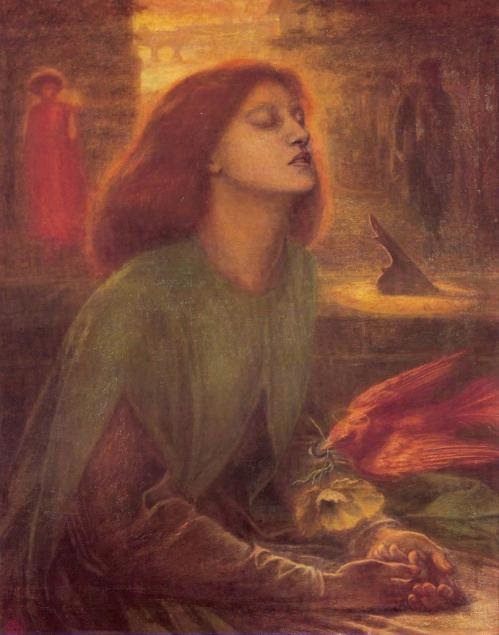
'The Mournfulness of Ancient Life'—Dante Gabriel Rossetti


So, thank you to all who said prayers for me. Thanks to God, I am doing much, much better already. I have been taking into account the advice I received in the comments on the last post, and I intend to slow down significantly my rate of posting on Logismoi. I’m not sure yet if I will set a new goal—I’ve been posting every day for quite some time—but for the time being I’ll just see how it goes and post as the mood strikes me. I may also try to keep the posts a bit simpler, so as not to overdo it.

Today, 12 May, is the birthday of the English Pre-Raphaelite painter and poet, Dante Gabriel Rossetti (1828-1882), named for but not to be confused with the Florentine poet and author of the Divine Comedy, Dante Alighieri (1265-1321). [1] While W.H. Auden has included Rossetti in his anthology of British minor poets, in the introduction to Rossetti in Lionel Trilling’s and Harold Bloom’s Victorian Prose & Poetry, it is argued that the Pre-Raphaelite, ‘though out of favor in our time, seems to this editor the best poet of the Victorian period, after Browning and Tennyson, surpassing Arnold and even Hopkins and Swinburne (greatly undervalued as Swinburne now is).’ [2] According to Benét’s Reader’s Encyclopedia, Rossetti’s ‘lyric poems are distinguished by richness and vividness of detail, mysticism and fantasy, and the frequent use of modified ballad form.’ [3]

Concerning Rossetti’s origin, Joseph Knight tells us that his family came from the city of ‘Vasto d’Ammone, the ancient Histonium’. His father, Gabriele Rossetti, was ‘distinguished as a patriot and a man of letters’, but was persecuted by Ferdinand, the King of the Two Sicilies, and forced to flee to England. [4] Once in England, Rossetti’s father married Frances Mary Lavinia Polidori, whose father was Gaetano Polidori, a translator of Milton into Italian, and whose brother was Dr John William Polidori, physician to Lord Byron, participant in the famous ghost-story game which spawned Frankenstein, and author, as a result, of the first vampire story in English, The Vampyre. A few years after Rossetti’s birth, his father took up the post of Professor of Italian Literature at King’s College, a post he held until 1845. Gabriele and Frances Rossetti had four children, who were ‘all honourably known in connection with literature’: [5] Maria Francesca, author of A Shadow of Dante, Dante Gabriel, William Michael, and Christina, the latter three of whom were all associated with the Pre-Raphaelite Brotherhood. According to George Creeger’s account of the eldest son’s work:

Rossetti possessed the talents of painter and poet alike: at the age of six he was already writing verses, and when he was fifteen there appeared a privately printed volume entitled Hugh the Heron. But he devoted much of his energy to mastering the craft of painting; and the Pre-Raphaelite Brotherhood founded in 1848 by him (together with [William Holman] Hunt, [John Everett] Millais, and [Thomas] Woolner) was at first only incidentally concerned with literary principles. But even as Rossetti’s fame as a painter grew, he wrote a good deal of poetry, much of which was printed in The Germ, a periodical started by the Brotherhood in 1850. Many of his later MSS. he buried, however, in the coffin of his wife and beautiful model, Elizabeth (née Siddal), who, already ill with tuberculosis, died of an overdose of laudanum in 1862. Seven years later the MSS. were recovered [6] and formed the basis of the volume of poems published in 1869. Rossetti’s last years were marked by increasing morbidity, quasi-paranoia, and addiction to drugs; but in 1881 he published a second volume of poetry, Ballads & Sonnets, in which the signs of his genius were still clear. [7]

James Merritt has quoted Rossetti’s brother, William Michael, as saying of one of his own poems that ‘the informing idea of the poem was to apply to verse-writing the same principles . . . which the Pre-Raphaelites upheld in their pictures’. [8] Similarly, Dante Gabriel actually has lyrics which are meant to accompany his paintings. His subject matter and symbolism are of course frequently Christian, as are those of his paintings, though we mustn’t conclude too much from this. While Rossetti was raised in his mother’s Anglican faith, unlike his sister Christina he seems not to have been a traditional believer. George Landow quotes William Holman Hunt as saying that Rossetti spoke ‘in a very patronising way about the “poor man” Jesus, and . . . ridiculed the promises about coming again’. [9] John Ruskin writes, ‘To Rossetti, the Old and New Testaments were only the greatest poems he knew; and he painted scenes from them with no more actual belief in their relation to the present life and business of men than he gave also to the “Morte d’Arthur” and the “Vita Nuova”.’ [10]

But Landow also points out in some detail Rossetti’s use of Christian typology in his poetry, particularly in one sonnet he composed to accompany a painting entitled ‘Passover in the Holy Family’:

Here meet together the prefiguring day
And day prefigured. ‘Eating, thou shalt stand,
Feet shod, loins girt, thy road-staff in thine hand,
With blood-stained door and lintel,’ – did God say
By Moses’ mouth in ages passed away.
And now, where this poor household doth comprise
At Paschal-Feast two kindred families,
Lo! the slain lamb confronts the Lamb to slay.
The pyre is piled. What agony’s crown attained,
What shadow of Death the Boy’s fair brow subdues
Who holds that blood wherewith the porch is stained
By Zachary the priest? John binds the shoes
He deemed himself not worthy to unloose;
And Mary culls the bitter herbs ordained.

In Landow’s words, Rossetti ‘was intrigued by the fact that prefigurative symbolism provides a means of redeeming human time, of perceiving an order and causality in human events.’ He goes on to observe, ‘It is precisely this aspect of typological symbolism with which Rossetti concerns himself in his sonnet, which . . . proceeds by setting forth the series of details—the types—which prefigure Christ’s ultimate self-sacrifice.’ Interestingly, this actually suggests a very good reason for the direct linking of painting and poetry for Rossetti. As Landow writes:

Ever since Lessing had reiterated the ancient truth that paintings were limited to a single moment in time, artists had increasingly concerned themselves with dramatically climactic moments. But this new form of symbolism offered a means of inserting the scene in several different times, as it were, and thus enriching the picture’s effect. Paradoxically, this potential also emphasizes the limited nature of the visual image, because it makes it depend heavily for its effect upon linguistic, extra-visual sources for meaning and drama.

Rossetti’s fascination with typological symbolism also appears in the poems he composed about other artists’ works, for in these he is adding the typological dimension on his own authority. [11]

In conclusion, I suggest all have a look at some of Rossetti’s other work, here for instance, as well as this stirring post on the Pre-Raphaelites by Kevin Edgecomb of biblicalia. There is also another interesting take on Rossetti’s religious symbolism here. I leave you with ‘The Sea-Limits’ (1849-50), anthologised by Auden as well as Trilling and Bloom:

Consider the sea’s listless chime:
Time’s self it is, made audible,—
The murmur of the earth’s own shell.
Secret continuance sublime
Is the sea’s end: our sight may pass
No furlong further. Since time was,
This sound hath told the lapse of time.

No quiet, which is death’s,—it hath
The mournfulness of ancient life,
Enduring always at dull strife.
As the world’s heart of rest and wrath,
Its painful pulse is in the sands.
Last utterly, the whole sky stands,
Grey and not known, along its path.

Listen alone beside the sea,
Listen alone among the woods;
Those voices of twin solitudes
Shall have one sound alike to thee:
Hark where the murmurs of thronged men
Surge and sink back and surge again,—
Still the one voice of wave and tree.

Gather a shell from the strown beach
And listen at its lips: they sigh
The same desire and mystery,
The echo of the whole sea’s speech.
And all mankind is thus at heart
Not anything but what thou art:
And Earth, Sea, Man, are all in each. [12]


[1] It is worth pointing out, however, that in their note on Rossetti’s ‘Sestina (after Dante)’, Lionel Trilling and Harold Bloom write, ‘No more successful version of anything by Dante exists in English . . .’ (Victorian Prose & Poetry (NY: Oxford U, 1973), p. 624).

[2] Ibid., p. 616.

[3] Katherine Baker Siepmann, ed., Benét’s Reader’s Encyclopedia, 3rd ed. (NY: HarperCollins, 1987), p. 846.

[4] Joseph Knight, Life of Dante Gabriel Rossetti (London: Walter Scott, 1887), p. 11.

[5] Ibid., p. 13.

[6] On the subject of the ‘recovery’ of the manuscript, which as is noted occurred seven years after the woman’s burial, Knight insists that the idea was suggested by various friends, culminating in an offer on the part of one Mr Charles Augustus Howell to actually ‘take charge of the execution of the task’, to which Rossetti ‘was still averse’. Finally, ‘All was found as it was left, but the book, though not in any way destroyed, was soaked through and through, and had to undergo a long process of ablution in the hand of the medical man who assisted Mr Howell. By his care also the whole was dried leaf by leaf’ (Knight, p. 106).

[7] George R. Creeger, ‘Notes’, 19th-Century British Minor Poets, ed. W.H. Auden (NY: Delacorte, 1966), p. 368.

[8] James D. Merritt, ed., The Pre-Raphaelite Poem (NY: E.P. Dutton & Co., 1966), p. 20.

[9] Qtd. in George P. Landow, Replete with Meaning: William Holman Hunt & Typological Symbolism, here.

[10] Ibid.

[11] Ibid.

[12] Trilling & Bloom, pp. 625-6.

24 March 2010

'Remember Me a Little Then I Pray'—William Morris


Now that I’ve used up much of my best hagiographical material, I’ve been trying to think of another regular ‘feature’ I could introduce so I’m not just posting on willy-nilly topics all of the time. I believe I’ve found one. A couple of times now when I’ve checked out with my purchases at Half Price Books, they’ve given me a wall calendar. Based on a polar bear theme, the aesthetics of the thing have not appealed to me much, but upon closer examination I’ve noticed two things of interest: a number of 15%-off coupons, and the names of a writer or two listed for every day—the days of their birth. Many of these are the sort that appeal to the lit majors at the typical American university these days, but others are writers of real merit.

I have decided to try posting on these whenever they interest me. I do hope that the more regular posts on literary figures won’t chase off too many Orthodox readers who are primarily interested in Orthodox matters. I hope to continue to post occasionally on Saints, and more frequently on patristic writings and moral and theological issues. I also have no intention of abandoning my occasional attempts to relate Orthodoxy and literature, whether on a superficial or a deeper level. The only question is what to do with the calendar so I can check it regularly without actually hanging it!

So the first to catch my attention after I noticed this intriguing little feature was William Morris (1834-1896), who, of all of those associated with the Pre-Raphaelite movement, displays to the greatest degree the sixth characteristic with which James Merritt has identified their work: ‘Deliberate “medievalism”, such as the use of vaguely medieval-sounding words, or the use of settings that, though unidentified, seem pre-Renaissance.’ [1] Peter Ackroyd notes that Morris ‘was described as possessing a “medievalised mind and turn of thought”’. [2]

In their anthology of Victorian prose and poetry, Lionel Trilling and Harold Bloom observe, ‘Morris is remembered today more for his personality, energies, Socialist politics, and vision of the arts (in which he followed Ruskin) than for either his verse or prose romances, which is a pity.’ [3] Remembered, that is, among academics and intellectuals. Among most people, if Morris is known at all, I’d say he’s known almost solely for his wallpaper, which is a great pity. This is not to say that he didn’t design great wallpaper, just that he did so many other things. Here is the brief sketch of Morris’s life—by George R. Creeger—in W.H. Auden’s anthology, 19th-Century British Minor Poets:

An enormously talented individual, Morris was competent at nearly everything that excited his interest, from architecture and domestic furnishings to poetry. Born into comfortable circumstances, he was educated at Marlborough College (a relatively new public school that permitted greater intellectual freedom and experimentation than the older ones) and at Oxford, where he came into association with [Dante Gabriel] Rossetti and [Edward] Burne-Jones, and where he showed great skill in writing poetry. No sketch can do justice to the incredible diversity of his career. Even in concentrating upon its poetic aspects, one can do little more than mention the publication, in 1858, of The Defence of Guenevere, and Other Poems; in 1868-70, The Earthly Paradise; in 1870, his translation of the Völsunga Saga; and in 1876, Sigurd the Volsung. [4]


Morris wrote, did, and said so many things, that I am only able to mention a few of them. As his physician said after his death in 1896, the cause of death was ‘simply being William Morris, and having done more work than most ten men.’ [5] So I shall confine myself to the poetry, and the ‘vision of the arts’. Concerning the first, Trilling and Bloom write:

Morris derives from a whole series of major 19th-c. poets—Keats, Tennyson, Browning, and Rossetti—but his directness, detachment in depicting savagery, and ability to convey swiftly the effect of violent action are entirely his own, and still unique in the language . . . . Medieval poems by Morris are utterly unlike Tennyson’s; the blood shed in them is not word painting, and the freedom from intrusive moral judgments is absolute. Morris is one of the very few poets ever who can be criticized for not being ambitious enough. His poems demonstrate more genius than he was willing to concentrate. If his interests had been fewer, his poetry would have sprawled less, and meant more, but he valued his other enterprises at least as much as he cared for his poetry. [6]

Here are three examples of Morris’s verse, from shortest to longest. The first is taken from his romance, The Hollow Land, and the last from the collection, The Earthly Paradise. [7]

Song

Christ keep the Hollow Land
Through the sweet springtide,
When the apple-blossoms bless
The lowly bent hill side.

Christ keep the Hollow Land
All the summer-tide;
Still we cannot understand
Where the waters glide:

Only dimly seeing them
Coldly slipping through
Many green-lipped cavern mouths
Where the hills are blue. [8]


Summer Dawn

Pray but one prayer for me ’twixt thy closed lips,
Think but one thought of me up in the stars.
The summer night waneth, the morning light slips,
Faint and grey ’twixt the leaves of the aspen, betwixt the cloud-bars,
That are patiently waiting there for the dawn:
Patient and colourless, though Heaven’s gold
Waits to float through them along with the sun.
Far out in the meadows, above the young corn,
The heavy elms wait, and restless and cold
The uneasy wind rises; the roses are dun;
Through the long twilight they pray for the dawn.
Round the lone house in the midst of the corn.
Speak but one word to me over the corn,
Over the tender, bowed locks of the corn. [9]


From The Earthly Paradise

Apology
Of Heaven or Hell I have no power to sing,
I cannot ease the burden of your fears,
Or make quick-coming death a little thing,
Or bring again the pleasure of past years,
Nor for my words shall ye forget your tears,
Or hope again for aught that I can say,
The idle singer of an empty day.

But rather, when aweary of your mirth,
From full hearts still unsatisfied ye sigh,
And, feeling kindly unto all the earth,
Grudge every minute as it passes by,
Made the more mindful that the sweet days die—
Remember me a little then I pray,
The idle singer of an empty day.

The heavy trouble, the bewildering care
That weighs us down who live and earn our bread,
These idle verses have no power to bear;
So let me sing of names rememberèd,
Because they, living not, can ne’er be dead,
Or long time take their memory quite away
From us poor singers of an empty day.

Dreamer of dreams, born out of my due time,
Why should I strive to set the crooked straight?
Let it suffice me that my murmuring rhyme
Beats with light wing against the ivory gate,
Telling a tale not too importunate
To those who in the sleepy region stay,
Lulled by the singer of an empty day.

Folk say, a wizard to a northern king
At Christmas-tide such wondrous things did show,
That through one window men beheld the spring,
And through another saw the summer glow,
And through a third the fruited vines a-row,
While still, unheard, but in its wonted way,
Piped the drear wind of that December day.

So with this Earthly Paradise it is,
If ye will read aright, and pardon me,
Who strive to build a shadowy isle of bliss
Midmost the beating of the steely sea,
Where tossed about all hearts of men must be;
Whose ravening monsters mighty men shall slay,
Not the poor singer of an empty day. [10]

Of course, I should hasten to admit that, while I am certainly a fan of Morris’s lyrics, I have not read any of his longer pieces (though at a shop near the British Museum I bought a wonderful Dover facsimile of Morris’s own Kelmscott Press edition—pictured above—of his Wood Beyond the World), and it is at least as much his ‘vision of the arts’ that interests me in him as his poetry. My introduction to this vision came primarily through a book on interior decoration—The Beautiful Necessity: Decorating with Arts & Crafts, by Bruce Smith and Yoshiko Yamamoto. In the introduction, the authors write:

Still, the true genesis of the Arts and Crafts movement was in England, not America, and primarily in the work of William Morris, the English poet, designer, and social reformer. As an undergraduate at Oxford, Morris had read and was inspired by the writings of the art critic John Ruskin, especially his influential chapter ‘The Nature of Gothic’, in The Stones of Venice, which was published during Morris’s time at Oxford. Ruskin, with his criticism of industrialization, his total rejection of the machine, and especially his belief that society could be saved only if one could change the nature of work, lit a fire in Morris that set the direction of his life’s work. Morris not only became adept at crafts, from designing wallpaper to the dyeing of cloth and the weaving of tapestries, but he preached his ideals, providing inspiration in turn for others around him and for those who followed. [11]

But there is more to Morris’s ‘vision of the arts’ than criticising the industrial revolution and learning of crafts. It is important to understand why Morris values crafts. Unlike that high ‘art’ which is largely considered the domain of snobs and geniuses in our day, Morris believed that crafts are the art that innocuously enriches—or at least should enrich—the life of ordinary people. In an 1880 lecture entitled ‘The Beauty of Life’, he writes:

So much is now known of the periods of art that have left abundant examples of their work behind them, that we can judge of the art of all periods by comparing these with the remains of times of which less has been left us; and we cannot fail to come to the conclusion that down to very recent days everything that the hand of man touched was more or less beautiful: so that in those days all people who made anything shared in art, as well as all people who used the things so made: that is, all people shared in art. [12]

To the objection that making art the business of all men was to make it too ‘intrusive’, Morris responds:

But indeed there seems no chance of art becoming universal, unless on the terms that it shall have little self-consciousness, and for the most part be done with little effort; so that the rough work of the world would be as little hindered by it, as the work of external nature is by the beauty of all her forms and moods: this was the case in the times that I have been speaking of: . . . . [13]

What Morris is talking about here, when he speaks of art having ‘little self-consciousness’, is what he calls the ‘lesser arts’—the craft of making furnishings and decorations, ‘those arts with whose products men are in touch every moment of their daily lives’, in Trilling’s and Bloom’s words. [14] Later in the same lecture I have been quoting, Morris writes:

I have spoken of the popular arts, but they might all be summed up in that one word Architecture; they are all parts of that great whole, and the art of house-building begins it all [see Morris’s ‘Red House’ to the left]: if we did not know how to dye or to weave; if we had neither gold, nor silver, nor silk; and no pigments to paint with, but half-a-dozen ochres and umbers, we might yet frame a worthy art that would lead to everything, if we had but timber, stone, and life, and a few cutting tools to make these common things not only shelter us from wind and weather, but also express the thoughts and aspirations that stir in us. [15]

It is interesting to note that in another lecture, ‘Art & the Beauty of the Earth’ (1881), Morris emphasises that when practicing such crafts, one must ‘try to get the most out of your material, but always in such a way as honours it most. Not only should it be obvious what your material is, but something should be done with it which is specially natural to it, something that could not be done with any other.’ He adds, ‘This is the very raison d’être of decorative art . . . .’ [16]


Although I’m afraid a detailed discussion and comparison might make this post a bit long, I think there is much here for Orthodox to consider. In my opinion, Morris’s ‘vision of art’ overlaps a good deal with that of the Orthodox Church, and some of these ideas remind me of specific passages in modern theologians I’ve read (I’m thinking primarily of Chrestos Yannaras and Archimandrite Vasileios of Iveron).

But these last observations naturally raise the question of Morris’s religious convictions. According to Trilling and Bloom, while he had entered Exeter influenced by ‘a devout sister’ with the aim of proceeding to holy orders, ‘So far as can be discerned, once Morris had made his decision [to dedicate himself to art], religion was for him a dead issue, and the influence of its idiom is not to be traced in his prose, as it so readily is in the prose, as it so readily is in the prose of Carlyle, Ruskin, and Arnold.’ [17] I have not read it through, but a bit of browsing through the study of William Morris by the famous Communist historian, E.P. Thompson, [18] suggests that he makes little mention of religion, as one might expect. For Thompson, it seems to have been a temptation of Morris’s youth, for, ‘Religion of all varieties was deeply compromised by the same evils’, and its ‘lure . . . began to fade’. He quotes an 1855 comment from Cormell Price that ‘Morris has become questionable in doctrinal points’, and then tells of Morris’s decision to turn to art. [19]

But I shall allow a more optimistic, if naïve, New York Times piece of 1900 (here) to have the last word. Responding to a letter from a reader asking precisely this question, and mentioning certain ‘sentences and paragraphs’ in Mackall’s 2-vol. biography, the author speaks of feeling ‘certain of the deep religious feeling underlying Morris’s nature—perhaps not the conventional ideas of an orthodox Christian, for the reason that his religious principles seem to have been so entirely expressed in deeds, not words’. The author remarks upon the great ‘influence’ of the Anglo-Catholic movement on Morris. But he tells us, unfortunately, that ‘art and literature, from being considered merely the handmaids of religion, came to be considered as worth pursuing for their own sake’, and that the young Morris had originally hoped to found a monastery and even to devote himself to a semi-monastic existence in some kind of ‘order’, but which ‘gradually broadened into . . . a social brotherhood.’ While the utopian, even chiliastic element of socialism cannot be denied, the author discerns ‘strong ethical Christianity’ in the political activity of Morris’s later years. Finally, the author concludes that ‘Morris’s desire on one occasion to be kept from the narrowing influence of the world, so that he might look at things “bigly and kindly”, was so well borne out that his whole life would seem but another and tacitly expressed proof of William Morris’s essential faith in religion.’

I for one have my doubts, but I certainly hope that it is so.

Addendum: It occurred to me that the uninitiated, reading this post, might come away not realising that all of the images here are of things that Morris himself designed or created directly. Even the book is not merely the edition of some clever publisher, but of Morris himself, who designed, illustrated, typeset, and even bound it. This is followed by a Morris tapestry, a house designed by Morris, the William Morris workshop, and a stained-glass window designed by Morris.


[1] James D. Merritt, ed., The Pre-Raphaelite Poem (NY: E.P. Dutton, 1966), p. 12.

[2] Peter Ackroyd, Albion: The Origins of the English Imagination (NY: Doubleday, 2003), p. 185.

[3] Lionel Trilling & Harold Bloom, eds., The Oxford Anthology of English Literature: Victorian Prose & Poetry (NY: Oxford U, 1974), p. 617.

[4] W.H. Auden, ed., 19th-Century British Minor Poets, notes by George R. Creeger (NY: Delacorte, 1966), pp. 373-4. The publications mentioned were early inspirations for C.S. Lewis and J.R.R. Tolkien. The latter attended Morris’s college at Oxford—Exeter—and bought Morris’s The Life & Death of Jason, his translation of the Volsungasaga, and his prose-and-verse romance The House of the Wolfings, with prize money from an award for undergraduates (Humphrey Carpenter, J.R.R. Tolkien: A Biography [London: HarperCollins, 1995], p. 77). W.B. Yeats said of the prose romances that they were ‘so great a joy that they were the only books I was ever to read slowly that I might not come quickly to the end’ (Trilling & Bloom, p. 290).

[5] Ibid., p. 290.

[6] Ibid., p. 618.

[7] E.P. Thompson’s description of the last is intriguing. In William Morris: Romantic to Revolutionary (NY: Monthly Review, 1961), he writes:

The Earthly Paradise is a collection of twenty-four poetic narratives, of greatly varying lengths, and from many sources, classical, Eastern, medieval, and Norse. They are grouped in pairs for each month of the year, prefaced by verses for the month. As in The Canterbury Tales, the poems are bound together by a slender narrative. (p. 144)

[8] Auden, p. 273.

[9] Trilling & Bloom, p. 648.

[10] Ibid., pp. 651-2.

[11] Bruce Smith & Yoshiko Yamamoto, The Beautiful Necessity: Decorating with Arts & Crafts (Salt Lake City: Gibbs-Smith, 1996), pp. 22-3.

[12] Trilling & Bloom, p. 293.

[13] Ibid., p. 293.

[14] Ibid., p. 289.

[15] Ibid., p. 306.

[16] Gillian Naylor, ed., William Morris by himself: Designs & writings (NY: Barnes & Noble, 2004), p. 153.

[17] Trilling & Bloom, p. 288.

[18] On Thompson, I really appreciated the opening paragraph of a piece by Michael Weiss at The New Criterion (here):

The late E.P. Thompson is not a man I would imagine finds much favor in these pages. The reformist Communist who needed the Soviet invasion of Hungary to give up the Party; the founding editor New Left Review, who fell out with that sodality after an arcane spat with its younger generation; the loser in a major intellectual debate with the great Polish anatomist of Marxism, Leszek Kolakowski. Yet Thompson is also remembered for a phrase which conservatives might consider stealing: ‘the enormous condescension of posterity’. . . .

Every historian should have as his guiding principle so generous an estimation of his subject [as Thompson’s].

[19] Thompson, p. 56.

11 March 2010

'Of Twilight Time'—Samuel Palmer in Word & Image


I’ve mentioned English artist Samuel Palmer (1805-1881) here before: in this post about his painting, ‘Coming from Evening Church’, and in this one, where I used one of his engravings to illustrate Alcman of Sparta’s ‘Night’. Peter Ackroyd, in his enchanting Albion: The Origins of the English Imagination (a copy of which I am currently looking to give away), tells us:

Samuel Palmer was decisively influenced by the poetry of John Milton, and with his etchings illustrated ‘L’Allegro’ and ‘Il Penseroso’; all his life he tried to re-create the ‘Valley of Vision’ [1] filled with the shadows cast by moonlight and the dark foliage of overhanging trees. [2]

This theme can obviously be seen in the painting above—Palmer’s ‘Cornfield in Moonlight’. But it seems he followed the same preoccupations in verse as well. A browse through W.H. Auden’s anthology, 19th-Century British Minor Poets, yielded the following delightful piece from Palmer:

Shoreham: Twilight Time

And now the trembling light
Glimmers behind the little hills and corn,
Ling’ring as loth to part; yet part thou must
And though than open day far pleasing more
(Ere yet the fields and pearlèd cups of flowers
Twinkle in the parting light; )
Thee night shall hide, sweet visionary gleam
That softly lookest through [3] the rising dew;
Till all like silver bright
The faithful witness, pure and white,
Shall look o’er yonder grassy hill,
At this village, safe and still.
All is safe and all is still,
Save what noise the watch-dog makes
Or the shrill cock the silence breaks.
Now and then—
And now and then—
Hark! Once again,
The wether’s bell [4]
To us doth tell
Some little stirring in the fold.
Methinks the ling’ring dying ray
Of twilight time, doth seem more fair,
And lights the soul up more than day
When wide-spread sultry sunshines are:
Yet all is right and all most fair,
For thou, dear God, has formèd all;
Thou deckest every little flower,
Thou girdest every planet ball,
And mark’st when sparrows fall. [5]

What I love about Palmer, aside from the beautiful portrayal of night in word and image, is the echo of a vanished world of simple, rustic pleasures. Even if we cannot completely recreate this world for ourselves, we can become attuned to its virtues, appropriate them in perhaps a limited degree, and at the very least, remind ourselves that there is another way to live than on processed foods and video games.


[1] I’m not entirely certain what Ackroyd is alluding to here. I noticed there is a book about Blake with this title, but I can’t seem to find the phrase in any of Blake’s works. Any ideas, dear readers?

[2] Peter Ackroyd, Albion: The Origins of the English Imagination (NY: Anchor, 2004), p. 76.

[3] Auden reads ‘lookest though the rising dew’, but after checking another text, I have emended it to the more logical ‘through’.

[4] George Creeger tells us, in a note on this line, that a ‘wether’s bell’ is ‘the bell hung round the neck of the lead sheep in a flock’ (W.H. Auden, ed., 19th-Century British Minor Poets, notes by George C. Creeger (NY: Delacorte, 1966), p. 359).

[5] Auden, p. 147.