Showing posts with label vampires. Show all posts

06 June 2012

Skiathan Addendum & Immoderate Quotation

I realised there were two more things I’d like to post but which didn’t really fit with today’s earlier post (even though one concerns Papadiamandis) and weren’t likely to fit with anything else anytime soon either.

First, I would like to post something I came across some time ago but of which I was only recently reminded. Concerning Papadiamandis, George Pappageotes tells us that the Skiathan ‘became a very competent translator of French and English, although he could not speak either language’. [1] The ‘Biographical Note’ in Boundless Garden gets more specific though:

Many of these hours [working for various newspapers] were spent in translating major European novels, such as Crime and Punishment, Quo Vadis, Dracula, and The Manxman, which appeared in daily instalments, as well as numerous short stories by such writers as Chekhov, Bret Harte and Jerome K. Jerome, in addition to translating works of non-fiction. [2]

Papadiamandis translating Crime & Punishment, Dracula, and Jerome K. Jerome? [3] This has thrilled me to no end since I first discovered it!

The other thing I wanted to post was something I just came across the other day. I finally got round to reading C.S. Lewis’s essay, ‘The Literary Impact of the Authorised Version’, and was encouraged by the following comments:

It would seem to me reasonable to say, for example, that my own habit of immoderate quotation showed the influence of Hazlitt, but not the influence of the authors I quote; or that Burton’s [4] habit of immoderate quotation might be influenced by Montaigne, not by the authors he quotes. Frequent quotation is itself a literary characteristic; if the authors whom we rifle were not themselves fond of quotation, then, in the very act of quoting, we proclaim our freedom from their influence. [5]

I was touched to see Lewis admitting to a ‘habit of immoderate quotation’, a habit to which I realise that I too am prone, but then to find him placing the two of us, himself and me, into the midst of such further distinguished company, nearly brought a tear to my eye. As Lewis himself has written of the ‘typical expression of opening Friendship’, ‘What? You too? I thought I was the only one.’ [6]


[1] Pappageotes, George C., The Story of Modern Greek Literature: From the 10th Century to the Present (NY: Athens, 1972), p. 168.

[2] Kamperidis, Fr Lambros, & Denise Harvey, ‘Biographical Note’, The Boundless Garden, by Alexandros Papadiamandis, ed. Fr Lambros Kamperidis & Denise Harvey (Limni, Evia, Greece: Denise Harvey, 2007), p. xi.

[3] I have fond memories of reading Three Men in a Boat—mostly in the toilet—at the behest of my Oxonian neighbour in Greece, who was also incidentally the translator of a couple of books by Elder Paisios the Athonite as well as the big collection of homilies by Elder Aimilianos of Simonopetra.

[4] I have had a hankering for a copy of Robert Burton’s Anatomy of Melancholy ever since first reading about it in the Eighth Day Books catalogue, but alas! I have yet to acquire one, and have to be satisfied with the excerpts printed in Seventeenth-Century Prose & Poetry, 2nd ed., ed. Alexander M. Witherspoon & Frank J. Warnke (NY: Harcourt, 1963), pp. 132-95, and Seventeenth-Century Verse & Prose, Vol. 1: 1600-1660, ed. Helen C. White, Ruth C. Wallerstein, & Ricardo Quintana (NY: Macmillan, 1965), pp. 169-82.

[5] C.S. Lewis, The Literary Impact of the Authorized Version, rev. ed., Facet Books Biblical Series—4 (Philadelphia: Fortress, 1967), p. 16. Thank you to my good friend, Lee Webb of OCU’s Dulaney-Browne Library, for furnishing me with this little gem!

[6] C.S. Lewis, The Four Loves (Orlando: Harcourt, 1988), p. 65.

23 June 2010

Genre & the Theme of Forbidden Love

In my last post, I mentioned attending Nathan Wilson’s talk ‘Story Wars’ at the ACCS conference last week. As the moral merits of Shakespeare, or lack thereof, formed the topic of a heated discussion on this blog a couple of months ago (here), I thought it might be interesting to consider briefly a comment of Wilson’s that comes very close to our concerns in that discussion. In the synopsis of his talk, Wilson writes: ‘Teach a girl to love “The Highwayman” (or Romeo & Juliet) and you’re just prepping her for the lies of Twilight.’ Now clearly, all three works he mentions share the theme of the forbidden love of a girl for a young man who is alien to, and even in opposition to her society, and most importantly, her father. As a father myself, I certainly balk at the prospect of teaching my daughter directly or indirectly to disregard me and my counsels in order to pursue an unstable romantic love. But I have somewhat different feelings about the three examples chosen, and I think these feelings are not unconnected with the fact that all three represent different genres.

First of all, as I’m sure all can predict, I have little regard for Twilight. The series offends me at a moral level, a literary one, and even as an afficianado of vampires, who in my view ought not to sparkle in the sunshine or play baseball. There is little likelihood that I will allow my daughter to read it until such time as she is sufficiently innoculated against it on moral and literary grounds. But part of the reason for this is that, quite apart from its merits, the books are novels, and in my opinion are thus most easily situated to ‘carry away’ their reader into the thoughts and feelings of the charactres. Working in everyday prose, with all the pathetic tools of the genre at one’s disposal, a writer needs very little real talent to turn the reader in whatever way he or she wishes them to go. Witness the example of Dan Brown.

Second, as I hope I made clear in the Shakespeare post, I am far from convinced of the moral merits of the Bard’s work. Indeed, I typically find such merits quite wanting. I do find it difficult however to ignore or contradict the opinion of what seems to be the majority of Anglophone critics that—despite the bleak morality of what looks like the glorification of ‘love at first sight’—even this play has some literary merit. Mark Van Doren applies to it Tolstoy’s back-handed compliment to Shakespeare’s work generally:

However unnatural the positions may be in which he places his characters, however improper to them the language which he makes them speak, however featureless they are, the very play of emotion, its increase, and alteration, and the combination of many contrary feelings, as expressed correctly and powerfully in some of Shakespeare’s scenes, and in the play of good actors, evokes even, if only for a time, sympathy with the persons represented. [1]

In other words, I think there is something that we can teach young people to love here, if it is properly tempered with a healthy dose of moral discernment. Juliet is of course no exemplar, however fair her speech may seem.

But it seems to me that however difficult such discernment may be in the context of the cathartic alchemy of a dramatic performance, it is greatly helped by the stylised, formal nature of Shakespeare’s poetry when read as text. With a book in hand, we do not forget that we are reading words on a page, words which are very different to the way any persons then or now speak and many of which we do not even know without the help of notes. A story told in this manner is much more difficult to experience uncritically—indeed, I daresay that for most young people in our day, it is impossible. If the theme of forbidden love is our primary concern, we are not of course helped by the habits of our culture’s heart, but from a Christian perspective I would say that the form gives us very nearly just the right kind of distance.

Third, I think we have even less to fear from Alfred Noyes’s famous ballad. Though ‘The Highwayman’ lacks Romeo & Juliet’s formality and obscure language, it strikes me that the genre makes up for this in other ways. We are not meant to identify with the subjects of a ballad as we are with the tragedian’s dramatis personae. It is not a cathartic journey in which we are supposed to participate. It is a story, plain and simple, in which we learn of something that has always happened to someone else—usually to some legendary figure(s). Its morals almost never purport to rise above the level of entertainment. ‘Bess, the landlord’s daughter’ loves the highwayman and dies, not that she might provide an example of what love is—though the poem no doubt depends upon the fact that people do sometimes behave this way—but because it is exciting. The homespun nature of the genre almost serves to remind the reader that we ourselves are good, simple folk, and are not to behave this way, however much fun it may be as a story.

Your thoughts are of course welcome.


[1] Qtd. in Mark Van Doren, Shakespeare (Garden City, NY: Doubleday, 1953), p. 60.

24 May 2010

'Our Sacred Pair of Enlighteners'—Ss Cyril & Methodius


Today, 11 May on the Church’s calendar, we celebrate the memory of the Holy Apostles to the Slavs, Cyril & Methodius of Thessaloniki (9th c.). I posted on these great Saints on their feastday last year, and have mentioned them and their mission numerous other times (see these posts), so this will likely be brief post. Sir Dimitri Obolensky calls Ss Cyril & Methodius ‘the greatest of all missionaries who worked among the Slavs’, and singles out St Cyril as ‘a linguistic genius’ who ranks ‘among the greatest philologists Europe has ever produced’. [1] Though widely renowned as the inventor of an alphabet, generally agreed to be the ‘Glagolitic’, R. Auty credits the Saints with the ‘establishment’ of the Old Church Slavonic literary language itself. [2] Here is the account of the lives of these two holy brothers in the Prologue:

They were brothers from Salonica, of eminent and wealthy parents, Leo and Maria. The elder brother, Methodius, spent ten years as an officer among the Slavs in Macedonia, and thus learned the Slavic language. [3] After that, Methodius went off to Olympus and gave himself to monastic asceticism, and Cyril (Constantine) later joined him there. When the Khazarite king, Kagan, sought preachers of the Christian faith from the Emperor Michael, the Emperor commanded that these two brothers be found and sent to the Khazars. They converted Kagan to the Christian faith and baptised him, together with a great number of his nobles and an even greater number of the people. After some time, they returned to Constantinople, where they compiled a Slavic alphabet of 38 letters and began to translate the service books from Greek to Slavonic. At the invitation of Prince Rastislav, they went to Moravia, where, with great devotion, they spread and confirmed the Faith, made more copies of the books, brought them priests and taught the young. They went to Rome at the invitation of the Pope, and Cyril fell ill and died there, on February 14th, 869. Then Methodius returned to Moravia and laboured at the confirming of the Faith among the Slavs until his death. After his death—he entered into rest in the Lord on April 6th, 885—his disciples, the Five Followers, with St Clement as bishop at the beginning, crossed the Danube [4] and moved towards the south, to Macedonia, where, from Ochrid, they continued the work among the Slavs that Cyril and Methodius had begun in the north. [5]

In another essay from the same book I have already quoted, Obolensky considers Ss Cyril and Methodius in their distinct rôle as Byzantine missionaries, or more properly, missionaries of the East Roman empire. Thus, they were missionaries and diplomats, a ‘double rôle’ which ‘resulted from the close relationship . . . between the evangelical ideal of the Byzantine Church and the foreign policy of the empire.’ The (Greek-speaking) Romans of this period directly identified ‘the Pax Romana and the Pax Christiana’, believing that they had been uniquely ‘consecrated to the service of Christ by the emperor Constantine, and were therefore the new chosen people who had the duty to bring the Gospel to the barbarians of the whole world.’ Obolensky goes on to write:

To such an ambassador was naturally attached something of the pomp and majesty of his political sovereign. Missionaries and diplomats of Byzantium, Cyril and Methodius were also Byzantines of their time, typical representatives, no matter how eminent, of the cultural elite of their period. The revival of monastic spirituality and of humanistic scholarship in the ninth century, which some historians have termed the ‘Byzantine renaissance’, remained imprinted on their thought and their careers. Methodius the monk and Cyril the scholar, professor at the University of Constantinople and pupil of [Saint] Photius [the Great], the greatest humanist of the age, admirably personified these two aspects of Byzantine civilization of the ninth century. This was a period in which the intellectuals and statesmen of Byzantium believed more than ever in their empire’s world-wide mission. [6]

I thought this an interesting dimension to a portrait of the Saints. It is rightly noted that they were so enlightened as to bring Christianity to the Slavs in the Slavs’ own language. As St Cyril wrote in his ‘Prologue’ to the Slavonic translation of the Gospels (which I have posted in full here):

. . .
Lest having an unenlightened mind,
And listening to the Word in foreign tongue,
You hear it like the voice of a copper bell.
For Saint Paul, in teaching, said this:
‘In offering my prayer up to God
I would rather speak five words
That all my brethren understand,
Than a multitude of incomprehensible words.’ [7]

But while it is thus undoubtedly correct in a certain sense to speak of the ‘baptism’ of Slavic culture, we mustn’t forget the extent to which the emerging Slavic Christianity was a Byzantine one speaking in the Slavonic language. Drawing on the renowned Russian literary historian and Slavicist, Dmitri S. Likhachev, [8] Anthony-Emil Tachiaos writes:

When they accepted Orthodoxy from Byzantium, the Slavic people simultaneously accepted a multitude of cultural and educational elements as well, the main vehicle of which was the Byzantine texts circulating amongst them in Slavic translation. And whereas the Slavs had only their popular oral tradition of folktales and songs, the Byzantines gave them an entire written tradition all at once. So the acquisition of the written word—as well as the other elements of which it was the bearer—cannot be described as ‘influence’, but rather as a wholesale transplantation of Byzantine culture into the Slavic world. [9]

Finally, I will just mention that the Apostles to the Slavs make a happy appearance in Elizabeth Kostova’s excellent vampire novel, The Historian (about which I have already posted here, here, here, and here), when the Bulgarian scholar Anton Stoichev welcomes students to his house to celebrate the feastday of the Saints:

You know, this is my favorite holiday. We have many saints’ days in the church calendar, but this one is dear to all those who teach and learn, because it is when we honor the Slavonic heritage of alphabet and literature, and the teaching and learning of many centuries that have grown from Kiril and Methodii and their great invention. [10]

In conclusion, here are the Troparion and Kontakion of the Saints, from the Great Horologion:

Dimissal Hymn of Saints Cyril & Methodius. Fourth Tone

Since ye were equal in character to the Apostles, and teachers of the Slavic lands, O divinely-wise Cyril and Methodius, pray to the Lord of all to strengthen all nations in Orthodoxy and unity of thought, to convert and reconcile the world to God, and to save our souls.

Kontakion of Saints Cyril & Methodius. Third Tone

Let us honour our sacred pair of enlighteners, who, by translating the divine writings, have poured forth for us a well-spring of divine knowledge from which we draw abundantly even unto this day: We call you blessed, O Cyril and Methodius, ye that stand before the throne of the Most High and intercede fervently for our souls. [11]


[1] Sir Dimitri Obolensky, Byzantium & the Slavs (Crestwood, NY: SVS, 1994), p. 207.

[2] R. Auty, ‘Introduction’, Handbook of Old Church Slavonic, Part II: Texts & Glossary (London: U of London, 1968), p. 1.

[3] Obolensky actually states that he was ‘a governor of a Slavonic province of the Empire (op. cit., p. 206).

[4] For some reason, St Nicholas does not mention that the Five Followers were actually imprisoned and sold into slavery by the Frankish clergy in Moravia. See Obolensky, p. 210.

[5] St Nicholas (Velimirović), The Prologue from Ochrid, Vol. 2, tr. Mother Maria (Birmingham: Lazarica, 1986), p. 166.

[6] Obolensky, p. 244.

[7] Qtd. in Thomas Butler, ‘Introduction’, Monumenta Bulgarica: A Bilingual Anthology of Bulgarian Texts from the 9th to the 19th Centuries (Ann Arbor: Michigan Slavic, 2004), p. xxii.

[8] On whom see this fascinating interview at the website of the ROCOR cathedral in Washington, DC, as well as this article in The New Yorker.

[9] Anthony-Emil N. Tachiaos, Cyril & Methodius of Thessalonica: The Acculturation of the Slavs (Crestwood, NY: SVS, 2001), p. 130.

[10] Elizabeth Kostova, The Historian (NY: Back Bay, 2006), p. 491.

[11] The Great Horologion, tr. Holy Transfiguration Monastery (Boston: HTM, 1997), pp. 480-1.

27 December 2009

'The Father of Moldavian Hesychasts'—St Daniel the Hesychast


Today, 14 December on the Church’s calendar, we celebrate the memory of the Holy Daniel the Hesychast of Voroneţ (†1496). [1] Speaking of St Daniel, Bishop Seraphim (Joantă) tells us that ‘tradition calls this Saint “the Father of Moldavian hesychasts” because of the influence he exercised on the development of the hesychastic life, both in his lifetime and after his death.’ [2] According to Archimandrite Ioanichie (Bălan):

By the holiness of his life, Saint Daniel the Hesychast showed himself to be a Christ-bearer and a great teacher of silence and the Jesus Prayer or even from his youth. During his lifetime there was no hesychast and spiritual father in Moldavia more renowned than he, nor any doer and teacher of prayer more skilled. For this reason all the abbots and spiritual fathers of northern Moldavia, as well as the high officials of the National Council (the Sfat), had him as their spiritual father. [3]

Here is the brief Life composed by Fr Ioanichie:

Our holy Father Daniel the Hesychast was one of the greatest Saints brought forth by the Moldavian land, a great teacher of the desert and a guide of monks.

This Romanian Saint was born at the beginning of the fifteenth century to a family of poor people who lived on the estates of Saint Nicholas Monastery in Rădăuţi. He was named Demetrius at Baptism. He became a monk at this same monastery when he was sixteen years old and was given the name of David. After some years of severe asceticism, he was granted the grace of the priesthood and went to live at Saint Laurence Monastery in Vicoul de Sus commune. Then being called by the Holy Spirit to the life of the desert, he became a schemamonk with the name of Daniel sometime before 1450. At first he lived the ascetic life alone in unknown spiritual labors in the valley of Secu Brook near Neamţ Monastery, and then in a small cell carved out of rock in the valley of Putna Creek.

After the consecration of Putna Monastery in 1470, Saint Daniel the Hesychast went to live in the vicinity of Voroneţ Monastery, where he carved for himself a cell out of rock under Falcon Cliff. He lived the ascetic life here for twenty years, pleasing God, training many disciples, and performing many miracles of healing.

When the church of Voroneţ Monastery was built in 1488, Saint Daniel the Hesychast—who was then over eighty years old—moved down to the community and became the abbot of this monastery. He lived for a short time longer and was honored by the people as a Saint and miracle-worker. Saint Daniel gave his soul into the hands of God about the year 1496 and was buried in the church, where his relics remain until today. [4]

Fr Ioanichie tells us that as a child, St Daniel ‘was never absent from church, nor did he play with other children, or seek repose and food, but rather he always prayed and was obedient to his parents in all things.’ He continues:

When he was about ten years old, the child Demetrius was given to Saint Nicholas Monastery in R to be educated. Although young in age, he showed himself old in understanding, for he quickly learned the Horologion and the Psalter by heart, as well as the practice of spiritual asceticism. [5]

A spiritual child of the holy hierarch St Leontius of Rădăuţi, as a monk St Daniel ‘loved silence, fasting, and prayer most of all. . . . In his cell he slept a little on a small stool, keeping vigil often and meditating on divine things. He loved the Psalter greatly, knew it by heart, and repeated it daily.’ [6] Later in his account, Fr Ioanichie refers to St Daniel’s life in a cliffside cell in the valley of Viteu Brook:

The asceticism practiced by our holy Father Daniel the Hesychast in his cell was this:

Day and night he kept vigil in unceasing prayer and meditation on divine things, fasting until sunset. He didn’t leave his cell all week. His food was dried bread, roots, and herbs, and for handiwork he wove baskets of withes. On Sunday he celebrated the Divine Liturgy and communed the Body and Blood of Christ. Afterwards he received those who came to him for healing and for a profitable word. During the fasts he would fast for as much as three and sometimes five days. He had the gift of prayer and tears. [7]

There are some interesting references to the variant activities and lifestyles of St Daniel’s disciples. First, Fr Ioanichie tells us:

He soon became the spiritual father of dozens of hesychasts who labored in the forests of Voroneţ, in the Rarău Mountains, and over the length of the Eastern Carpathians. Most of them practiced the Jesus Prayer, fasting, and silence, others read the Psalter daily, others made thousands of prostrations and wove baskets, while others, being good calligraphers, wrote service books for churches and monasteries. [8]

Later on, Fr Ioanichie writes specifically of the Fathers of Voroneţ:

During his abbacy Voroneţ monastery reached the height of its spiritual flourishing, being for a long time considered Moldavia’s lavra of hesychasm. All the monks of the community, over sixty ascetics, practiced the Jesus Prayer. Some were renowned pastors and spiritual fathers for the faithful, others were learned teachers in the monastery school and untiring calligraphers, and most were monks of prayer who glorified God unceasingly and prayed for the whole world. Many parish priests, abbots, bishops, monks, hesychasts, and officials were educated and learned spiritual asceticism at Voroneţ. More than fifty other hesychast disciples of Saint Daniel lived in asceticism out of love for Christ in the age-old forests of the Voroneţ, Rarău, and Stînişoara Mountains. The great Abbot and guide of souls, ‘our holy Elder, Father Daniel the Hesychast’, directed all these men and guided them on the good path to the Kingdom of Heaven. [9]

I have already referred to St Daniel’s relationship with St Stephen the Great of Moldavia in my post on the latter. Although he flubs the holy Prince’s name, calling him ‘Petru Rares’ [10], Fr John McGuckin in what looks to be a fascinating article refers to St Daniel’s counsel to St Stephen during his battles with the Turks as an example of the ambivalent attitude to war and violence in the Eastern Church. Fr McGuckin writes:

The saint commanded the prince to erect monasteries on the site of the great battles, to ensure mourning and prayer for the lost souls whose blood had been shed. This was an act that was seen as a necessary expiation of Petru’s ‘equally necessary’ violence. Both he and his spiritual mentor were heavily burdened by their perceived duty of defending the borders of Christendom. To this day Romania’s most ancient and beautiful churches stand as mute witnesses to a bloody history where Islam and Christianity’s tectonic plates collided (as often they did in the history of the Christian East). [11]

At one point, speaking of St Daniel’s call by the Holy Spirit to the desert-dweller’s life, Fr Ioanichie writes, ‘His soul was wounded by the love of Christ and he desired to glorify Him unceasingly with the angels and with the hesychasts who lived in the Carpathian forests.’ [12] I cannot help but pause and reflect here. I first learned of the Carpathians when I read the words of Jonathan Harker in his journal entry from Bistritz on 1 May: ‘I find that the district he named is in the extreme east of the country, just on the borders of three states, Transylvania, Moldavia, and Bukovina, in the midst of the Carpathian mountains; one of the wildest and least known portions of Europe.’ [13] Thus, in my imagination the Carpathians took on a dark, superstitious, even Gothic cast from my very first encounter with them. But more importantly, due to the idiosyncracies of my childhood, it was a landscape that stuck with me. The Carpathians were to me something like what Narnia probably is to many other children.

Little did I know then that, as Bishop Seraphim notes, what ‘appears to be the most ancient monastic center in the Romanian land’ consisted ‘of a notable number of sketes and stone cells located in the mountains in the angle of the Carpathians.’ [14] The discovery not only of Orthodoxy, but Orthodoxy in its deepest and most radical form in the midst of that imaginative landscape of my childhood gave me a wonderful sense of fulfillment, of everything being brought full circle by God’s providence. Lewis speaks of the baptism of his imagination. For me it was like discovering that much of what I’d imagined had already been baptised. (For more examples, see this post, and this one.)

The image at the top of the post represents the first depiction of St Daniel ‘as a Saint with a halo’. It was painted by his disciple, Metropolitan Gregory (Roşca) ‘in 1547 on the southern wall of Voroneţ Monastery, to the left of the entrance to the pridvor as can still be seen today. He is holding in his hand an open scroll on which is written, Come, brothers, hearken unto me. I will teach you the fear of the lord. Who is the man . . . (Ps. 33).’ [15]


[1] The Holy Trinity parish calendar site seems to have an error here, listing ‘Venerable Daniel the Hesychast of Voronej (17th c.) (Romania)’. The only Romanian ‘Daniel the Hesychast’ connected with a place-name resembling this one is St Daniel the Hesychast of Voroneţ, who lived in the 15th c., and according to Fr Ioanichie, this St Daniel is commemorated on 14 December. Clearly, Holy Trinity has some typos.

[2] Bishop Seraphim (Joantă), Romania: Its Hesychast Tradition & Culture (Wildwood, CA: St Xenia Skete, 1992), pp. 66-7.

[3] Archimandrite Ioanichie (Bălan), Romanian Patericon: Saints of the Romanian Orthodox Church, Vol. 1 (Platina, CA: St Herman of Alaska Brotherhood, 1996), p. 190.

[4] Ibid., pp. 182, 184.

[5] Ibid., p. 184.

[6] Ibid., pp. 184, 186.

[7] Ibid., p. 188.

[8] Ibid., pp. 191-2.

[9] Ibid, pp. 192-3.

[10] Petru IV Rareş was a Moldavian voievode of the 16th century.

[11] Fr John McGuckin, ‘Nonviolence and Peace Traditions in Early & Eastern Christianity.’

[12] Fr Ioanichie, p. 186.

[13] Bram Stoker, The Annotated Dracula, ed. Leonard Wolf, Illust. Stty (NY: Clarkson N. Potter, 1975), p. 2.

[14] Bishop Seraphim, p. 19.

[15] Fr Ioanichie, p. 193.

30 November 2009

'They Do Their Homage to the Saint'—St Hilda of Whitby


Today, 17 November on the Church’s calendar, we celebrated the memory of St Hilda of Whitby (c. 614–680), perhaps the most renowned woman Saint of Anglo-Saxon England. A disciple of the great St Aidan of Lindisfarne, she is most famous as the eldress of two monasteries—one for men and one for women—at Whitby (Yorkshire) in northern England, and as an important figure in the Synod of Whitby (663) which decided between the Roman and Celtic dates for Pascha. Here is the account of St Hilda’s life from the Thyateira Diocese website (here):

Abbess of Whitby. Born in Northumbria in 614; died at Whitby in 680.

Hilda was a grandniece of King Edwin of Northumbria and daughter of Hereric. Hild is her correct name and means ‘battle’. Both she and her uncle were baptized by Saint Paulinus at York in 627, when she was 13....

She lived the life of a noblewoman until 20 years later she decided to join her sister Saint Hereswitha at the Chelles Monastery as a nun in France. In 649, Saint Aidan requested that she return to Northumbria as abbess of the double monastery (with both men and women, in separate quarters) in Hartlepool by the River Wear.

After some years Saint Hilda migrated as abbess to the double monastery of Whitby at Streaneshalch, which she governed for the rest of her life. Among her subject monks were Bishop Saint John of Beverly, the herdsman Caedmon (the first English religious poet), Bishop Saint Wilfrid of York, and three other bishops.

At the conference she convened in 664 at Whitby abbey to decide between Celtic and Roman ecclesiastical customs, Saint Hilda supported the Celtic party. Nevertheless, she and her communities adhered to the decision of the Council of Whitby to observe the Roman rule and customs. Her influence was certainly one of the decisive factors in securing unity in the English Church.

Hilda became known for her spiritual wisdom and her monastery for the calibre of its learning and its nuns. Saint Bede is enthusiastic in his praise of Abbess Hilda, one of the greatest Englishwomen of all time: she was the adviser of rulers as well as of ordinary folk; she insisted on the study of Holy Scripture and on proper preparation for the priesthood; the influence of her example of peace and charity extended beyond the walls of her monastery; 'all who knew her called her Mother, such were her wonderful godliness and grace'.

Saint Hilda is represented in art holding Whitby Abbey in her hands with a crown on her head or at her feet. Sometimes she is shown (1) turning serpents into stone; (2) stopping the wild birds from ravaging corn at her command; or (3) as a soul being carried to heaven by the angels.


In Ecclesiastical History IV.23, the Venerable Bede records the following about St Hilda (The Ecclesiastical History of the English People, trans. Bertram Colgrave, ed. Judith McClure & Roger Collins [Oxford: Oxford, 1994], pp. 212-3):

All who knew Hild, the handmaiden of Christ and abbess, used to call her mother because of her outstanding devotion and grace. She was not only an example of holy life to all who were in the monastery but she also provided an opportunity for salvation and repentance to many who lived far away and who heard the happy story of her industry and virtue. This was bound to happen in fulfillment of the dream which her mother Breguswith had during the child's infancy. While her husband Hereric was living in exile under the British king Cerdic, where he was poisoned, Breguswith had a dream that he was suddenly taken away, and though she searched most earnestly for him, no trace of him could be found anywhere. But suddenly, in the midst of her search, she found a most precious necklace under her garment and, as she gazed closely at it, it seemed to spread such a blaze of light that it filled all Britain with its gracious splendour. This dream was truly fulfilled in her daughter Hild; for her life was an example of the works of light, blessed not only to herself but to many who desired to live uprightly.


A great monastic legislator in her day, St Bede tells us that St Hilda ‘established the same Rule of life’ as in an earlier monastery she had led, teaching the monastics ‘to observe strictly the virtues of justice, devotion, and chastity and other virtues too, but above all things to continue in peace and charity’ as well as ‘the study of the holy Scriptures’ and ‘the performance of good works’ (p. 211). She is also noted for her patronage of the early English poet, St Cædmon, who was one of her many spiritual children. Furthermore, according to Dorothy Neuhofer’s In the Benedictine Tradition: The Origins & Early Development of Two College Libraries (Lanham, MD: UP of America, 1999), p. 22:

Under Hilda, the Abbey of Whitby, considered the greatest monastic house in northeast England, became a noted center of learning. Hilda herself took great interest in furthering the study of literature. Whitby’s library reputedly was rich in humanistic literature, reflecting her intellectual interests.


While Whitby may not yet have been Benedictine under St Hilda, Leonard von Matt and Dom Stephan Hilpisch, OSB, note that the unique monasticism in early mediaeval England ‘became the prototype of monastic culture [in the West]. Schools, scholarship and the arts were at home in the monastery. Freedom of the spirit; a noble humanity; a wide intellectual outlook were part of the piety’ (Saint Benedict, trans. Dom Ernest Graf, OSB [Chicago: Henry Regnery, 1961], p. 149). Thus it is not surprising that, as Butler says, ‘The monastery of men at Streaneshalch [Whitby], became a nursery of holy and learned prelates; and out of it St Bosa, St Hedda, Ostfor, St John of Beverley, and St Wilfrid were raised to the Episcopal dignity.’ It has been noted (here) as a typical example of the ‘continuing functioning of cloistered royal women . . . in the broader field of the relationship between kings and the Church.’

Although St Bede is the primary source for St Hilda’s life, according to this book there is an interesting anonymous verse life of the Saint dating to the later Middle Ages, based on St Bede but incorporating other traditions about her later picked up by Sir Walter Scott in his narrative poem (which I've quote previously here) ‘Marmion’, Canto II, xvi (The Poetical Works of Sir Walter Scott [Boston: James R. Osgood & Co., 1878], p. 55):

They told . . .
. . . how, of thousand snakes, each one
Was changed into a coil stone,
When holy Hilda prayed:
Themselves, within their holy bound,
Their stony folds had often found.
They told how sea-fowls’ pinions fail,
As over Whitby’s towers they sail,
And, sinking down, with flutterings faint,
They do their homage to the saint.

My own edition of Scott lacks his notes on the poem, but the note on this passage—which I found here—reads:

These two miracles are much insisted upon by all ancient writers who have occasion to mention either Whitby or St Hilda. The relics of the snakes which infested the precincts of the convent, and were, at the abbess’s prayer, not only beheaded, but petrified, are still found about the rocks, and are termed by Protestant fossilists, Ammonitae.

The other miracle is thus mentioned by Camden: ‘It is also ascribed to the power of her sanctity, that these wild geese, which, in the winter, fly in great flocks to the lakes and rivers unfrozen in the southern parts, to the great amazement of every one, fall down suddenly upon the ground, when they are in their flight over certain neighbouring fields hereabouts: a relation I should not have made, if I had not received it from several credible men. But those who are less inclined to heed superstition, attribute it to some occult quality in the ground, and to somewhat of antipathy between it and the geese, such as they say is betwixt wolves and scyllaroots: For that such hidden tendencies and aversions, as we call sympathies and antipathies, are implanted in many things by provident Nature for the preservation of them, is a thing so evident that everybody grants it.’ Mr Charlton, in his History of Whitby, points out the true origin of the fable, from the number of sea-gulls that, when flying from a storm, often alight near Whitby; and from the woodcocks, and other birds of passage, who do the same upon their arrival on shore, after a long flight.


St Hilda’s original monastery at Whitby was, of course, destroyed by the Danes. Thus, D’Anvers tells us, ‘Her memory will ever be associated with the ruins of the Abbey at Whitby, although, as a matter of fact, they belong to a building with which she had nothing to do; a Benedictine monastery founded in the eleventh century.’ This Norman abbey, was rebuilt by William de Percy ‘for Benedictin monks, in which state it continued till the suppression of monasteries’ (Butler), when it was reduced to the present ruin. The ruins, and indeed the entire town, were made most famous perhaps by Dracula, when Mina Murray writes in her journal entry of 24 July (Bram Stoker, The Annotated Dracula, ed. Leonard Wolf [NY: Clarkson N. Potter, 1975], p. 65):

Right over the town is the ruin of Whitby Abbey, which was sacked by the Danes, and which is the scene of part of ‘Marmion’, where the girl was built up in the wall. It is a most noble ruin, of immense size, and full of beautiful and romantic bits; there is a legend that a white lady is seen in one of the windows.


According to Leonard Wolf, the ‘white lady’ is ‘The shade of St Hilda, daughter of the abbey’s founder [St Oswy]. According to some versions of the legend, St Hilda, carrying her lamp, showed herself, on particularly stormy nights, in the northern windows of the abbey to guide seamen safe to shore’ (p. 67, n. 6).

More recently, the young adult novel Shadowmancer (Lake Mary, FL: Charisma House, 2004), by G.P. Taylor, is also set in Whitby, and incorporates much of the local folklore. The final chapter is set amongst the Norman abbey ruins, which are depicted on the dust jacket.

In conclusion, there is a lovely Service to St Hilda by Reader Isaac Lambertsen here, at Orthodox England. I close with the Kontakion in Tone 6 and the Ikos of the Canon at Matins:

Kontakion, in Tone VI—
As the waves of the North Sea wash the strands of Whitby, O venerable Hilda, so let thy supplications wash over our sins, which are more than the sands of the sea, to sink them in the unfathomable depths of the mercy of God. As one who standeth with great boldness before the throne of Christ the King of kings, intercede for us now, that by thine entreaties we may find a place at His right hand.

Ikos: Heated and annealed in the furnace of burning fevers, and forged by repeated blows from the hammer of affliction, O Hilda, thou wast finely wrought by God into a mighty weapon through adversity, the steel of thy soul, thus tempered, forming an unbreakable blade to pierce the heart of the prince of this world and to fell his vile hordes, the implacable foes of our salvation. Wherefore, as we do battle against the enemy, grant that we may wield thy mediation as a sword, O venerable one, to parry the thrusts of the adversary and prevail over them, that saved by thine entreaties, we may find a place at the Lord's right hand.

27 June 2009

'The Shame of Cassova'?


As an addendum to the posts about St Lazar and the Battle of Kosovo, I return to one of my favourite novels. There is an interesting, passing reference to Kosovo in Dracula, where Stoker (or perhaps the Count?) and Leonard Wolf in his note on the passage seem to me to misinterpret the significance of Kosovo among the Orthodox peoples of the Balkans. In the course of his rousing late-night history lesson, the Count says to Jonathan Harker (Bram Stoker, The Annotated Dracula, ed. Leonard Wolf, illust. Sätty [NY: Clarkson N. Potter, 1975], p. 31):

Who more gladly than we throughout the Four Nations received the ‘bloody sword’, or at its warlike call flocked quicker to the standard of the King? When was redeemed that great shame of my nation, the shame of Cassova, when the flags of the Wallach and the Magyar went down beneath the Crescent, who was it but one of my own race [John Hunyadi, Wolf suggests—p. 32, n. 19] who as Voivode crossed the Danube and beat the Turk on his own ground? This was a Dracula indeed!

It strikes me that it is rather idiosyncratic of Dracula to call Kosovo ‘that great shame of my nation’, when the Serbs themselves held it to be either glorious—‘Everything was holy and honorable, and acceptable to gracious God’ say the poets (qtd. in Fr Justin [Popović], ‘Life of the Holy and Great Martyr Tsar Lazar of Serbia’, The Mystery and Meaning of the Battle of Kosovo, trans. Fr Todor Mika & Fr Stevan Scott [Grayslake, IL: New Gračanica, 1989], p. 39)—or at least in keeping with the tragic nature of things (per Simic). Unfortunately, the problem is compounded by Wolf’s note, where he quotes William Stearns Davis to the effect that ‘the battle of Kossova had proved that it was beyond the power of the Balkan people to turn the intruders come out of Asia’ (qtd. in Stoker, p. 32, n. 17). Clearly this was not the Serbs’ understanding of the battle.

06 June 2009

'Quod Ubique, Quod Semper, Quod ab Omnibus'—St Vincent of Lérins


This morning, 24 May on the Church’s calendar, we celebrated the memory of St Vincent of Lérins (c. 450). A monk of the island monastery of Lérins, which Fr Seraphim (Rose) has called the ‘great seedbed of Orthodox monasticism in 5th-century Gaul’ (‘A Prologue of the Orthodox Saints of the West’, Vita Patrum: The Life of the Fathers, by St Gregory of Tours, trans. Fr Seraphim [Rose] and Paul Barlett, ed. Fr Seraphim [Rose] [Platina, CA: St Herman of Alaska Brotherhood, 1988], p. 18), St Vincent is famous almost entirely for his Commonitory, an exposition of the catholic, Orthodox faith which he describes as an aid to his memory of ‘the things which I have truthfully received from the holy Fathers’ (Comm. I, NPNF).

St Eucherius of Lyons calls him ‘a jewel shining with the brilliance of his spiritual life’ (‘In Praise of the Desert: A Letter to Bishop Hilary of Lérins’, trans. Charles Cummings, rev. Jeffrey Burton Russell, The Lives of the Jura Fathers, trans. Tim Vivian, et al. [Kalamazoo, MI: Cistercian, 1999], p. 214). Here is the account of his life in Gennadius, almost the sole source of information about St Vincent (from De viris illustribus lxiv, NPNF):

Vincentius, the Gaul, presbyter in the Monastery on the Island of Lerins, a man learned in the Holy Scriptures and very well informed in matters of ecclesiastical doctrine, composed a powerful disputation, written in tolerably finished and clear language, which, suppressing his name, he entitled 'Peregrinus against heretics'. The greater part of the second book of this work having been stolen, he composed a brief reproduction of the substance of the original work, and published in one [book]. He died in the reign of Theodosius and Valentinianus.

One of the many eloquent passages of the Commonitory is St Vincent's description of ‘the notes of a true Catholic’, in Chapter XX:

This being the case, he is the true and genuine Catholic who loves the truth of God, who loves the Church, who loves the Body of Christ, who esteems divine religion and the Catholic Faith above every thing, above the authority, above the regard, above the genius, above the eloquence, above the philosophy, of every man whatsoever; who sets light by all of these, and continuing steadfast and established in the faith, resolves that he will believe that, and that only, which he is sure the Catholic Church has held universally and from ancient time; but that whatsoever new and unheard-of doctrine he shall find to have been furtively introduced by some one or another, besides that of all, or contrary to that of all the saints, this, he will understand, does not pertain to religion, but is permitted as a trial, being instructed especially by the words of the blessed Apostle Paul, who writes thus in his first Epistle to the Corinthians, ‘There must needs be heresies, that they who are approved may be made manifest among you’ (I Cor. 2:9): as though he should say, This is the reason why the authors of Heresies are not forthwith rooted up by God, namely, that they who are approved may be made manifest; that is, that it may be apparent of each individual, how tenacious and faithful and steadfast he is in his love of the Catholic faith.

Of course, this passage harkens back to the most celebrated passage of the Commonitory, the famous ‘Vincentian Canon’ in Chapter II: ‘Moreover, in the Catholic Church itself, all possible care must be taken, that we hold that faith which has been believed everywhere, always, by all [quod ubique, quod semper, quod ab omnibus].’ Although Fr Georges Florovsky has pointed out the ultimate insufficiency of the canon in his 1934 article ‘The Catholicity of the Church’ (see Bible, Church, Tradition: An Eastern Orthodox View, Vol. 1 in The Collected Works of Georges Florovsky [Vaduz: Büchervertriebsanstalt, 1987], pp. 51-4), nearly 30 years later he at least conceded, in ‘The Function of Tradition In the Ancient Church’ (1963), that the canon ‘was characteristic of the attitude of the Ancient Church in the matters of faith’ and that it ‘was at once the criterion and the norm’ (Bible, Church, Tradition, p. 73). On this subject, see also these comments from Orthodox Tradition.

There is a nice, short article on St Vincent in Orthodox America here, and a brief Life on the GOA website here. There is also the informative Catholic Encyclopedia article here, but of course one must keep in mind that it is heavily biased against St Vincent’s very Orthodox views on predestination, falsely calling them 'Semi-Pelagian'. Fr Seraphim notes that Lérins ‘was noted for its fidelity to Eastern doctrines in general, and to St Cassian’s teaching on grace on particular’ (The Place of Blessed Augustine in the Orthodox Church [Platina, CA: St Herman of Alaska Brotherhood, 1996], p. 45), and he cites Comm. 26, where St Vincent takes to task those who believe that grace can be had ‘without any labour, without any effort, without any industry, even though they neither ask, nor seek, nor knock’. See the helpful post on this subject by John Sanidopoulos here (speaking of whom, check out his post on vampires, featuring a fascinating video of interviews with Romanian peasants about their encounters with the undead).

On the subject of Lérins and the Eastern Church, the infallible Adalbert de Vogüé has noted (Foreword, trans. Kim Vivian, Lives of the Jura Fathers, p. 13) that the author of the Lives of the Jura Fathers groups ‘the institutions . . . of the holy fathers of Lérins’, along with those of St Basil, St Pachomius, and St Cassian, under the heading ‘Eastern’ (see Lives of the Jura Fathers, p. 182). De Vogüé writes:

Consequently, it is clear that the ‘fathers of Lérins’, gallic like Cassian, have themselves something fundamentally ‘eastern’ that allows them to be compared with their three colleagues. Who then are these sancti lirinensium patres? In all likelihood they are the authors of what is called the ‘Rule of the Four Fathers’, namely ‘Serapion, Macarius, Paphnutius, and the second Macarius’. These abbots with egyptian names give an eastern flavor to a text written in Latin. This short rule is probably the legislation which formed the basis of the monastery of Lérins, enacted around 400-410 by the founders of the community: Bishop Leontius of Fréjus, the aged monk Caprasius, and the first superior, Honoratus.

This testimony of the anonymous jura author is in fact one of the major pieces of evidence that allows us to identiy with great certainty the primitive rule of that celebrated cenobitic institution. The same text, in addition to the conspicuous service it renders historiography, offers a remarkable feature: the ‘fathers of Lérins’ are connected there in a special way to Saint Pachomius. This link established between the lerinsian Rule and the pachomian Rule is in turn one part of the evidence that hints at situating in the Jura another document of latin cenobitism that in parallel fashion combines extracts from Pachomius and lerinsian texts: the ‘Eastern Rule’ (Regula Orientalis). (pp. 13-4)

In conclusion, here is a Troparion for St Vincent in Tone 4 (from the GOA site):

With wisdom hast thou made plain to all the Orthodox Faith as that which alone hath been believed and honoured by all men, always and everywhere, also showing heresy to be innovation, groundless and unstable as a gust in a tempest. O Vincent, thine invincible prayers shelter the Church of God.

19 May 2009

The Venerable Sinaites of Serbia


This morning, 6 May on the Church’s calendar, apart from Righteous Job the Long-suffering my favourite online Orthodox calendar listed a group of Saints as follows: ‘Venerable Sinaites [Синајци] of Serbia: Romil of Ravanica, Romanos of Ravanica, Sisoje of Sinai and Sisojevac, Martirije of Rukumije, Grigorije of Gornjak, Zosim of Tuman and Gregory of Sinai’.

I suppose, knowing that St Gregory of Sinai himself, the last named of the group (if this does not refer to another Gregory), really was from Sinai, and remembering that at least Romil and Romanos were his direct or indirect disciples, I might have surmised that here the term ‘Sinaites’ is referring to a group of hesychastic disciples of St Gregory of Sinai. But still, it was neat to have only just come across a reference to them in an article I had long planned to read but finally acquired only last Thursday: Anthony-Emil Tachiaos’s ‘Gregory Sinaites’ Legacy to the Slavs: Preliminary Remarks’, Cyrillomethodianum 7, 1983, pp. 113-65. I shall simply give in full the paragraph where Tachiaos explains the background to the ‘Venerable Sinaites of Serbia’:

We have specific evidence that Gregory of Sinai’s Hesychast spirituality penetrated into Serbia from the Life of Romylos the monk, a testimony that goes back to the time of Prince Lazarus (1371-1389). Romylos was born in Vidin of a Greek father and a Bulgarian mother. At an early age he became a monk in the Monastery of the Hodegetria in Tirnovo, and it was while he was there that he heard about Gregory of Sinai, who was then in Paroria for the second time. Struck by Gregory’s wide renown and in the face of his abbot’s objections, Romylos went to Paroria and was accompanied by another monk, named Hilarion. There they remained until Gregory’s death in 1364, after which they want to Zagora in the district of Tirnovo. The rest of Romylos’ life is a saga of ceaseless wandering. He returned to Paroria, as Gregory’s biographer also did from Constantinople, and later the two of them, with Hilarion, set off once more for Zagora. But again they did not remain there long, and we see them moving backwards and forwards between Paroria, Zagora and Athos. They stayed on Athos for a fairly lengthy period. To begin with, Romylos lived in the Melana region, near Lavra Monastery, subsequently moving to the foot of Athos mountain, where his disciple and biographer Gregory helped him to build a cell. he lived a hermit’s life there until the death of the despot John Uglješa in 1371, which was followed by a Turkish attack on Mount Athos. This sent Romylos to the town of Valona on the Adriatic coast, where he lived for a short time; but later, disappointed by the low moral standards prevailing there, he set off with his disciples for Serbia. He selected the environs of Ravanica Monastery for his place of ascesis, a monastery founded by Prince Lazarus in 1376 or 1377. It would seem that, since Ravanica Monastery had maintained close relations with Mount Athos from the time of its foundation, it offered Romylos a familiar environment. It was also his last home. After his death, his pupil and biographer Gregory went to Serbia, where, together with the monks who went with him, he settled in Gornjak Monastery, which Prince Lazarus had set apart especially for him. There Gregory built up a monastic centre of upholders of Gregory of Sinai’s Hesychast tradition, and these monks became known in Serbian history as ‘Sinaites’. It may have been due to these Hesychasts that during the time of Prince Lazarus the elements of Byzantine Orthodoxy gained strength in the spiritual life of Serbia, whereas western trends suffered the opposite effect. Thus the Hesychast mystic tradition of Gregory of Sinai came into Serbia during the time of Prince Lazarus, and to a probably limited extent. As a dogma and philosophical conviction, on the other hand, Hesychasm prevailed utterly in the Serbian Church during the XIVth century.

Incidentally, I came across a passage in Tachiaos’s article that reminded me a bit of Elizabeth Kostova’s vampire novel, The Historian (NY: Back Bay, 2006), which I’ve a mentioned a time or two. Tachiaos, an historian no less (!), quotes a study by G. Gorov entitled ‘Местонахождението на средневековната Парория и Синаитовия монастир’ in Исторически преглед, 28.1 (1972), p. 75:

Paroria is none other than the frontier mountain range of Bosna-Živak-Ugraš-Hadzijka Athman in present-day Inner Strandža, and . . . the Sinaite’s monastery was on the site of the present-day chapel of Sveta Petka (Balaklija), in the locality of Manastirăt, on the right-hand bank of the mountain river Zaberska reka, between the villages of Zbernovo and Kalovo. (qtd. in Tachiaos, p. 117)

The interesting thing is that the ‘Sveti Georgi’ monastery that the charactres in The Historian are looking for is gone, and its old church has now become ‘the Church of Sveti Petko the Martyr’ (the more recent name is mentioned in p. 568, the revelation of its former identity on p. 586; it would take some serious rereading to determine, but there may also be a demonstrable geographic link involving, among other things, the river Gorov mentions). A search for ‘Saint Petko’ turned up the following from this website:

There is another, parallel line in the meaning of Saint Petka’s day [in Bulgaria]. According to popular belief, there is a male-saint by the same name—Saint Petko, who is patron of this day. This saint takes the guise of a wolf—probably a leftover from the ancient cult of the wolf as a sacred animal. Saint Petka’s day, and the whole month of October as well as November are considered to be a transition from autumn to winter. That is why people in villages harboured great fears about the coming months of snow and cold. Winter was regarded as the time of wild animals. In their honour, these transition months are rich in long ritual periods and all kinds of days—like Beast days, Wolf days, Mouse days. Bear days. In the past, people were acutely aware of the presence of forest beasts. And the rituals and feast days, preceding the winter were a magic charm to ward off these fears. Through ritual taboos and sacrifices, the animals of danger to man were neutralized and sent far away.

It is also worth noting that the protagonists are assisted in attempting to locate Sveti Georgi by a pious Bulgarian scholar—Anton Stoichev—with an expertise in the wanderings of 15th-c. (not 14th-c., since it had to coincide with the end of Vlad’s life) Orthodox monks. Perhaps Stoichev owes something to Gorov? Unfortunately I know nothing about the latter!

13 May 2009

'Model of Mortification'—St Walburga


It seems particularly appropriate that as I am writing this, lightning is striking and the lights of my house are temporarily blacking out, ‘for you know what night it is’.

Well, perhaps you don’t.

You may say, ‘Tell me, Aaron, what is to-night?’ And I shall cross myself, as I answer laconically: ‘Walpurgis nacht’.

This exchange, very similar to the one concerning the eve of St George’s Day in the finished version of Dracula, is had between the protagonist (Jonathan Harker?) and his coachman, Johann, as he leaves the Quatre Saisons (Vier Jahreszeiten) in Munich in Stoker’s short story, ‘Dracula’s Guest’, a tale bearing an uncertain relationship to the more famous novel. The conversation can be found on p. xxv of Dracula: The Definitive Edition, by Bram Stoker, intro. and appendices by Marvin Kaye, illust. Edward Gorey (NY: Barnes & Noble, 1996).

In the course of the story, the expression ‘Walpurgis nacht’ is repeated several times by the superstitious Johann, essentially to account for his fear or to cut off conversation about a particular topic. Finally, a bit exasperated, our protagonist tells Johann that he will walk, saying, ‘Go home, Johann—Walpurgis nacht doesn’t concern Englishmen’ (p. xxviii). At last, when the Englishman unknowingly seeks shelter from a snowstorm in a graveyard, only to find where he is by the moonlight breaking through the clouds, the coachman’s fear finally has its influence. The narrator writes:

Walpurgis Night, when, according to the belief of millions of people, the devil was abroad—when the graves were opened and the dead came forth and walked. When all evil things of earth and air and water held revel. This very place the driver had specially shunned. . . . It took all my philosophy, all the religion I had been taught, all my courage, not to collapse in a paroxysm of fright. (p. xxxi)

It is at this point that a thunder and hail storm begin, and a flash of lightning eventually reveals a female vampire. In his note in The New Annotated Dracula (NY: Norton, 2008) on the first reference to ‘Walpurgis nacht’, Leslie Klinger writes:

The night before 1 May, Walpurgis-Nacht, the antipode of Halloween, is said to mark the final victory of spring over winter. Traditionally, before the evil spirits occupying winter depart, they have one last gathering, on the Brocken, the highest peak in the Harz Mountains. Goethe records the scene in his play Faust (published in parts, 1790-1833), when Mephistopheles takes Faust to the Brocken to revel with the witches.

Walpurgis-Nacht is named after Walpurga or Walburga, Abbess of Heidenheim near Eichstätt, a Catholic saint whose protection was often invoked against witchcraft and sorcery. As the festival became Christianised, the eve became marked with tolling bells and prayers, blessings with holy water, and displays of blessed sprigs in homes and barns. The most widespread precaution adopted during Walpurgis-Nacht is noise-making, produced by diverse means, including the beating of boards on the ground and the firing of weapons. (p. 504, n. 4)

The passage from ‘Dracula’s Guest’, accompanied by some sort of explanation—the source of which I’ve forgotten—along the lines of Klinger’s note, was of course my first acquaintance with the eve of the translation of St Walburga’s relics, Walpurgis Night, 30 April. Needless to say, I knew very little about the Saint herself until quite recently, when I was pleased to learn that she was not only English, she was Benedictine. Here is the account of St Walburga (a.k.a. ‘"Walpurgis", "Gauburge", "Vaubourg", "Falbourg", and the very unfortunate "Waltpurde"’) from the Fish Eaters site, along with the usual note on customs for the feast:

Sadly, the word ‘Walpurgisnacht’ is nowadays mostly associated with pagans, who see the day as a mere adjunct to Beltane (May Day) and even dare to use the label ‘Walpurgisnacht’ for their festivities....Odes to May, Spring, fertility, and the earth, the playing of pranks—these are the things most often thought of when ‘Walpurgisnacht’ comes to mind, and thoughts of the great Saint are all too rare.

...But it doesn't have to be that way. Bonfires—practically ubiquitous in Catholic celebrations but which pagans also light today in honor of the god (demon) Bel—recall the divine light that illuminated Wallburga's monastery, and as their hypnotic beauty is enjoyed, one can pray a litany to St Walburga. The ancient Swedish tradition of collecting branches at dusk to decorate homes? Make those branches oak branches, and decorate them with symbols of Christ and the great Apostles to Germany to recall the Benedectines' victory over paganism, as perfectly seen in the story of St Boniface and the ‘sacred oak’. As to foods, German fare and beer brewed by Benedictines or their brothers, the Trappists, sound perfect.

Now, because Walpurgisnacht does fall on the same date as Beltane Eve, this will be, for pagans, a night much like Hallowe’en (the Eve of All Saints) insofar as the pagan Samhain coincides calendrically with our Feasts for the dead. Therefore, prayers for pagans and for witches who hold their sabats tonight would be a wonderful thing. May St Walburga—who, with St Boniface, her brothers, and other Benedictines—brought the good news of Christ to Germany intercede for them now and bring them to Jesus through His Church!

Finally, here is part of the litany mentioned above:

Holy Virgin of virgins, Saint Walburga,
St Walburga, lily of purity,
St Walburga, model of humility,
St Walburga, model of obedience,
St Walburga, perfect model of monastic discipline and modesty,
St Walburga, ornament of virgins consecrated to God,
St Walburga, model of mortification,
St Walburga, conqueror of all temptations,
St Walburga, perpetual sacrifice of Divine love,
St Walburga, glorious example of perseverance in the service of God,
St Walburga, zealous servant of Jesus and Mary,
St Walburga, light and ornament of thy order,
St Walburga, miraculous help in time of need,
St Walburga, refuge of the afflicted,
St Walburga, solace of the sick and sorrowful
St Walburga, powerful advocate of all who venerate thee,
St Walburga, who through love of Jesus didst despise the pomps and vanities of the world,
St Walburga, who through love for Jesus didst forsake thy home and country,
St Walburga, who didst bring from afar the light of faith to heathen nations,
St Walburga, who as a wise and prudent virgin didst make an entire offering of thyself to thy heavenly Spouse,
St Walburga, who didst teach the true Faith both by thy word and example,
St Walburga, who through works of charity poured out the oil of tender compassion,
St Walburga, who through thy holy example didst gain many virgins to follow Jesus Christ,
St Walburga, who, strong in faith, didst conquer the world,
St Walburga, who didst at all times confide in the Lord,
St Walburga, who didst faithfully serve God in perfect love,
St Walburga, who didst restore sight to the blind and hearing to the deaf,
St Walburga, who didst restore speech to the dumb and reanimate the paralyzed limbs of the lame,
St Walburga, who through thy example and intercession didst convert so many sinners.
Also, see the Catholic Encyclopedia article here, and a post on St Walburga at this blog.

10 May 2009

St George in The Historian


I have already posted about the reference to the eve of St George’s Day in Dracula, but there is a more recent novel about the famous vampire that also makes reference to St George. Readers may recall Elizabeth Kostova’s debut, The Historian (NY: Back Bay, 2006), from this post on St Anthimus the Iberian. A central element of the plot of that book was the idea that after his death in 1476 Dracula’s body was taken from Snagov Monastery near Bucharest to an isolated monastery in Bulgaria named Свети Георги (‘Saint George’). By the 1950’s, when two of the protagonists have gone looking for the place, the monastery is long gone and the former katholikon, no longer dedicated to the Great Martyr, has become merely a village church. But there is an old woman there, Baba Yanka, whom they prevail upon to sing an old folk song which they hope will provide some clues (p. 575):

The dragon came down our valley.
He burned the crops and took the maidens.
He frightened the Turkish infidel and protected our villages.
His breath dried up the rivers and we walked across them.
Now we must defend ourselves.
The dragon was our protector,
But now we defend ourselves against him.

The protagonists question Baba Yanka about the song, and their translator tells them (p. 575):

She learned this song in secret from her great-grandmother, who told her never to sing it after dark. The song is an unlucky song. It sounds lucky but it is unlucky. They do not sing it here except on Saint George’s Day. That is the only day you can sing it safely, without bringing bad luck. She hopes you have not made her cow die in this way, or worse.

By this point in the story, it has become clear that Kostova is playing with the fact that Dracula identifies himself with the dragon, whose name he bears and the image of which he uses as his printer’s device. But this, of course, creates a sort of paradox, since he was supposed to be a Christian, for whom the dragon is a symbol of the devil (the word dracul in Romanian can also mean ‘the devil’) and by whom St George is venerated as a dragon-slayer. For this reason, the monks of the former St George Monastery, who are in fact minions of Dracula, are considered heretics by the Church because they are believed to hold ‘the idea that the dragon has slain Sveti Georgi—Saint George’, ‘a strange reversal indeed’, according to Anton Stoichev, a sort of Bulgarian Van Helsing, or at least Arminius Vambery (p. 542).

But according to a letter of 1477 by a ‘Brother Kiril’, one of the Snagov monks transporting the body, the ‘sign’ identifying this monastery is ‘the monster equal to the saint’ (p. 523, italics mine). Thus, when our protagonists finally identify the village church as that of the St George Monastery, the first clue they find is not necessarily an icon of St George being defeated:

The icon she carried in her arms must have been very old, like that of the Virgin, but through its smoke stains and the wavering heat I could make out an image quite distinctly: it showed two figures facing each other in a sort of dance of their own, two creatures equally dramatic and forbidding. One was a knight in armor and red cape, and the other was a dragon with a long, looping tail. (p. 581)

Once they realise the significance of the church, the protagonists find a missing friend who gives them a small book of beautiful description:

Wrapped in a handkerchief . . . was a book—not the great folio I’d imagined when Rossi had told us about its existence, but a volume small enough to fit in my hand. Its casing was elaborately patterned gold over painted wood and leather. The gold was set with emeralds, rubies, sapphiress, lapis, fine pearls—a little firmament of jewels, all to honor the face of the saint at the center. His delicate Byzantine features looked as if they’d been painted a few days earlier, rather than centuries, and his wide, sad, dragon-forgiving eyes seemed to follow mine. His eyebrows rose in fine arches above them, the nose was long and straight, his mouth sadly severe. The portrait had a roundness, a fullness, a realism I hadn’t seen in Byzantine art before, a look of Roman ancestry. If I had not been in love already, I would have said this was the most beautiful face I’d ever seen, human but also celestial, or celestial but also human. Across the neck of his robe I saw finely inked words. ‘Greek,’ Helen said. Her voice was less than a whisper, hovering at my ear. ‘Saint George.’

Inside were small sheets of parchment in breathtakingly good condition, each covered in a fine medieval hand, also Greek. Here and there I saw exquisite pages of illustration: Saint George driving his spear into the maw of a writhing dragon while a crowd of nobles looked on; Saint George receiving a tiny gilded crown from Christ, who reached down with it from his heavenly throne; Saint George on his deathbed, mourned by red-winged angels. Each was filled with astounding miniature detail. (pp. 633-4)

Now I hope I’m not being too pedantic to note that, as much as I admired the description of a Byzantine manuscript (which, I admit, may have other problems as well), the reference to an illumination depicting St George ‘on his deathbed’ struck me as an unfortunate choice of words. I don’t know if anyone else thought there was something wrong about this, but to me it makes it sound as though St George died in bed of an illness, rather than being brutally decapitated for his Faith. Indeed, I would almost have said that there were no depictions of the Saint that could be construed as a ‘deathbed’ scene, since I only remembered seeing him at the moment of his Martyrdom. But if one clicks on the icon to the right (a 13th-c. panel icon from Sinai, the one at the top is early 14th-c. Novgorod) and examines the lower right corner at full size, one can see the Great Martyr wrapped in burial cloths and lying on a bier. I suppose one could take this to be a ‘deathbed’, but considering the panel immediately to the left shows his head being struck off, I would think the expression hardly apt.

One thing Kostova definitely has right though is the date. At one point we read the following exchange between Paul (who described the manuscript above) and a Bulgarian translator (p. 576):

‘When is Saint George’s Day?’ I asked.

‘On May sixth.’ Ranov stared me down. ‘You have missed it by several weeks.’

Judging by the testament from Rossi (the source of the MS described above), which must have been written at some point in the month before this conversation, this takes place in 1954 (p. 597). At first I thought Kostova had made a mistake, though one opposite to that which one might expect—i.e., I thought she had dated the feast by the patristic calendar (according to which 6 May on the civil calendar would be 23 April in the 20th century) when I knew that the Church of Bulgaria had unfortunately switched to the new. But this article tells us that the Bulgarian Church didn’t adopt the papal calendar until 1968 (and, sadly, that it recently voted not to return to the old, consciously choosing to follow the fashions of Western Europe rather than the decisions of the Fathers and the example of Russia, George, Serbia, Jerusalem, Sinai, and Athos). So in 1954, it would be correct to say that the feastday of St George in the Bulgarian Church would fall on 6 May on the civil calendar.

05 May 2009

'It Is the Eve of St George's Day'


When Jonathan Harker is about to leave the Golden Krone Hotel in ‘Bistritz’ (Bistriţa) to take the diligence to the Borgo Pass, where Dracula’s carriage is scheduled to meet him, he relates that the following exchange takes place (Bram Stoker, The Annotated Dracula, ed. Leonard Wolf [NY: Clarkson N. Potter, 1975], p. 7):

Just before I was leaving the old lady came up to my room and said in a very hysterical way:

‘Must you go? Oh! young Herr, must you go!’ . . . When I told her that I must go at once, and that I was engaged on important business, she asked again:

‘Do you know what day it is?’ I answered that it was the fourth of May. She shook her head as she said again:

‘Oh yes! I know that, I know that! but do you know what day it is?’ On my saying that I did not understand, she went on:

‘It is the eve of St George’s Day. Do you not know that to-night, when the clock strikes midnight, all the evil things in the world will have full sway? Do you know where you are going, and what you are going to?’

In his note on this statement (p. 7-8, n. 27), Leonard Wolf excerpts a sceptical account of the ‘legend’ of St George, concluding: ‘In this tale, as in other Christian dragon tales, the dragon represents Satan. And he does in Stoker’s fiction, as well, if we remember that Dracul in Romanian means both “dragon” and “devil”.’ Wolf then points us toward the excellent account of the background of the landlady’s concern in Montague Summers’s intriguing The Vampire in Europe (NY: Gramercy, 1996), pp. 311-2. There we read (I quote slightly more than Wolf):

Throughout the whole of Eastern Europe, indeed, the feast of S. George, 23 April, is one of the most important celebrations of the whole year and it has become the occasion of numberless observances and rites which can barely be glanced at here. . . . S. George, ‘le très-loyal Chevalier de la Chrétienneté’, has always been honoured in the East as ‘The Great Martyr’, and one of the first churches erected by Constantine, after his profession of Christianity, was in honour of this saint. He is the especial patron of cattle, horses and wolves, and it may not untruly be said that among the herdsmen and shepherds of Eastern Europe the feast of S. George, who will protect their flocks from the ravages of wild beasts has a national, one might almost write an international as well as an ecclesiastical character. At the same time upon the eve of the saint the power of vampires, witches and every evil thing is at its height. Among the Ruthenians of Bukowina and Galicia the farmer’s wife gathers great branches of thorn to lay on the threshold of her house and every door is painted with a cross in tar to protect it from the witches. The Huzuls kindle large bonfires for their houses for the same reason whilst throughout Transylvania, Walachia and Bulgaria precautions of various kinds are similarly taken. The South Slavs favour bundles of thistles which are placed on the fence, the windows and the doors to prevent the entry of any evil thing. On the morrow, 23 April, the house is garlanded with flowers, chaplets of roses decorate the stalls and the horns of the cows are wreathed with blossom in honour of the saint. Until quite recent years in Swabia all the church bells used to be kept ringing a merry chime from nightfall until dawn on the day of the festival. This no doubt was often taken to be merely the due ushering in of the celebrations, but originally it had a further signification, for in those parts it was believed that no vampire and no witch can come within the sound of a church bell. Although unfortunately, in many cases as in England, owing to the blameworthy coldness and neglect of the authorities, the cultus of S. George cannot be said to be flourishing or popular, yet in some places the saint is still particularly honoured and it is sad to think that the solemn celebrations which attracted pilgrims from far and near to Ostrotta in Poland and Ertringen in Bavaria have lost much of their popularity.

It is curious that Wolf fails to notice the discrepancy between Harker’s reply concerning the day (not to mention the date of his journal entry) on the one hand, and the date of St George’s feast mentioned by Summers (and which Wolf includes in his excerpt) on the other. The reason for the discrepancy is, of course, that the Romanians at the time of Harker’s trip (Wolf suggests the year 1887 to account for the moon phases as given by Stoker [p. 343]) were still following the Church’s calendar for fixed feast days. In 1887, 23 April on the Church’s calendar would fall 12 days after the same date on the Gregorian calendar: i.e., 4 May.

21 April 2009

Dracula on Constantinople


In Elizabeth Kostova's fascinating Dracula novel, The Historian (NY: Back Bay, 2006), there is the following exchange between the undead Prince Vlad and one of the mortal charactres:

. . .‘I have nearly fulfilled my ambition of printing fourteen hundred and fifty three of them, but slowly, so that I have time to distribute them as I work. Does that number mean anything to you?’

‘Yes,’ I said after a moment. ‘It is the year of the fall of Constantinople.’

‘I thought you would see it,’ he said with his bitter smile. ‘It is the worst date in history.’ (pp. 605-6)

I thought this sentiment a highly plausible one for him to express on two counts. First, Raymond McNally and Radu Florescu describe Dracula's father's visit to Constantinople, saying, 'Vlad's first glimpse of the glamour and glitter of the dying thousand-year-old civilization of Byzantium made an indelible impression' (Dracula, Prince of Many Faces [Boston: Back Bay, 1989], p. 38). It's hard to imagine the son did not share his father's feelings.

Second, Dracula spent his entire life in a vain effort to stem the flood of Muslim Turks into the Orthodox lands of the Balkans. Had Constantinople held, his kingdom too might have stood strong and independent, and he himself might have lived into old age.

The illustration above is by Benjamin Constant, 'The Entry of Mahomet II into Constantinople' (1876).

07 April 2009

Dracula & Orthodox Hymnography


In Chapter III of Bram Stoker's Dracula (I shall refer to The Annotated Dracula, ed. Leonard Wolf [NY: Clarkson N. Potter, 1975], which exactly reproduces the text of the 1st ed.), when the Count is giving Jonathan Harker a late-night history lesson on Trasylvania and the Dracula family in Harker’s entry after midnight for the 5 May, Dracula tells Harker:

When was redeemed that great shame of my nation, the shame of Cassova [Kosovo], when the flags of the Wallach and the Magyar went down beneath the Crescent, who was it but one of my own race who as Voivode [this is identified on p. 32, n. 19, as John Hunyadi—generally believed by scholars to have been of Romanian descent] crossed the Danube and beat the Turk on his own ground? (p. 31)

Later on, in Chapter XVIII, Mina Harker’s journal entry for 30 September records a short history lesson on Dracula himself given by Dr Van Helsing. The ‘great specialist’ tells the assembled vampire hunters, ‘He must, indeed, have been that Voivode Dracula who won his name against the Turk, over the great river on the very frontier of Turkey-land’ (p. 214).

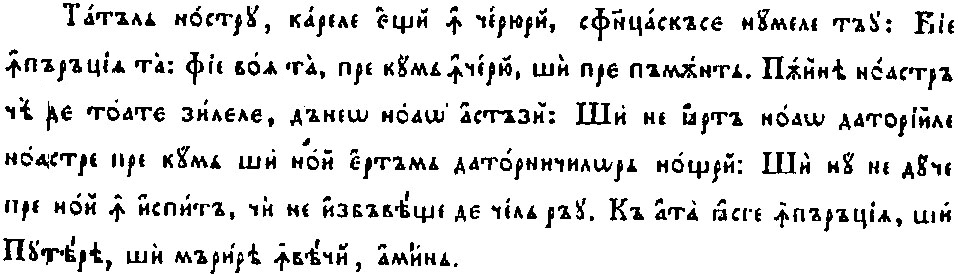
I don’t recall whether there are other uses of this word ‘Voivode’ in Dracula, but there are at least these two. In a note after the first use, Wolf tells us, simply: ‘A Romanian word for “prince”. Webster’s defines it as a military commander or governor of a town or province’ (p. 32, n. 18). The note is a bit misleading, however. It was indeed used in Romania for centuries to refer to the princes of Moldavia and Wallachia, but it was not a native ‘Romanian’ word, but rather a Slavic one. Many people do not realise that Slavonic was the literary and ecclesiastical language of the Romanian lands until the eighteenth century, and even then Romanian was often written in the Cyrillic alphabet (here, for example, is the Our Father in Romanian from a book printed in the 1850s).

So the word ‘voivode’ derives originally from the OCS words for ‘soldier’ and ‘leader’ and originally referred to a military commander or warlord. It gradually came to denote a leader whose duties were primarily civil, although in the Slavic languages it obviously retained its etymological connection to the military (the modern Russian word for ‘war’ is voina, for example). As a rabid Dracula fan, and a geeky kid fascinated with foreign languages, I knew about this connotation before my teen years. So imagine my fascination when I became Orthodox and, eventually, discovered the Church Slavonic translation of the Kontakion for today’s feast, the Annunciation (‘To thee the Champion Leader’):

Взбранной Воеводе победительная, яко избавльшеся от злых, благодарственная восписуем Ти рабы Твои, Богородице, но яко имущая державу непобедимую, от всяких нас бед свободи, да зовем Ти: Радуйся, Невесто Неневестная.

The words ‘Champion Leader’ (Ὑπερμάχῳ Στρατηγῷ in Greek) are here translated Vzbrannoi Voevode. The Theotokos is addressed with the title of (and, in the icon above, depicted as) a mediæval Slavic warlord! I for one thought this was really cool!

12 February 2009

Saints & Vampires


A few years ago, a new vampire novel came out that attracted a lot of attention. While I was a fan of Dracula growing up (I read the Victorian novel in the fifth grade), I have long been wary of subsequent vampire novels, for the simple reason that most of them are trash. But this one seemed a bit different. Incorporating a great deal of actual research into Eastern Europe and the historical Prince Vlad who bears an ill-defined relationship to Stoker’s monster, The Historian by Elizabeth Kostova (NY: Back Bay, 2006) was actually thought to have some literary merit. Suffice to say, though it is not flawless, I was scarcely disappointed with the book when, at last, I read it.

Anyway, a good deal more could be said about this book, but I wanted to focus on just one of the many interesting historical references Kostova makes. In Part II, Chapter 41, two of the protagonists discover a book in the library of the University of Budapest entitled, ‘Ballads of the Carpathians, 1790’ (Kostova, p. 338). Inside, they discover a number of woodcuts including one that shows a forest with some animals seemingly hidden within it, among which is a dragon, a domed church, and letters spelling the word ‘Ivireanu’ (Kostova, p. 352). While they ask another scholar in Budapest if he has any clue as to its meaning, this first fellow is clueless (Kostova, p. 354), and it is not until they meet a very interesting character in Bulgaria, Anton Stoichev, that they learn the significance of this word. Asked if he knows it, Stoichev replies:

‘Yes, yes, my son.’ Stoichev seemed to be looking through me without seeing. ‘It is the name of Antim Ivireanu, a scholar and printer at Snagov at the end of the seventeenth century—long after Vlad Ţepeş. I have read about Ivireanu’s work. He made a great name among the scholars of his time and he attracted many illustrious visitors to Snagov. He printed the holy gospels in Romanian and Arabic, and his press was the first one in Romania, in all probability. But—my God—perhaps it was not the first, if the dragon books are much older. There is a great deal I must show you!’. . . (Kostova, p. 493)


Now, while I didn’t immediately recognise ‘Ivireanu’, despite its obvious similarity to ‘Iveron’ and thus, ‘Iberia’, ‘Snagov’, on the other hand, is a name I have known at least since I was 11 years old. It is almost certain that I first learned of it in the book, In Search of Dracula: A True History of Dracula and Vampire Legends, by Raymond T. McNally and Radu Florescu (NY: Warner, 1974). On pp. 128-9 of that volume, the authors tells us:

Snagov is an island in one of the lakes surrounding Bucharest, and is located in the heart of the Vlasie forest. The island is about a mile in length, and a half mile in width. Today, a small brick chapel is all that remains of the ancient monastic complex. This chapel, one of three that originally belonged to the monastery, was rebuilt in 1517. It is here that tradition assigns Dracula’s grave. . . .

As in the case of Castle Dracula, one may safely pressume that the island monastery with its secure strategic position was originally built on an extensive scale, either by Dracula’s grandfather, Prince Mircea of Wallachia, or by one of the boyars at his court. From official documents we do know that mircea often resided at the monastery and that he endowed it with vast tracts of land from the surrounding villages. Relatively few official documents mention this monastery in Dracula’s reign, but in the 16th century a Wallachian prince, in an act of endowment, confirmed those estates bestowed upon the monastery by Dracula. In addition, we know that between 1436 and 1447 Dracula’s father endowed Snagov with more land than any other monastery of the realm, and that in 1464 Radu the Handsome endowed it with three additional villages: Vadul Parvului, Calugareni and Stroiesti. These along with gifts from other memberss of the family lead the conclusion that Snagov is par excellence a Dracula ecclesiastical establishment.

In Dracula’s time, Snagov undoubtedly was one of the three largest and most important monasteries in Wallachia.


Bishop Seraphim (Joantă), in his important study of Romanian monasticism, adds a little to McNally’s and Florescu’s account. He calls Snagov the ‘most ancient hermitage known in the Codrii Vlăsiei . . . , whose origins may go back before the 14th century’, and ‘an important spiritual and cultural center for the country’ (Romania: Its Hesychast Tradition and Culture [Wildwood, CA: St Xenia Skete, 1992], pp. 57, 58). Finally, Bishop Seraphim corroborates Kostova even further:

In the 17th and 18th centuries the monks of Snagov printed on their own presses numerous service books and books of religious teaching destined for Orthodox Romanians, Greeks, Arabs, and Georgians. At the turning point between these two centuries, Abbot Anthimus of Iberia (Georgia), the future Metropolitan of Wallachia, particularly distinguished himself by his publishing activities. (Bishop Seraphim, p. 58)


This piece of information about ‘Antim Ivireanu’ leads us to our fourth and final source of relevant information: Archimandrite Ioanichie (Bălan)’s Romanian Patericon: Saints of the Romanian Orthodox Church, Vol. I: Third to Eighteenth Centuries (Platina, CA: St Herman of Alaska Brotherhood, 1996). Here we learn that this man who plays an enigmatic, if not sinister rôle in Kostova’s novel, was a holy man, martyred for his faith by the Muslim Turks in 1716, glorified by the Romanian Orthodox Church in 1992, and commemorated (according to the Romanian Wikipedia article) on 27 September. I shall reproduce in full Fr Ioanichie’s brief Life of St Anthimus, as well as a short paragraph or two from the various teachings of the Saint that he gives.

The venerable Metropolitan Anthimus was born in Georgia. His parents, John and Maria, gave him the name of Andrew at his baptism. In his youth he was made a slave by the Turks, and he lived for many years in Constantinople, where he learned the Greek, Arabic, and Turkish languages, as well as the arts of sculpture, painting, and embroidery.

About 1690 Andrew was brought to the Romanian Land by Constantine Brîncoveanu. There he learned the art of printing from Bishop Metrophanes, and after a year he became a monk and was ordained a priest.

From 1691 to 1694 he directed the royal printing house in Bucharest and printed three books. Between the years 1694 and 1696 he founded a new printing house at Snagov Monastery, and from 1696 to 1701 he was abbot of that monastery. During that time he printed fourteen books, four of which were in Romanian, and the others in Greek, Slavonic, and Arabic.

Between 1701 and 1705 he again directed the printing house in Bucharest, where he printed fifteen books, most of them service books.

From 1705 to 1708 he was bishop at Rîmnicu Vîlcea, founding the first printing house there. During those three years he printed ten books, seven of which were in Romanian. From 1708 to1716 he was Metropolitan of the Romanian Land, where he founded new printing houses and produced another nineteen books, of which twelve were in Romanian.

In the autumn of 1716 Metropolitan Anthimus was imprisoned by order of the Turks, defrocked, and exiled to the Monastery of Saint Catherine on Mount Sinai. On the way there he was martyred by the soldiers and thrown into the Tungia River, near Adrianople (today’s Edirne in Turkey). It is now thought that he may have been drowned in Snagov Lake. (Fr Ioanichie, pp. 383-4)


There are nearly 14 pages in Fr Ioanichie’s book full of the teachings of this holy hierarch. I shall give two passages, the first being particularly appropriate as we prepare to begin the Lenten fast:

29. What profit is it for the body to be empty of food, but the soul full of sins? What profit is it to be pale and withered from fasting, but burning with envy and covetousness? What profit is it to abstain from wine, but to be drunk with the venom of anger? What profit is it to not eat meat, but to rend the flesh of our brethren by slander? What profit is it for us to cease from things which are sometimes allowed, but to do things that are never allowed? God loves and honors those who keep themselves from what is forbidden. (Fr Ioanichie, pp. 388-9)


Finally, the second passage is quite interesting in light of the desire for unnatural immortality that Dracula expresses to a 15th-c. abbot of Snagov on p. 675 of Kostova’s book, a desire he obviously achieves within the story:

70. Death is a great gift and merciful cure given to man by God, for this body of sin decays and another spiritual body, incorrupt and deathless is raised up at the general resurrection. Death brought great gain to man, says St Gregory the Theologian, for sin is cut off so that evil may not live forever. (Fr Ioanichie, p. 396)