Showing posts with label books. Show all posts

02 January 2020

Images of Childhood & the Christmas Mystery


This morning’s Epistle and Gospel readings (for 19 December, in the 29th week after Pentecost according to the Old Calendar) came from Hebrews 5:11-6:8 and Mark 10:11-16. Being wont to make connections between the two readings on any given day, I would note the following. The Hebrews passage contains the rebuke:


For when for the time ye ought to be teachers, ye have need that one teach you again which be the first principles of the oracles of God; and are become such as have need of milk, and not of strong meat. For every one that useth milk is unskillful in the word of righteousness: for he is a babe. (Heb. 5:12-13)


Mark 10 on the other hand contains the more positive reference to childhood in Our Lord’s insistence, ‘Verily I say unto you, Whosoever shall not receive the kingdom of God as a little child, he shall not enter therein’ (Mk. 10:15).

But it is still more interesting to note that the juxtaposition of these two references to childhood was repeated for me almost immediately after. My one piece of reading specific to the Nativity Fast is by an English Benedictine nun and translator of St. Augustine—Maria Boulding’s The Coming of God. In the course of a meditation on the implications of Our Lord’s childhood for our own ‘paschal rebirth’, Sr Maria cites in tandem a Gospel and Epistle passage which quite closely parallel those in the Eastern lectionary for today. She writes:


Echoing in our minds is the Lord’s warning, ‘Unless you change and become like little children, you shall not enter the kingdom of heaven’ (cf. Matt. 18.3), yet St Paul rebuked the Corinthians for childishness: ‘I could not address you as spiritual men, but as men of the flesh, as babes in Christ. I fed you with milk, not solid food; for you were not ready for it; and even yet you are not ready, for you are still of the flesh’ (I Cor. 3.1-3). (58)


For Sr Maria, this juxtaposition reveals the paradoxes involved in using the image of childhood to convey, not only the mystery of Christmas, but (already present within that mystery) an anticipatory ‘promise of our paschal rebirth in Christ’ (58). In His condescension, Our Lord too became a ‘babe’ who had need of milk rather than strong meat. But in being born as a little child, He invites us to participate in that self-emptying of becoming children once again so that we may enter the Kingdom of Heaven.

Maria Boulding, OSB. The Coming of God. London: SPCK, 1982.

02 July 2016

Discoveries Among Benedictine Books


In the last few weeks I’ve made a happy series of discoveries about connections between some of my books. I’ll begin with the series of histories of English monasticism and religious orders by Dom David Knowles, which my dear friend, the old Ochlophobist, sent to me a few weeks ago. I began slowly reading the first of these upon receipt—The Monastic Order in England: A History of Its Development from the Times of St Dunstan to the Fourth Lateran Council, 943-1216 (Cambridge: Cambridge U, 1950)—and there are still three more to go: The Religious Orders in England, Vols. 1-3.

A footnote at the bottom of the first page of The Monastic Order in England made an intriguing reference to a work I had been rather mildly interested in for some years: ‘For a general view of Benedictine history, polity and life Abbot [Cuthbert] Butler’s Benedictine Monachism (1919; 2 ed. 1927) stands in a class by itself.’ [1] Thus it was that during my solitary sojourn on the campus of the University of Oklahoma a few weeks ago, I was excited to discover a copy of the second edition of Abbot Butler’s work in the old stacks of the Bizzell Library. This copy was a later reprint featuring a foreword by Dom David Knowles, and it was this forward that determined me on acquiring the book for myself. Knowles writes of Benedictine Monachism: ‘It was accepted at once as being, what it still remains, the best historical and analytical survey of Benedictine life in the English language, or indeed in any language, even if we may go to others for a fuller historical account or for a more adequate definition of the monastic spiritual ideal.’ [2]

Having received a copy in the mail earlier this week, I have begun reading it for myself. It is in this way that I made two more fun discoveries.

First, I learned from the second footnote of chapter II that Abbot Butler is responsible for the article on monasticism (and, according to a footnote on p. 16, an article on ‘Basilian monks’ as well!) in the 11th edition of the Encyclopaedia Britannica (1911), which rests on the shelf just a few feet away from me. I have not yet read these articles, but I now intend to.

But second, at the bottom of the very same page where Butler references his own EB 11 article, he also writes:

If it be desired to control what is here set forth by reference to historians of monasticism who stand outside the movement and criticize it from an independent standpoint, no better books in English can be recommended than those of Hannay and Workman, mentioned in the List of Works. [3]

Upon turning to the List of Works, which immediately precedes the beginning of chapter I, I found this:

It will be of interest to name also two writers who view monasticism from outside with a critical though not unfriendly eye; they both write with wide and accurate knowledge of the literature, old and new, and with sympathetic understanding: James O. Hannay (clergyman of the Church of Ireland), The Spirit and Origin of Christian Monasticism (1903); Herbert B. Workman, Principal of the Westminster Training College (Wesleyan), The Evolution of the Monastic Ideal (1913). Both books are frequently referred to in these pages. [4]

Although I had never heard of Hannay’s work, I immediately realised that although I had not recognised his surname, Workman’s Evolution of the Monastic Ideal was familiar to me as a book I had purchased in paperback reprint several years ago for just a few dollars (and which, embarrassingly, I have also not yet read!).

But the final discovery really brought a smile. The forward to my reprint of The Evolution of the Monastic Ideal was written by none other than Dom David Knowles, OSB! [5]


[1] Dom David Knowles, The Monastic Order in England: A History of Its Development from the Times of St Dunstan to the Fourth Lateran Council, 943-1216 (Cambridge: Cambridge U, 1950), p. 3, n. 1.

[2] Dom David Knowles, Foreword, Benedictine Monachism: Studies in Benedictine Life & Rule, by Dom Cuthbert Butler (NY: Barnes & Noble, 1961), no page number.

[3] Dom Cuthbert Butler, Benedictine Monachism: Studies in Benedictine Life & Rule, by Dom Cuthbert Butler (NY: Barnes & Noble, 1961), p. 11.

[4] Ibid., no page number.

[5] Dom David Knowles, Foreword, The Evolution of the Monastic Ideal from the Earliest Times Down to the Coming of the Friars: A Second Chapter in the History of Christian Renunciation, by Herbert B. Workman (Boston: Beacon Press, 1962), 13 pages, unnumbered.

16 July 2015

Marginalia, No. 3


'If the heart of one friend is open to another, the truth glows between them, the good enfolds them, and each becomes a mainstay to his companion, a helpmate in his endeavor, and a potent factor in his attaining his wish. There is nothing surprising in this: souls ignite one another, minds fertilize one another, tongues exchange confidences; and the mysteries of this human being, a microcosm in this macrocosm, abound and spread.' [1]
 
That is the 10th-century Islamic philosopher Abu Sulayman al-Sijistani--who, like Socrates, 'wrote little or nothing himself' [2]--speaking to his disciples in the Muqabasat, or 'Borrowings', of Abu'l-Hayyan al-Tawhidi, quoted from an excerpt of Joel L. Kraemer's Humanism in the Renaissance of Islam found in Night & Horses & the Desert: An Anthology of Classical Arabic Literature, edited by Robert Irwin.
 
It's a powerful classical conception of friendship, on which of course there is a tradition of philosophy beginning with the ancient Greeks, particularly Aristotle, and running through Cicero, and finding beautiful Christian treatments in St John Cassian's Conferences and Aelred of Rievaulx's Spiritual Friendship. Since this is only a marginalium and not a proper post, I won't go to the trouble of walking downstairs and finding my new volume on Islamic philosophy to see if there are any comments on these figures in there. But I will note that Irwin writes: 'Tawhidi and his teachers and friends were interested in Greek philosophy and Sufism, and in reconciling Sufism with Neoplatonism.' [175] I suppose then that it is at least very likely that Abu Sulayman would have been familiar with Aristotle's thoughts on the subject of friendship, whatever else he may have read.
 
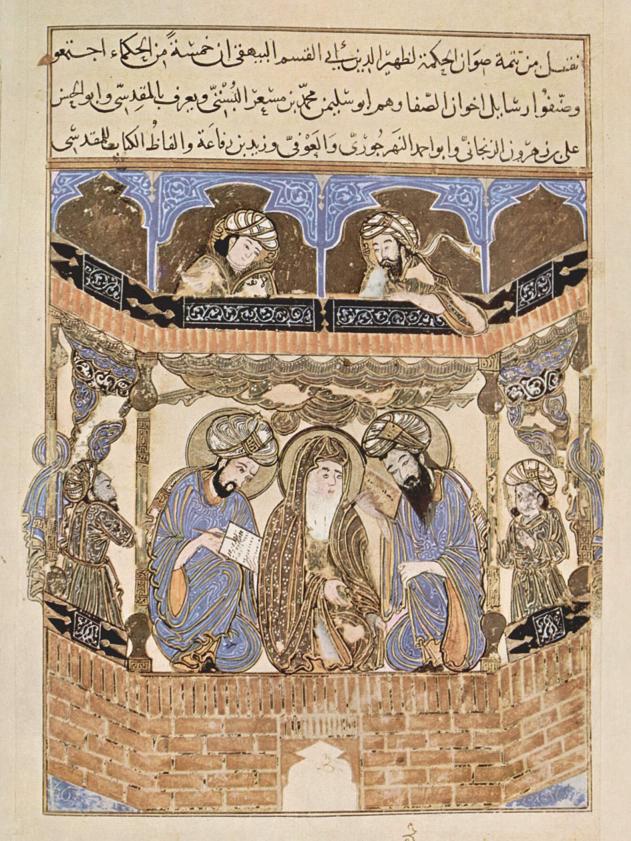
The image above is from a manuscript of the Rasa'il Ikhwan al-Safa dating from 1287 AD (Suleimaniye Library, Istanbul).
 
 
[1] Robert Irwin, ed., Night & Horses & the Desert: An Anthology of Classical Arabic Literature (NY: Anchor, 2001), p. 177.
 
[2] Ibid., p. 174.
 
[3] Ibid., p. 175.

10 July 2015

Marginalia, No. 2


Engagement in the church's practices puts us in a position where we may recognize and participate in the work of God's grace in the world.
 
[Practices] become arenas in which something is done to us, in us, and through us that we could not of ourselves do, that is beyond what we do.
 
The practices of Christian faith turn out in the end not primarily to be practices, efforts. They turn out to be places in the contours of our personal and communal lives where a habitation of the Spirit is able to occur. And it is this that is the source of their power and meaning. [1]

This is Craig Dykstra, in Growing in the Life of Faith: Education and Christian Practices, quoted by Glenn E. Sanders of Oklahoma Baptist University in 'How Christian Practices Help to Engage Students Morally and Spiritually: Testimony from a Western Civilization Course', his contribution to Teaching and Christian Practices: Reshaping Faith & Learning, edited by David I. Smith and James K.A. Smith.

It strikes me as a good, evangelical-friendly way to explain the effect of 'good works' that avoids the opprobrium that term acquires for those who are quick to smell 'works righteousness'. In fact, it also seems to apply well to the 'practice' of the Mysteries or Sacraments. This may be significant for evangelicals too, since I was baffled several years ago to hear one of them object to the idea that Baptism had any importance to salvation since it was a 'work' that we did rather than an act of God. In Dykstra's terms, the Mysteries may be something that we practice, but they are nevertheless 'done to us, in us, and through us', they are something 'we could not of ourselves do, that is beyond what we do'.


[1] Qtd. in Glenn E. Sanders, 'How Christian Practices Help to Engage Students Morally & Spiritually: Testimony from a Western Civilization Course', Teaching & Christian Practices: Reshaping Faith & Learning, ed. David I. Smith & James K.A. Smith (Grand Rapids, MI: Eerdmans, 2011), p. 161.

09 July 2015

Marginalia, No. 1


I had toyed some time ago with the idea of doing some shorter posts featuring quotations from my reading, with less commentary and original input than has always been typical at Logismoi. It would be something, in fact, rather like the 'Marginalia' I have long admired over at The New Psalmanazar. I have been less than satisfied with simply posting quotations on Facebook, and partly to make some fun use of my new computer, I have decided that now is the time to begin. I hope I won't be reproached for being entirely unoriginal and also referring to these posts as 'Marginalia'. I mean, the Bible says there's 'nothing new under the sun' anyway.
 
So, to kick things off:
 

Ibn al-Alkami  The last vizier of Baghdad, who owned one of the largest libraries of that city. The library, which contained 10,000 books, was destroyed during the sack of Baghdad by the Mongols in 1258, when every one of Baghdad's thirty-six libraries also perished. [1]
  
This is one of the entries in 'An Annotated Guide to the Historical and Literary References in The Name of the Rose' (which novel I am rereading so as to discuss it with students this Autumn), located in The Key to 'The Name of the Rose', Including Translations of All Non-English Passages by Adele J. Haft, Jane G. White, and Robert J. White. [2]
 
I am somewhat embarrassed to admit it, as I always have been about those things that most fire my imagination, but I've recently been quite taken by the 'Orientalist' bug. I won't go into the details (although I think it coincided with reading some of the stories of Borges), but it has given me a new interest in Arab references everywhere, including those in Eco's novel.
 
But obviously it didn't take Orientalism to get me to sit up and take notice of this. The destruction of thirty-six mediaeval libraries, including at least one holding 10,000 books, was enough to do it. It reminds me of an anecdote I read last year in Jaroslav Pelikan's The Idea of the University: A Reexamination:
 
When the armies of the German Empire invaded Belgium in August 1914, one of their first victims was the University of Louvain, established by a papal charter of 9 December 1425. The burning of the university library cost the world of scholarship three hundred thousand books and more than a thousand original manuscripts (including the university's charter from 1425), and it has ever since symbolized the triumph of the irrational over the rational. As one historian has told the story, 'In Brussels the Rector of the University, Monseigneur de Becker, whose rescue was arranged by the Americans, described the burning of the Library. Nothing was left of it; all was in ashes. When he came to the word "library"--bibliothèque--he could not say it. He stopped, tried again, uttered the first syllable, "La bib--" and unable to go on, bowed his head on the table and wept.' [15-6]
 
The image above shows scholars at an Abbasid library, and was made in Baghdad in 1237, twenty-two years before the destruction.
 
 
[1] Adele J. Haft, Jane G. White, & Robert J. White, The Key to 'The Name of the Rose', Including Translations of All Non-English Passages (Ann Arbor: U of Michigan, 1999), p. 67.
 
[2] Unfortunately, I'm not sure where the reference to Ibn al-Alkami is in Eco's text.
 
[3] Jaroslav Pelikan, The Idea of the University: A Reexamination (New Haven, CT: Yale, 1992), pp. 15-6.

29 May 2015

My Journey to Borges


I think I can confidently say that I first encountered Borges through William Poundstone’s delightful book, Labyrinths of Reason: Paradox, Puzzles & the Frailty of Knowledge. Knowing of my youthful interest in math and the logic puzzles of Lewis Caroll, my dad introduced me to Labyrinths of Reason when I was probably 12 or 13. Although for some reason I never followed it up until years later, I never forgot Poundstone’s description of Borges’s ‘Tlön, Uqbar, Orbis Tertius’: 

The best paradoxes raise questions about what kinds of contradictions can occur--what species of impossibilities are possible. Argentine writer Jorge Luis Borges (1899-1986), whose work appeals to all lovers of paradox, explored many such questions in his short stories. In ‘Tlön, Uqbar, Orbis Tertius’, he describes an encyclopedia, supposedly from another world, created as an elaborate hoax by a group of scholars. Borges’s scholars can even imagine the paradoxes of their fictitious world; so alien is the thinking of ‘Tlön’ that their paradoxes are commonplaces to us. [1] 

Poundstone goes on to quote the Tlönian paradox of the ‘nine copper coins’. I will not reproduce it here, but of course the whole story is worth reading. Poundstone comes back to it in Chapter 10, ‘Meaning: Twin Earth’, where he discusses the mysterious Voynich Manuscript. There he observes: 

The Voynich manuscript is reminiscent of (and conceivably inspired) Borges’s short story ‘Tlön, Uqbar, Orbis Tertius’. In the story an eccentric millionaire financed a conspiracy of scholars to write an encyclopedia of the imaginary world ‘Tlön’. The first drafts were in English, but the plan was to translate the encyclopedia into Tlön’s (equally imaginary) language and calligraphy, creating a wholly inscrutable work. [2]  
There are other references to Borges in Poundstone--the essay ‘The Analytical Language of John Wilkins’ on pp. 44-5; another essay, ‘Avatars of the Tortoise’, on p. 135; the story ‘The Garden of Forking Paths’ on pp. 160-1; and, with Adolfo Bioy Casares, Extraordinary Tales on pp. 258-9. But I am less certain I actually read these parts as a youth. 

My next encounter with Borges was my freshman year of college. I had my first bookstore job at a tiny little used shop run by a late friend of mine, Bob Cowden, and while I can’t pin it down, at some point during my stint at that shop I read and fell in love with Umberto Eco’s magnificent The Name of the Rose. Of course, nothing about the reference to Borges in Poundstone, even as well as I remembered it, came to me when reading of the blind librarian, Jorge da Burgos, zealous to prevent anyone from reading Aristotle’s lost work on comedy. But when I reached Eco’s ‘Postscript’, printed at the back of the trade paperback translation I read, I found this (spoiler alert): 

The constructed world will then tell us how the story must proceed. Everyone asks me why my Jorge, with his name, suggests Borges, and why Borges is so wicked. But I cannot say. I wanted a blind man who guarded a library (it seemed a good narrative idea to me), and library plus blind man can only equal Borges, also because debts must be paid. And, further, it was through Spanish commentaries and illumination that the Apocalypse influenced the entire Middle Ages. But when I put Jorge in the library I did not yet know he was the murderer. He acted on his own, so to speak. [3] 

I suppose it is possible that it had only been five years since I’d first learned of this Borges from Poundstone, but when I found him in Eco I definitely knew him already as the Argentine author of ‘Tlön’, about an encyclopedia. 

Maybe this was why I found him memorable. I had been a lover of encyclopedias since I could first read. Maybe even longer. I had grown up with 1940s or 50s editions of the World Book Encyclopedias--which I used to pore over exhaustively, following the suggestions for additional articles on a given topic--at the homes of both sets of grandparents. My own parents had a Funk & Wagnalls, which, incidentally, was the first source I consulted to learn about the Orthodox Church (that edition had a fine article by the late Fr John Meyendorff). One of my most treasured possessions now is an eleventh edition Encyclopaedia Britannica--an encyclopedia that Jaroslav Pelikan once called ‘easy...to romanticize’. [4] I can’t help but think that this connection of Borges, not just with libraries, but with an ‘imaginary encyclopedia’, is part of what caused him to stick in my mind. 

I nearly forget to mention that within 6 or 7 years of reading Eco, in Thessaloniki, I became very dear friends with a Greek-Italian-American graduate of St John’s College Santa Fe named Philip Navarro (you’ll find him credited in one way or another in a number of English-language Orthodox publications). Sadly, I have found that dear Philip is a difficult person to stay in touch with, but the years that we spent either in the same city or at least talking frequently on the phone were sufficient for the fellow to acquire his own real estate in my mind. Anyway, this is relevant because Philip was a huge fan of Borges, and made reference to him every once in a while. I sheepishly admitted that I had not actually read him, but I knew that the day must come eventually. 

Nevertheless, it could only have been within about the last 10 years that I finally got round to purchasing something of Borges’s--a Book-of-the-Month Club edition of Labyrinths: Selected Stories & Other Writings. And it was probably a few more years after the purchase that I finally read my first actual Borges story, ‘Deutsches Requiem’ (a powerful piece vividly depicting the psychology of an educated Nazi prison camp guard--read it while listening to Brahms’s Ein Deutsches Requiem and try not to weep). It was a few years more before I read any further into Labyrinths. 

In the end it was the brief little pieces, not quite fiction, not quite essays, that Borges calls ‘parables’ that really drew me in. As an example, I shall post perhaps the briefest one in Labyrinths, ‘Parable of Cervantes & the Quixote’: 

Tired of his Spanish land, an old soldier of the king sought solace in the vast geographies of Ariosto, in that valley of the moon where the time wasted by dreams is contained and in the golden idol of Mohammed stolen by Montalbán.
In gentle mockery of himself, he imagined a credulous man who, perturbed by his reading of marvels, decided to seek prowess and enchantment in prosaic places called El Toboso or Montiel.
Vanquished by reality, by Spain, Don Quixote died in his native village in the year 1614. He was survived but a short time by Miguel de Cervantes.
For both of them, for the dreamer and the dreamed one, the whole scheme of the work consisted in the opposition of two worlds: the unreal world of the books of chivalry, the ordinary everyday world of the seventeenth century.
They did not suspect that the years would finally smooth away that discord, they did not suspect that La Mancha and Montiel and the knight’s lean figure would be, for posterity, no less poetic than the episodes of Sinbad or the vast geographies of Ariosto.
For in the beginning of literature is the myth, and in the end as well. [5] 

Obviously, this is quite simple. It is the briefest observation about Cervantes. It might perhaps even have been stated by someone else in a much less interesting way--in Cervantes’s day, his own time and place were not terribly romantic, whereas 400 years later they are practically the stuff of legend. But in Borges’s hands, it becomes something that awakens the imagination, enchanting the world itself and the books that tell us of it. 

Just a few weeks ago I finally purchased Borges’s Collected Fictions--as I understand it, his complete fiction--and I’ve begun working on it. I did finally read ‘Tlön’ as well as another one, which I think Philip must have told me about, called ‘Pierre Menard, Author of the Quixote’. I’ve read nearly all of the short pieces originally published in the 1960 volume, The Maker. I just completed Borges’s homage to H.P. Lovecraft, ‘There Are More Things’. I’ve read a wonderful essay of Borges on Dante, ‘The Divine Comedy’, [6] as well as two lectures by Eco on Borges: ‘Between La Mancha & Babel’ and ‘Borges & My Anxiety of Influence’, both in On Literature. [7] 

I realise all of this is kind of superficial, and not likely to be of much interest to anyone who doesn’t know me. I plan to do a second Borges post wherein I will explore a couple of short pieces in a little more depth. 


[1] William Poundstone, Labyrinths of Reason: Paradox, Puzzles & the Frailty of Knowledge (NY: Anchor, 1988), p. 19. 

[2] Ibid., p. 195. 

[3] Umberto Eco, The Name of the Rose, Including the Author’s Postscript, tr. William Weaver (San Diego: Harcourt, 1994), p. 515. 

[4] Jaroslav Pelikan, The Vindication of Tradition (New Haven, CT: Yale, 1984), p. 4. 

[5] Jorge Luis Borges, Labyrinths: Selected Stories & Other Writings, ed. Donald A. Yates & James E. Irby (NY: Book-of-the-Month Club, 1996), p. 242. 

[6] Jorge Luis Borges, ‘The Divine Comedy’, tr. Eliot Weinberger, The Poet’s Dante: Twentieth-Century Responses, ed. Peter S. Hawkins & Rachel Jacoff (NY: Farrar, Straus & Giroux, 2001), pp. 118-35. 

[7] Umberto Eco, On Literature, tr. Martin McLaughlin (Orlando, FL: Harcourt, 2004), pp. 104-17, 118-35.