Showing posts with label Martyrs. Show all posts

16 July 2012

'He Put No Difference Between Us'—Ss Peter & Paul in Radner & St Maximus


Last Thursday, 29 June on the Church’s calendar, we celebrated the memory of the Holy Apostles Peter and Paul. I had thought about doing an old-school Logismoi post for the Apostles, but unfortunately things were much too busy for the full treatment and I let it pass. A perusal of a borrowed book the other day, however, convinced me that I should at least do a post connecting back to their feastday, even if it wasn’t one of my traditional Saints’ posts. 

I have more than once, I am sure, mentioned my enthusiasm for John O’Keefe’s and R.R. Reno’s Sanctified Vision: An Introduction to Early Christian Interpretation of the Bible. Well, my tremendous esteem for the merits of the authors’ arguments and conclusions led me to reread with careful attention the preface to the volume, wherein they acknowledge the various influences and intellectual debts that contributed to the book. One passage that caught my attention was this: ‘The work of Ephrem Radner defies epitome, but the fabric of his many publications is woven with figural patterns of biblical interpretation. He is a rare contemporary practitioner of an ancient art.’ [1] 

I don’t quite remember how it happened, but somehow or another I shortly afterward discovered the Brazos Theological Commentary on the Bible, edited by Reno, which ‘advances upon the assumption that the Nicene tradition, in all its diversity and controversy, provides the proper basis for the interpretation of the Bible as Christian Scripture’, and could be seen in some ways as a commentary attempting to carry out what O’Keefe and Reno present in Sanctified Vision. [2] I recalled having seen the series at our local evangelical megastore (which I was distressed to find no longer carries it, although the Christian romance section has certainly expanded), but I had never carefully examined it to discover its approach. Fortunately, my boss, the headmaster of our school, has what I take to be the entire series to date in his office, and I was surprised and excited to discover that the volume on Leviticus—surely a unique text for demonstrating the rich exegetical possibilities of the ‘Nicene tradition’—was written by that ‘rare contemporary practitioner of an ancient art’, Ephraim Radner. 

I realise I’m taking the long route to get back to Ss Peter and Paul. What does Ephraim Radner’s commentary on Leviticus have to do with the two chiefs of the Apostles? It so happens that interpreting Leviticus as Christian Scripture provides a direct connection: St Peter’s vision in Acts 10:9-16, which presupposes the distinction between clean and unclean animals in Leviticus 11: 

For I am the Lord who brought you up [ἀναγαγὼν ὑμᾶς] out of the land of Egypt to be your God; and ye shall be holy, for I the Lord am holy. This is the law concerning beasts and birds and every living creature [πάσης ψυχῆς] moving in the water, and every living creature creeping on the earth; to distinguish between the unclean and the clean [διαστεῖλαι ἀνὰ μέσον τῶν ἀκαθάρτων καὶ ἀνὰ μέσον τῶν καθαρῶν]; and between those that bring forth alive, such as should be eaten, and those that bring forth alive, such as should not be eaten. (Lev. 11:45-7, LXX) 

Compare then, the vision of the Apostle Peter in Acts: 

On the morrow, as they went on their journey, and drew nigh unto the city, Peter went upon the housetop to pray about the sixth hour: and he became very hungry, and would have eaten: but while they made ready, he fell into a trance, and saw heaven opened, and a certain vessel descending unto him, as it had been a great sheet knit at the four corners, and let down to the earth: where in were all manner of four-footed beasts of the earth, and wild beasts, and creeping things, and fowls of the air. And there came a voice to him, ‘Rise, Peter; kill, and eat.’ But Peter said, ‘Not so, Lord; for I have never eaten any thing that is common or unclean.’ And the voice spake unto him again the second time, ‘What God hath cleansed that call not thou common.’ This was done thrice: and the vessel was received up again into heaven. (Authorised Version) 

Clearly, St Peter is professing his fidelity to the distinction outlined in Leviticus 11. Just as clearly, the same God who gave to the Israelites the category of ‘unclean’ in Leviticus, is telling St Peter that He Himself has ‘cleansed’ all things. The exhortation to ‘be holy’ is not negated, however, and indeed, St Peter himself quotes it in I Peter 1:16, but it is no longer tied to the observance of dietary laws. 

In his commentary on this chapter of Leviticus, Radner draws on the mediaeval Benedictine writer, Rupert of Deutz (c. 1075-1129), whom Jean Leclercq notes as an exemplar of the use of ‘Old Testament texts...for expressing the loftiest realities of the New Testament,’ in whom ‘we sense the shadow of the whole archaic Eastern [patristic] background’. [3] I shall quote Radner at length: 

For Rupert of Deutz (Patrologia latina 167.796-801), the pentecostal focus in Lev. 10 [he connects the fire that devours the sons of the Prophet Aaron in Lev. 10:2 with the tongues of fire of Pentecost] explicates the framework of Lev. 11 in terms of the mission to the Gentiles entrusted the church by God. That is, the outline of distinction that Aaron (and Moses) provide the people—in terms of animal life, food, and even the touching of carcasses—properly embraces the distinctions of the peoples and their place within the providential calling of God. From the perspective of the New Testament, this coordination of elements is almost natural. It is, after all, Peter himself, in the course of his calling by God to turn to the Gentiles with the church’s first deliberate Christian evangelistic effort in their direction, who is presented with a threefold divine vision treating specifically the question of clean and unclean foods (Acts 10:9-16)....Rather than seeing Peter’s vision as a simple nullification of the Levitical laws of distinction, Rupert of Deutz understands these laws as the reflection of this single providential goal, by which the whole of the world will be brought into right relationship with God, gathered into the heavenly sheet. The vision sets in motion Peter’s visit to the Gentile centurion Cornelius in Caesarea, who is baptized despite his fundamental nonadherence to the breadth of the Levitical laws. Hence the Levitical laws pertain to—they advance toward and present—this goal of Gentile baptism, both in terms of reference and object; they do not contradict it. [4] 

Thus, the taking up of the animals without distinction into the four-cornered sheet is a symbolic revelation of the taking up of the peoples of the earth without distinction into the Church, where ‘There is neither Jew nor Greek, there is neither bond nor free, there is neither male nor female: for ye are all one in Christ Jesus’ (Galations 3:28). In the words of St Irenaeus of Lyons, ‘For the God who had distinguished through the law the pure food from the impure, that same God had cleansed the nations through the blood of his Son, and that is the God whom Cornelius worshiped.’ [5] 

I have not been reading Radner’s commentary through, and so it was a look at the index for Greek Fathers, particularly for St Maximus the Confessor, that led me to the chapter on Leviticus 11. Unfortunately, the great 7th-c. Father is only cited once by Radner—when the latter writes: 

The allegorical reading—both Jewish and Christian—by which the sacrificial animals of Leviticus refer to those beastly, irrational, or wild (Maximus the Confessor [in Palmer, Sherrard, and Ware 1979-95: 2.273]) aspects of the self that require subjugation is in fact congruent with and perhaps even founded upon the presuppositions of this reality of distinction and offering. [6] 

A look at the text from the Philokalia which Radner cites is interesting. It is a Maximian anthology known as ‘Various Texts on Theology, the Divine Economy, & Virtue & Vice’. The part in question is numbered as the ‘Fifth Century’ of such texts in the English Philokalia, whereas it is the ‘Seventh Century’ in the Greek. The greater part of this century, including all of the chapters I will excerpt below, is taken from the treatise To Thalassios: On Various Questions relating to Holy Scripture. It is there that St Maximus dwells at length on what he calls ‘the spiritual contemplation [ἡ πνευματικὴ θεωρία] of...the written law’. [7] The simple statement—in chapter 50—of the allegorical reading of the animals as passions to which Radner is referring is believed to be the work of a 10th-c. scholiast. [8] St Maximus’s own comments in chapter 51, which the scholiast is presumably explaining, takes for granted the ‘passion’ reading: 

By spiritual sacrifices is meant not only the putting to death of the passions, slaughtered by ‘the sword of the Spirit, which is the word of God’ (Eph. 6:17), and the deliberate emptying out of all life in the flesh, as if it were blood; the term also signifies the offering up of the moral state we have gained through the practice of the virtues, together with all our natural powers, which we dedicate and offer [προσαγωγὴν ἀφιερουμένων] to God as whole burnt sacrifices, to be consumed by the fire of grace in the Spirit, so that they are filled with divine power. [9] 

The ‘fire of grace in the Spirit’, an obvious allusion to Pentecost, is only the second tie into Rupert’s connection of Leviticus with Pentecost. In chapter 49, the Confessor writes: 

The mystery of Pentecost is the direct union with providence of those things that are in its care. It is the union of nature with its principle, the Logos, under the guidance of providence; and in this union there is not the slightest trace of time or generation. Again, the Logos is our trumpet (cf. Lev. 23:24), summoning us with divine and hidden knowledge. He is our propitiation (cf. Lev. 25:9), since He expiates our offences in His own person by becoming like us, and divinizes our sinful nature by the gift of grace through the Spirit. He is our booth or tabernacle (cf. Lev. 23:42), since He is the realization of that immutability with which our inner being, conformed to God, is concentrated on the divine, and also the securing bond of our transformation into an immortal state. [10] 

Indeed, it is a shame that Radner does not make more use of St Maximus in his commentary. The Confessor comments specifically on St Peter’s vision itself in Questions & Doubts 116, where he responds to the question of what is signified by the sheet and the beasts that were on it: 

Since, according to the vision by the prophet Ezekiel, ‘their work was like a wheel within a wheel’, and through these a perceptible as well as an intelligible world are depicted as existing within one another—for the intelligible world is in the perceptible world by types, and the perceptible world is in the intelligible world by its logos—therefore, all of the perceptible world was shown to the Apostle. For the letting down by its four corners’ signifies the world composed of four elements, existing as clean in the intelligible world according to the logos that exists inherently in these things. And he heard, ‘rise up, kill, and eat,’ that is, ‘by (your) nous raise yourself up from that which is according sense, and “kill and eat”, which means by the distinction of reason divides sense perception, [11] and taking up these things spiritually make them your own.’ 

Or, it also signifies the church that is supported by the four foundations of the gospels or, again, by the four cardinal virtues. And the beasts and reptiles depict the different human customs which, from the Gentiles, are going to (change over to) the faith in Christ. And the ‘kill and eat’ shows ‘first, by the word of teaching, “kill” the evil in them and then “eat”, making their salvation your own just as the Lord also made it food for himself.’ [12] 

Of course, this post has been mostly taken up with St Peter, and for reasons of length I do not intend to devote equal space here to St Paul. But I will point out that St Peter’s experience of the vision, and his subsequent baptism of Cornelius, ‘Knowing that a man is not justified by the works of the law, but by the faith of Jesus Christ’ (Gal. 2:16), connect him directly with the great Apostle of the Gentiles. ‘And’, in the words of Didymus the Blind, ‘through the figure shown by the linen cloth and through the granting of the grace of the Holy Spirit in like manner to the nations according to faith [cf. Acts 10:44-8], he [St Peter] made the case that in Christ there is no distinction between Jew and Gentile.’ [13] 

St Paul of course makes himself a compliment to St Peter, ‘For He that wrought effectually in Peter to the apostleship of the circumcision, the same was mighty in me toward the Gentiles’ (Gal. 2:8). But the baptism of Cornelius makes clear that the division in their duties is not a strict one, and St Peter at the Council of Jerusalem says to the apostles and elders: 

‘Men and brethren, ye know how that a good while ago God made choice among us, that the Gentiles by my mouth should hear the word of the Gospel, and believe. And God, which knoweth the hearts, bare them witness, giving them the Holy Ghost, even as He did unto us; and put no difference between us and them [διέκρινε μεταξὺ ἡμῶν τε καὶ αὐτῶν], purifying their hearts by faith.’ (Acts 15:7-9) 

Once again, we see here that the erasure of difference between Jew and Gentile is signified by the erasure of difference between clean and unclean animals (the words of Acts 15:9 and Lev. 11:47 are not the same, but the phrases nevertheless echo one another). But if the separation of Jew and Gentile is abolished within the Church, how much more so that between these two holy Apostles? St Paul tells us ‘when Peter was come to Antioch, I withstood him to the face’ (Gal. 2:11), but in the words of St John Chrysostom, ‘there was here a deep though hidden understanding between Paul and Peter’: 

Paul does not now say this to condemn Peter, but in the same spirit as when he said those who are ‘reputed to be something’ [in other words, St Paul does not in 2:9 deny that St Peter really is a ‘pillar’], he now says this too....And so Paul rebukes and Peter voluntarily gives way. It is like the master who when upbraided keeps silent, so that his disciples might more easily change their ways. [14] 

Thus, the witness of the Church to the spiritual unity of these two Apostles, testified to by their co-commemoration and the liturgical texts which praise them as ‘separated in body, united in the Spirit’, [15] is also expressed in the exegetical consensus of the Fathers. 


 [1] John J. O’Keefe & R.R. Reno, Sanctified Vision: An Introduction to Early Christian Interpretation of the Bible (Baltimore: Johns Hopkins, 2005), p. x. 

[2] R.R. Reno, ‘Series Preface’, Leviticus, by Ephraim Radner, Brazos Theological Commentary on the Bible (Grand Rapids, MI: Brazos-Baker, 2008), p. 11. 

[3] Jean Leclercq, OSB, The Love of Learning & the Desire for God: A Study in Monastic Culture, tr. Catharine Misrahi (NY: Fordham, 1961), pp. 102-16. 

[4] Radner, p. 107. 

[5] Francis Martin, ed., with Evan Smith, Acts, NT Vol. V in Ancient Christian Commentary on Scripture (Downers Grove, IL: IVP, 2006), p. 128. 

[6] Ibid., p. 110. 

[7] The Philokalia: The Complete Text, Vol. 2, tr. G.E.H. Palmer, et al. (London: Faber, 1990), p. 267. 

[8] See ibid., p. 395. 

[9] Ibid., p. 273. 

[10] Ibid., pp. 272-3. 

[11] I’m not sure I understand the grammar of Prassas’s translation at this point. 

[12] St Maximus the Confessor, Questions & Doubts, tr. Despina D. Prassas (DeKalb, IL: Northern Illinois U, 2010), p. 103. 

[13] Martin, p. 125. 

[14] Mark J. Edwards, ed., Galatians, Ephesians, Philippians, NT Vol. VIII in Ancient Christian Commentary on Scripture (Downers Grove, IL: IVP, 1999), p. 26. 

[15] First sticheron at Lord I have cried, Tone 2, by St Andrew of Crete, from Great Vespers for the Feast; from the translation of Archimandrite Ephrem (Lash), here.

17 July 2010

Review of a St Elisabeth Biography


Today, 5 July on the Church’s calendar, we celebrate the memory of the New Martyr Elisabeth of Russia. In honour of St Elisabeth, patron of my daughter as well as my mother (and likely, many, many other convert women as well!), I thought I would post a little review—written years ago in a reader’s journal I used to keep—of a secular biography of the New Martyr: Hugo Mager’s Elizabeth: Grand Duchess of Russia (NY: Carroll & Graf, 1999). I have made one or two minor editorial changes, and added page references where I could still find them.

The first problem I have is the author’s utter ignorance of Orthodoxy. After repeated remarks about the ‘rottenness’ of the relics of St Seraphim of ‘Sarovo’ [sic], Mager concludes that this ‘should have barred him from sainthood’; [1] but a brief look into the glorification of saints in the Orthodox Church would have shown that incorrupt remains are not required by any means. He claims that all startsy (which he translates imprecisely as ‘holy men’) are ‘semiliterate, eternal wanderer[s]’; some of them ‘fastened chains to their legs as a sign of asceticism’, or ‘claimed to possess powers of healing’. [2] He gives a dramatic description of some schema-monks without apparently realising what they are. He consistently uses imprecise, western language to describe Orthodox things: ‘High Mass’, ‘Te Deum’, ‘Monsignor’. He repeatedly refers to the Roman Catholic ‘saint’ Elisabeth of Hungary, an ancestor of the New Martyr, as ‘St Elizabeth’ without noting that she was not Orthodox (a legitimate ‘bar to sainthood’ in the Orthodox Church). [3] He mentions ‘the monastery at Mount Athos’, apparently unaware that there are twenty. [4]

More importantly, the ignorance of Orthodoxy in particular seems to be aligned to a deeper ignorance of and lack of interest in what it means to be a believer, period. The spiritual life seems to him to consist mostly of consolations, feelings and sentiments, except where it’s expressed in charitable works—which, to his credit, he covers admirably. But the account of St Elisabeth’s life in the Ss Martha and Mary Convent is given short schrift in favour of a sensationalistic and historically questionable account of the fall of the autocracy. Even clothes, jewelry, and balls are given more attention than spiritual things.

But even from a secular perspective the book leaves something to be desired. First of all, there are quite a few typographical and grammatical mistakes (he spells podvignodvig’!). Then, there’s the historiography. Although it doesn’t give any credentials, the jacket refers to the author as ‘historian Hugo Mager’, and indeed, the appendix (‘Documentary Evidence of the Last Journey & Death of Grand Duchess Elizabeth & the Removal of Her Remains to Beijing’) shows him to be pretty good at doing historical scholarship when he wants to be. [5] But the rest of the book makes matter of fact assertions about the nature and motivations of various people’s thoughts, feelings, and actions about which—having read other accounts—I sometimes felt rather dubious. At the very least, how can Mager claim to know some of the things he does? He does not provide extensive reasoning or documentation behind much of it, probably because he intended the book as a popular biography and not a work of scholarly historiography. But some of the more extraordinary claims (like the allegation of Grand Duke Sergei Nikolaievich’s homosexuality, or perhaps more importantly, the ‘cool’ sexual relations which provide the basis for the allegation) could have done with a good deal more well-documented evidence (although sexuality might have been left entirely unmentioned in any case). In numerous cases, it is clear to someone a little bit acquainted with the subject that much of what is presented is founded on more or less unreliable testimony, including, in at least one or two places, that of witnesses whom Mager himself has discredited. Furthermore, serious scholars of the Revolution would disagree with the central rôle he assigns to Rasputin in the story. The latter certainly didn’t help matters, but didn’t Vladimir Lenin have at least something to do with it, not to mention well nigh irresistable historical forces?

Another problem is the author’s obvious biases: for Britain and liberal politics, against Pobedonostsev, Grand Duke Sergei Nikolaievich, the Russian peasants, the Tsaritsa-Martyr Alexandra, and certainly Rasputin (who, despite the testimony of multiple witnesses, is made to seem closer to the Tsaritsa-Martyr than anyone else she knows). One friend of the Tsaritsa-Martyr’s who was an admirer of Rasputin is consistently referred to as ‘plain and unintelligent’, and even ‘fat’, whenever she figures into the narrative. [6] The author’s opinions on politics are constantly interjected. Whenever someone becomes drunk, it is said to be in ‘typical Russian fashion’. He always describes the Tsar-Martyr—in typical biographer fashion—as ‘weak’ and ‘indecisive’.

But most annoying, I think, is Mager’s apparent determination to play up a dramatic contrast between the New Martyr Elisabeth and her sister, the Tsaritsa-Martyr Alexandra. St Elisabeth is presented as the warm, saintly, reasonable sister who does everything she can to save Russia, St Alexandra as the cold, self-centered, hysterical sister who does everything she can to ruin it. The author seems quite satisfied—often basing himself on the testimony of witnesses he himself elsewhere calls unreliable—to pronounce their relationship as being at distressing odds and ending in complete coldness.

There are good things to be said about the book. The author certainly reveres St Elisabeth. He also appears to respect Christianity, monarchy and, to some extent, Ss Nicholas and Alexandra. Passages like the note contrasting the ‘repression’ of Tsar Alexander III’s reign with that of communism—concluding, ‘Compared with its Soviet successor, Alexander III’s empire was a remarkably free country’—are really nice. [7] But Mager’s politics, his preoccupation with Grand Duke Sergei’s sexuality (about which he himself acknowledges that there is ‘no firm evidence’), [8] his ignorance of Orthodoxy and superficial notions of spirituality, and his exaggerrated antinomy between the two saintly sisters are all very annoying, and detract greatly from an interesting story. More importantly, Mager clearly lacks the experience and insight to do any kind of justice to the spiritual life of a great Saint. His Victorian psychologising is a poor substitute, not compensated for, in the end, by his attention to detail in presenting an in-depth story.

Those who want to read about St Elisabeth should stick with the Life by Lubov Millar, Grand Duchess Elizabeth of Russia: New Martyr of the Communist Yoke (Richfield Springs, NY: Nikodemos, 1991), only venturing toward Mager’s book for superficial and extraneous details about things like the Hessian grand duchy or Queen Victoria. Those interested in St Alexandra should never open Mager’s book, but stick with A Gathered Radiance: The Life of Alexandra Romanov, Russia’s Last Empress (Chico, CA: Valaam Society of America, 1992), by Mother Nectaria (McLees).

Addendum: Mary Mansur has just informed me that Nikodemos has recently published a new, expanded edition of Millar's biography of St Elisabeth, featuring all new materials. It can be ordered for $26.95 + $4 s&h. Just send a check to Nikodemos Orthodox Publication Society, PO Box 383, Richfield Springs, NY 13439-0383.


[1] Hugo Mager, Elizabeth: Grand Duchess of Russia (NY: Carroll & Graf, 1999), p. 200.

[2] Ibid., p. 226. True startsy, or ‘elders’, of course, may well be educated, are rarely wanderers, would never display an external ‘sign of asceticism’, and would never claim to ‘possess powers of healing’.

[3] Ibid., pp. 19-20, 240.

[4] Ibid., p. 227.

[5] Ibid., pp. 343-9.

[6] Ibid., pp. 235, 255, 277.

[7] Ibid., p. 80. The final paragraph of this lengthy note deserves to be quoted in full:


However, these enormous powers [of the tsarist political police] were used with remarkable leniency. During Alexander [III]’s repressive reign only four thousand persons, out of a population of nearly a hundred million, were detained or interrogated in connection with political offenses; only forty-four, all assassins or potential assassins, were executed for political crimes. The right to travel abroad and property rights, even those of expatriate revolutionaries, were scrupulously respected. The vast majority of criminals were tried fairly, by jury. Censorship was little more than a nuisance: between 1867 and 1894 only 158 books, not including Marx’s Capital, were forbidden to circulate in Russia. Compared with its Soviet successor, Alexander III’s empire was a remarkably free country.

[8] Ibid., p. 74.

28 May 2010

'Come Ye, Christian People of Norway!'—St Hallvard of Husaby


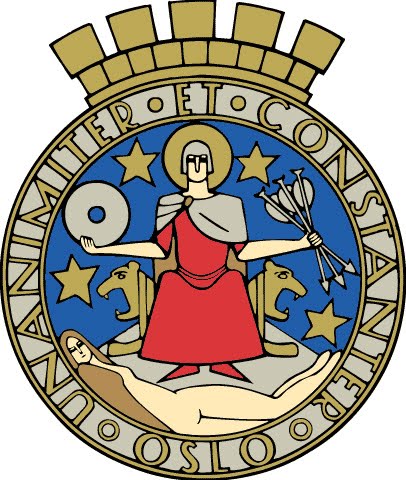
Today, 15 May on the Church’s calendar, we celebrate the memory of the Holy Passion-bearer Hallvard Vebjørnsson of Husaby (1020-1043), Defender of Oslo. [1] St Hallvard is the patron Saint of Oslo (and indeed, is depicted on the seal of the city, as one can see below), as well as of my sponsor when I was first received into the Orthodox Church fourteen years ago. As with many martyred Saints, very little is known about St Hallvard apart from the story of his death. Here is the entry for him in the Oxford Dictionary of Saints:

Hallvard (d. 1043), martyr and patron of Oslo. The son of a noble landholder of Husaby (Norway), he spent his youth in Viking activities.

One day, crossing the Drammenfiord by boat, he was accosted by a woman who appealed to him to take her with him, as she was falsely accused of stealing and was in danger of death. Her pursuers then arrived and called on him peremptorily to give her up. He refused as he believed her to be innocent; whereupon they were both shot dead with a bow. Hallvard’s body was thrown in the sea with a stone attached, but it floated: he was revered as a martyr for defending an innocent person. His body was enshrined in a stone church in Oslo, whose patron he became and still remains. [2]

I will add only that according to the Wikipedia article (here), St Hallvard was the son of one Vebjørn of Husaby and his wife Torny, a relative of St Olaf of Norway.

Although I still have not read the acclaimed novel Kristin Lavransdatter by Sigrid Undset, I noticed that volume 2 of my edition is entitled The Mistress of Husaby. Three hundred years after the time of St Hallvard, Kristin’s husband is a knight of Husaby, and the volume opens with their return there. We read:

They had come up into Skaun, and were riding high on a hillside. Below them in the valley bottom the woods stood white and shaggy with rime; everywhere the sunlight glittered, and a small lake in the midst flashed blue. Then all at once the troop passed out from a little pinewood, and Erlend pointed ahead:

‘There lies Husaby, Kristin. God grant you many happy days there, my own wife!’ he said, with a thrill in his voice.

Before them stretched broad plough-lands, white with rime. The manor stood, as it were, on a broad shelf midway on the hillside—nearest them lay a small church of light-coloured stone, and just south of it were the clustered houses; they were many and great; the smoke whirled up from their smoke-vents. Bells began ringing from the church, and many folk came streaming from the courtyard to meet them, with shouts of greeting. The young men in the bridal trains clashed their weapons one on another—and with a great clattering and the thunder of hoofs and joyous uproar the troop swept forward towards the new-married man’s abode. [3]

Reader Isaac Lambertson has written a beautiful Akolouthia for St Hallvard, available online here at the Orthodox England site. In conclusion, I offer the Idiomelon in Tone 2 and the Kontakion in Tone 8 of the Passion-bearer:

Idiomelon in Tone 2

Come, all ye Orthodox peoples! Come ye, Christian people of Norway! Come, ye citizens of Oslo! Let us extol Hallvard the wondrous youth. who, nurtured from infancy on the precepts of Christ, and reared in piety and reverence, bravely sheltered the defenseless woman, whose life and that of her unborn babe were sought by savage malefactors; for he was mindful of the words of Jesus, that no-one hath greater love, than that he lay down his life for his fellow man. Wherefore, let us imitate Hallvard as he imitated his Lord, that we also may be vouchsafed a place in paradise with Him.

Kontakion in Tone 8

Like a merchant man seeking fine pearls, the young Hallvard plied the seas of life; and having freighted the ship of his soul with compassion and all the Christian virtues, he found a most precious treasure on the waters of Dremmenfjord, and sold all he had, purchasing it with the very blood of his life, for he bravely shielded the defenceless woman for the sake of Christ his God. Wherefore, marvelling at his innocence and valour, let us cry aloud: Wondrous is God Who is glorious in His saints!


[1] Today, of course, is also the feastday of the more well-known St Pachomius the Great, and I put a great deal of work into a post for him (here) last year.

[2] David Hugh Farmer, The Oxford Dictionary of Saints, 5th ed. (Oxford: Oxford U, 2004), p. 242.

[3] Sigrid Undset, Kristin Lavrandatter, Vol. II: The Mistress of Husaby, tr. Charles Archer (NY: Knopf, 1946), p. 277.


06 May 2010

'Most Honoured Cultivator of Piety'—St George the Trophybearer


Today, 23 April on the Church’s calendar, we celebrate the memory of the Great Martyr and Victorious Wonderworker, George the Trophybearer (†303). [1] Here is the account of his life in the Great Horologion:

George, this truly great and glorious Martyr of Christ, was born of a father from Cappadocia a nd a mother from Palestine. Being a military tribune, or chiliarch (that is, a commander of a thousand troops), he was illustrious in battle and highly honoured for his courage. When he learned that the Emperor Diocletain was preparing a persecution of the Christians, Saint George presented himself publicly before the Emperor and denounced him. When threats and promises could not move him from his steadfast confession, he was put to unheard-of tortures, which he endured with great bravery, overcoming them by his faith and love towards Christ. By the wondrous signs that tookplace in his contest, he guided many to the knowledge of the truth, including Queen Alexandra, wife of Diocletian, and was finally beheaded in 296 in Nicomedia.

His sacred remains were taken by his servant from Nicomedia to Palestine, to a town called Lydda, the homeland of his mother, and then were finally transferred to the church which was raised up in his name. (The translation of the Saint’s holy relics to the church in Lydda is commemorated on November 3; Saint Alexandra the Queen, on April 21.)

Through the centuries Saint George has shown himself to be a swift and present helper to all who call on him with faith, whether on land or sea, to the uttermost ends of the earth; yet so many miracles have been worked at his tomb in Lydda (the present-day Lod0, that when Palestine was in the hands of the Moslems, they took half of his church and turned it into a mosque, which may still be seen to this day, dedicated in his honour and testifying to the abundant power of his intercession. [2]

I posted extensively on St George last year, as can be seen if one clicks on the ‘St George’ label in the sidebar. At any rate, I will certainly not be able to devote so much attention to him this year, if only because I’ve already used most of my material. I have, however, come across two interesting books in the meantime, both of which examine the history of the cult of St George from a fairly secular, English perspective. Both also include extensive discussions of the story of St George’s slaying of the dragon (on which I have posted here and here). By far the shorter and simpler of the two, Giles Morgan’s St George: Knight, Martyr, Patron Saint & Dragonslayer is a helpful overview and an attractive little volume, but it lacks notes and illustrations. St George: Hero, Martyr & Myth by mediaeval and art historian Samantha Riches has better notes, copious illustrations, and is in general a fuller account. It is also a handsome, coffeetable-sized book. One of the many interesting things I’ve learned from these books is the foundation in 1871 by John Ruskin of the ‘Guild of St George’. Riches writes:

Perhaps the most interesting of the associations that have taken St George as their tutelary saint is the Guild of St George, founded by the aesthete, writer and political thinker John Ruskin in 1871 with the principal aim of furthering and assisting agricultural society in England. One of the first goals of the organisation was to purchase land for agriculture ‘which shall not be built upon but cultivated by Englishmen with their own hands’; another was to persuade member of the upper classes of English society that agriculture was an honourable occupation ‘consistent with high thoughts and noble pleasures’. The list of objectives of the Guild includes not only the acquisition and cultivation of land, and the building of farms and houses for agricultural labourers alongside the repair of buildings in impoverished rural areas, but also the offer of financial grants and the erection of educational establishments. Besides the teaching of agricultural skills, there was also an intention to create museums of art and natural history ‘for the cultivation of taste and intelligence among rural labourers and craftsmen’ . . . . The Ruskin Museum at Meersbrook Park in Sheffield formed a lasting monument to the ambition to edify, but at the outset this aspect of the Guild’s work was secondary: ‘there were to be the schools of St George, the Museums of St George, and always first and foundationally the land of St George’. The creed of beliefs of the companions, or members, of the Guild, included the following:

‘I will not kill or hurt any living creature needlessly, nor destroy any beautiful thing, but will strive to save and comfort all gentle life, and guard and perfect all natural beauty upon the earth.’ [3]

The sentiments expressed in this credo sum up a combination of interests—nature, art and chivalry—which were clearly important to Ruskin himself. It is likely that St George appealed to him as a figure of chivalry, although the choice of patron of the new organisation will almost certainly have been influenced by the saint’s links with agriculture, and perhaps also metalworking. Ruskin is known to have had a long-standing personal interest in the concept of chivalry. . . . He claimed that a specific painting of St George and the dragon (from a cycle of the dragon legend by Vittore Carpaccio, c. 1505-7, at the Scuola di San Giorgio degli Schiavoni, Venice) represented a perfection of chivalry, reading into the image a moral lesson in the use of physical power for noble purposes. . . . In Fors Clavigera, the series of open letters which he wrote to the working classes of the British nation between 1871 and 1884, Ruskin made it clear that he considered St George to be the essence of a Christian gentleman. The letters dealt directly with the problems of capitalism: he planned that the Guild of St George should evolve into a utopian rural society where the land would be worked for the greater good, where English people could flourish far from the corrupting influence of city life. . . . [4]

Apart from my own posts, however, I would also refer the reader to the excellent posts produced by John Sanidopoulos around the time of the New Calendar feastday a couple of weeks ago. In one post (here), John has a number of videos featuring Greek folk songs about the Great Martyr, while in another (here) he reposts a collection of ancient references to the Saint, including the following inscription from the lintel of a St George church—formerly a pagan temple—dating to 515 at ‘Zorava in the late Roman province of Arabia’:

The abode of daimones has become the house of God. The light of salvation shines where darkness caused concealment. Where sacrifices to idols occurred, now there are choirs of angels. Where God was provoked, now He is propitiated. A certain Christ-loving man, the town-councillor John, son of Diomedes, offered a gift to God from his own property, a beautiful building, after installing within it the worthy body of the martyr George, who appeared to this John not in a dream, but manifestly. [5]

John also links (here) to Budge’s translation of ‘The Passion of St George’ by the blessed Abba Theodotus, 4th- & 5th-c. Bishop of Ancyra in Galatia (in full here). A note in the manuscript which introduces the Passion calls the Saint ‘the martyr of Diospolis of Palestine, the sun of the truth, the star of the morning, the mighty man of the Galileans from Melitene and the valiant soldier of Christ’. The Passion itself concludes with Abba Theodotus’s appraisal:

Behold now, O beloved brethren, we have told you these things of the great honours which God has vouchsafed to the valiant soldier of strength, the mighty athlete, Saint George, whose festival is celebrated this day throughout all earth and heaven, and of the remainder of his glory and of the mighty and exalted honour he holds in the heavenly Jerusalem, the city of Christ the King. And now O beloved, blessed of God, since we know of a truth that Saint George has drawn nigh to God in this manner and has obtained freedom to enter into the presence of the Holy Trinity at all times and to show favour to every one, let us make ourselves champions, through love, of our poor brethren and strangers; let us love one another, let us keep innocence, and it shall come to pass to all of us, O beloved, that Saint George will, through our Lord Jesus Christ, show favour to us, and have compassion upon us, and forgive us our sins, and bless the gathering together of our people, small and great, old men and young men, and widows and virgins.

I shall conclude with the Kontakion of the Saint, taken from the Great Horologion:

Kontakion. Fourth Tone
Thou Who wast raised up

Having been cultivated well by the Lord God, * as the most honoured cultivator of piety * thou has now gathered sheaves of virtues for thyself; * for, as thou didst sow with tears, * thou dost reap with rejoicing; * with thy blood didst thou contest * and thou now hast received Christ. * And by thine intercessions, O Saint George, * thou grantest all the forgiveness of trespasses. [6]

Addendum: I was just surprised to learn that there is a Guild of St George, inspired by Ruskin, that is still in existence. According to their website:

Today the Guild is a charitable Education Trust, which tries to put Ruskin's ideas into practice. Its purpose has never been to pursue specifically Ruskinian or antiquarian projects. It aims to work in the spirit of Ruskin's Company, but to pursue those values in contemporary ways. It works through a number of properties. It has an educational art collection, built up by Ruskin and supplemented since, in the Millennium Gallery, Sheffield. It owns some farmland and woodland in the Wyre Forest, near Bewdley, Worcestershire, which it manages in an environmentally friendly manner. It owns a number of houses in the Arts and Crafts style in the Hertfordshire village of Westmill; these are let at affordable rents and maintained as buildings of quality.
It also provides scholarships and awards across a variety of subjects close to Ruskin's heart. It recently funded the very successful national Campaign for Drawing, and it provided the finance for a nine-year cycle of Triennial Exhibitions in the Millennium Gallery, which have Ruskin at the heart of them but extend his concerns into the present century. It has also begun organising a series of open symposia on issues of current importance. These are designed to question the political truisms of our day, much as Ruskin questioned those of his. The Guild is also, at present, supporting work in the regeneration of old orchards and hay meadows in the Wyre Forest area, and it helped to build an architecturally striking study centre on its land, The Ruskin Studio.


[1] I take this date from David Hugh Farmer, The Oxford Dictionary of Saints, 5th ed. (Oxford: Oxford U, 2004), p. 213.

[2] The Great Horologion, tr. Holy Transfiguration Monastery (Boston: HTM, 1997), pp. 465-6.

[3] One can read the full ‘creed’ in John D. Rosenberg, ed., The Genius of John Ruskin: Selections from His Writings (Boston: Routledge & Kegan Paul, 1980), pp. 415-6.

[4] Samantha Riches, St George: Hero, Martyr & Myth (Thrupp, UK: Sutton, 2000), pp. 199-200. Giles Morgan mentions it briefly in St George: Knight, Martyr, Patron Saint & Dragonslayer (Edison, NJ: Chartwell, 2006), pp. 111-2.

[5] The source is given as F. Trombley, Hellenic Religion & Christianization c.370-529 II (Leiden, 1995), p. 363.

[6] Horologion, p. 466.

18 April 2010

'We Long for Your Church'—Saints of Thessaloniki


Today, the Third Sunday of Pascha, besides the well-known commemoration of the Myrrh-Bearing Women, the great city of Thessaloniki also commemorates the Synaxis of her many Saints. Among these, she counts first of all the holy Apostle Paul, who exhorted the Thessalonians to ‘stand fast, and hold the traditions which ye have been taught, whether by word, or our epistle’ (II Thess. 2:15). But immediately after St Paul comes Thessaloniki’s Great Martyr, St Demetrius the Myrrh-gusher, whose relics continue to pour forth miracles even to this day. Perhaps next in fame are the great Apostles to the Slavs, Ss Cyril and Methodius, to whom all Slavs are eternally indebted for bringing them the Gospel in their own language. Finally, we must not neglect to note the great Archbishop, St Gregory Palamas, who so courageously defended the Faith against the heresies of Barlaam and Akindynos. But these five are only the most renowned of a multitude of cœlestial luminaries standing before the throne of God in intercession for Thessaloniki. As Sophia Ahtaridis writes:

Thus, this city justifies the boast of the Apostle Paul when he wrote in his Second Epistle to the Thessalonians: ‘We are bound to thank God always for you, brethren, as it is meet, because that your faith groweth exceedingly, and the charity of every one of you all toward each other aboundeth; so that we ourselves boast of you in the churches of God for your patience and faith in all the persecutions and tribulations that ye endure’ (1:3-4). [1]

In his fascinating book on Ss Cyril and Methodius, Professor Emeritus Anthony-Emil N. Tachiaos of the Aristotle University of Thessaloniki writes:

Apart from bathing in the fount of Greek education at the houses of their teachers, Drungarius Leo’s remarkable children also acquired further knowledge from their life in the ‘Thessalonians’ great and noteworthy city, protected by God’, where they gradually became acquainted with the burning issues of the Empire. Thessalonica was a school in itself—the Empire’s second city after Constantinople, with the marks of each historical epoch deeply etched upon its face. Thessalonica was Byzantium’s gateway to the West, the Empire’s eye, which was firmly fixed upon the ‘Western regions’—that is, the vast expanse of its dominions extending from the Macedonian capital to Sirmium and Dalmatia, or in other words the whole of Illyricum. Thessalonica stood upon the road which linked ancient Rome with the new Rome, Constantinople, and indeed, until 732 the city came under the ecclesiastical jurisdiction of Rome itself. Within its walls profound deposits and traditions had been laid down and survived at successive notional levels. Beginning at the time of the illustrious Macedonian Kings, and continuing on through the Hellenistic and Roman eras, they passed on to subsequent generations Greek and Latin memories and wisdom, which were all fused together by a common catalyst, the Greek Christian tradition. Their enduring symbols, the city’s magnificent monuments bore living witness to these traditions. All this, together with the contemporary historical events that were being acted out in the broader environs of the city, formed another kind of school for Constantine [St Cyril] and Methodius. [2]

As a resident of this God-protected city for two years, this commemoration of her Saints has special meaning for me. It was one of my great pleasures to walk up and down the streets of Thessaloniki, stopping at her many churches, old and new, [3] to venerate the relics of her Saints—St Demetrius, St Gregory Palamas, St Theodora, St David, St Basil the Confessor, and others—and to encounter there the pious clergy, monastics, and simple faithful, many of them perhaps modern Saints in their own right. Profoundly moved by these experiences, I wrote the following poem (dated 15 February 2002), which stands as my humble attempt at a tribute to the heavenly beauties of this city:

Salonika

Encircled by ancient walls,
On the slope of a hill by the sea you lie,
Your dazzling churches and ruined mosques
Sleeping in a garden of our vain edifices.
You’ve stood firm, lady,
Since the days of Philip and Alexander,
Since your Apostle’s letters,
Since your emperor’s palace,
Through invasions of Avars and Bulgars
And your fall to the Turk,
Since the welcoming of Abraham’s children
And the horrors of your occupation.
And even now the ghosts of your Roman splendour
Haunt your little old streets,
Hallowed by centuries of faith,
And the uncreated light of a spiritual aristocracy
Gleams in the eyes of your merchants,
And you live still
Under your martyred Patron’s spear
And your holy Archbishop’s prayers.

In conclusion, here are two troparia from an Old Church Slavonic canon for St Demetrius believed to have been written by St Methodius, Equal-to-the-Apostles. As Thomas Butler notes, ‘The poet is evidently a native of Thessaloniki. He is homesick for his city, as he recalls its annual celebration of Demetrius’s feast day, October 26.’ [4]

Hear now your poor supplicants, O glorious one, and heed our prayers, as we have become separated far from your radiant shrine, and our hearts burn within us as we long for your church, holy one—to worship there again some day through your prayers.

Why, O wise one, should we—your miserable slaves—alone be deprived of your beauty, travelling through foreign lands and towns for the love of the Creator, blessed one, warriors for the humiliation of the cruel trilinguals and heretics? [5]

(The painting of Byzantine Thessaloniki is the work of Thanasis Bakogiorgos, who to my knowledge still runs his beautiful shop, Porphyra, near the Plateia Navarino. Incidentally, on the right side of the centre wall, just opposite the large domed church of St George’s Rotunda, is where the modern Aristotle University of Thessaloniki is.)


[1] Sophia Ahtaridis, Foreword, Byzantine Monuments of Thessaloniki, by Constantine Cavarnos (Belmont, MA: Institute for Byzantine & Modern Greek Studies, 1995), p. x.

[2] Anthony-Emil N. Tachiaos, Cyril & Methodius of Thessalonica: The Acculturation of the Slavs (Crestwood, NY: SVS, 2001), p. 6.

[3] Constantine Cavarnos notes, ‘Thessaloniki, the second city of Greece from the point of view of size and importance as an administrative and cultural center, is the most glorious one from the standpoint of Byzantine monuments. It boasts of more than a dozen beautiful, awe-inspiring Byzantine churches’ (Cavarnos, p. 19).

[4] Thomas Butler, Monumenta Bulgarica: A Bilingual Anthology of Bulgarian Texts from the 9th to the 19th Centuries (Ann Arbor, MI: Michigan Slavic, 2004), p. 31.

[5] Ibid., p. 41.

14 April 2010

'Stages of a Discovery'—Guéranger & Me, Part 2


Continued from this post.

So I took home these precious photocopied pages with no small amount of excitement. I can’t remember now when I first sat down and read them, but I am certain that it was soon upon returning to the city.

Unfortunately, I was disappointed. I have mentioned this disappointment and quoted extensively from Guéranger’s chapter on St Dionysius in last year’s post on the Areopagite (here). It is indeed a beautiful chapter which, though more eloquent, is similar in structure to my own hagiographical posts here at Logismoi. But there is no argument for the identity of the various Ss Dionysius, only assertion. After a brief introduction about how St Dionysius fits into the Western liturgical year, Guéranger has a long series of quotations from the Corpus Dionysiacum:

De cœlesti hierarchia. i, iv, viii.

De ecclesiastica hierarchia. i.

De cœlest. hier. iii.

De eccl. hier. i.

De cœlesti hier. iii, vii, x.

De eccl. hier. i-vii.

De divinis Nominibus, i-xiii.

De mystica Theologia, i-v.

De divinis Nominibus, i, iv, viii, xiii.

De myst. Theol. i.

Guéranger then interrupts the Saint’s voice to ask:

Could we presume to add anything? As we have already remarked (on the Decollation of St John the Baptist), the Church herself, at this season which prepares the world for the last coming of the Spouse, moderates her voice. Especially ought we to imitate her to-day, when the divinely inspired Areopagite, oppressed with the weight of his own powerlessness, cirest out: ‘Our language is the more redundant in proportion as it is less pertinent to God. . . .’ [1]

He then resumes with De myst. Theol. iii. Immediately after comes the identification of the ‘Dionysii’:

Meanwhile, Rome will tell us how the revealer of the heavenly hierarchies, coming from Athens to the West, watered with his generous blood the seed he sowed in the future capital of France. Enriched with his sacred body, the humble borough now known as Saint-Denys long surpassed in renown its neighbour Lutetia (Paris). France repaid her Apostle’s devotedness by the glory wherewith she surrounded him; it would seem as if, by a chivalrous inspiration, she had undertaken to compensate him for having abandoned his native country for her sake. Immense was the concourse of people to his holy tomb; and still greater was the piety of the kings. The martyr’s banner, the oriflamme, was their standard, Mountjoy St Denys their battle-cry, in every clime whither victory led them. As, in life, they never quitted the kingdom without entrusting it to the protector of France in his Abbey; so at death, they bequeathed to him their mortal remains. In spite of sacrilegious profanations, what a sublime spectacle will the holy necropolis present to the world on the last day, when, before the eyes of Adrian and his prefects, he whom they executed at Montmartre and condemned to infamy, will rise from his tomb escorted by three dynasties of monarchs proud to form, at the resurrection, the court of him whom they deemed it an honour to surround in death. ‘Thy friends, O God, are made exceedingly honourable’ (Ps. cxxxviii. 17.)! [2]

Guéranger then gives the Roman Martyrology of St Dionysius in Latin and in translation (rendered in English in this edition), followed by an encomium, of which I have quoted a great part in the post on the Areopagite. There is a paragraph on the indebtedness of Gaul to the Holy Father, and then the following, in which, unfortunately, Guéranger—an outspoken supporter of papal infallibility—beseeches the Saint to subject us Orthodox to the pope:

O Dionysius, quicken again the divine seed thou didst sow. Restore to Paris and to France their traditions, now forgotten in the fever of gain and pleasure. Bring back Athens to the communion of Christ’s Vicar, the indispensable condition of union with our Lord. For every church under heaven obtain such pastors as thou didst describe in the following lines which reveal thyself: . . . [3]

And he ends with De eccl. hier. i. I was impressed with Guéranger’s writing and his veneration for the Saint (though annoyed with his papalism), and ready to believe the identity of the Parisian Martyr with the Areopagite and author of Dionysian Corpus, but did not find the reasoned defense of this that I was hoping for. Recalling Coulombe’s reference to ‘the martyred Archbishop [Georges] Darboy’, I also tracked down the latter’s translation of St Dionysius and copied the introduction. But this is in French—of which I understand very little—and I do not believe it has been translated. I can confirm that the subject is at least addressed by Darboy, for the introduction contains an ‘Article’ entitled ‘Où l’on discute l’authenticité des livres attribués à saint Denys l’Aréopagite’. [4] The nature of Darboy’s arguments, however, I cannot follow.

So that is nearly all. I have used those parts of Liturgical Year that I have found on Google Books as well as on the various particular days of the Fish Eaters ‘Seasonal Customs’ page (here). I would love to buy the edition of it which Owen White has mentioned in the comments here, though even the more affordable edition ‘Elijahmaria’ mentions there is well out of my budget except at my birthday and Christmas. I learned at some point that Guéranger was responsible for the revival of the Benedictine Order in France, the renewal of Solesmes Abbey, the revival of Gregorian chant, and the founding of the Solesmes Congregation (which now has a priory right here in Oklahoma at Clear Creek that I was able to drop by one afternoon). But that is the full story of Guéranger and me.


[1] Dom Prosper Guéranger, The Liturgical Year: Time After Pentecost, Vol. V, tr. Benedictines of Stanbrook (Worcester: Stanbrook Abbey, 1903), p. 380.

[2] Ibid., pp. 380-1.

[3] Ibid., p. 384.

[4] Georges Darboy, Introduction, Œuvres de Saint Denys l’Aréopagite, tr. Georges Darboy (Paris: Sagnier et Bray, 1845), p. iv.

09 March 2010

Hesychastic Hermeneutics at Work


Although we may sometimes be tempted to think of hesychasm as merely a ‘school of mysticism’ somehow unconnected with other aspects of ecclesiastical life, it is interesting to note that the practice of hesychastic prayer naturally gives rise to a hermeneutic. The guarding of thoughts, the descent of the mind into the heart, and the standing before God there in supplication inevitably inform the Fathers’ reading of the Scriptures.

A particularly striking example—used to astonishing effect by my friend, Hieromonk Alexis (Trader) of Karakallou Monastery on Mt Athos, in his response to Pentecostalism [1]—is St Nicetas Stethatos’s interpretation of I Corinthians 14 in the 89th of his chapters on ‘spiritual knowledge’: ‘By merely praying and psalmodizing inwardly with your tongue—that is, by praying in the soul—you edify yourself, but your intellect is unproductive (cf. I Cor 14:14), for you do not prophesy with the language of sacred teaching or edify God’s Church.’ [2] In this case, it is interesting to note that the hesychastic approach to the Scripture has the advantage of not reading into the text such glosses as ‘unknown’ with ‘tongue’, or the—as far as I know—sole use of ακούει to mean ‘understands’ in the entire New Testament. [3]

I discovered another, admittedly less striking, example yesterday. The last verse of the 5th Ode from the Psalter [4] reads, ‘Go, my people; enter thine inner chamber, shut thy door, hide thyself for a little while, until the wrath of the Lord shall pass away’ (Isaiah 26:20). [5] Now, I have long read this naturally as a reference to the hesychastic practice of descending with the mind into the heart, but without recalling a specific patristic use of it as such. Yesterday, however, was the day I finally decided to go looking for one. While the English Philokalia translations unfortunately lack a Scriptural index, the Greek edition from Astir does not. A simple search for Is. 26:20 yielded two results. I will first quote the less significant one. In his work, ‘To the Nun Xenia’, St Gregory Palamas aludes to this verse: ‘Instead of in the desert, you should abide in your cell and hide yourself a little until the tempest of passion has passed over you. When it has passed, spending time outside your cell will do you no harm.’ [6] Although there is here no reference to practice of interior withdrawal, the substitution of ‘the tempest of passion’ for ‘the wrath of the Lord’ does suggest generally a more interiorised, hesychastic understanding of the passage.

But we actually find an already full-blown hesychastic exegesis of this verse from Isaiah in a writer believed to be much earlier than St Gregory. St John of Carpathos, in his ‘Texts for the Monks of India’, writes:

91. So as not to be deceived and carried away by the vain and empty things that the senses bring before us, we should listen to the words of the prophet Isaiah: ‘Come, my people, enter into your inner room’—the shrine of your heart, which is closed to every conception derived from the sensible world, that image-free dwelling-place illumined by dispassion and the overshadowing of God’s grace; ‘shut your door’—to all things visible; ‘hide yourself for a brief moment’—the whole of man’s life is but a moment; ‘until the Lord’s anger be passed by’ (Isa. 26:20. LXX); or, as the Psalms put it, ‘until inquity has passed’ (Ps. 57:1). This anger of the Lord and this iniquity may be caused by demons, passions and sins; as Isaiah says to God, ‘Behold, Thou art angry, for we have sinned’ (Isa. 64:5). A man escapes this anger by keeping his attention fixed continually within his heart during prayer, and by striving to remain within his inner sanctuary. As it is written, ‘Drawn wisdom into your innermost self’ (Job 28:18. LXX); ‘all the glory of the king’s daughter is within’ (Ps. 45:13. LXX). Let us, then, continue to struggle until we enter the holy place of God, ‘the mountain of Thine inheritance, the dwelling, O Lord, which Thou hast made ready, the sanctuary which Thy hands have prepared’ (Exod. 15:17). [7]

It is interesting to note that while we may initially be inclined to think of the more ‘mystical’, interiorised, and allegorical interpretation as being the more appropriate one for monastics, of these two it is actually St Gregory Palamas’s interpretation of the ‘inner chamber’ as the monastic cell which applies the verse in a way more limited to the monastic life. St John, by interiorising the sense of the ‘inner chamber’ within the heart, actually extends the possibility of fulfilling this injunction to all Christians, who are able to descend into and pray within the heart in any circumstances. If we are in doubt about this, let us consider the words of the New Martyr Bishop German (Ryashentsev), written to his spiritual daughter, Vera, from internal exile in the far north of Russia in June of 1925:

Naturally each Christian must persuade himself of the logic of the position which his faith has placed him in: there are fewer churches, so be one yourself. Also become a temple of God. Entry to many shrines has become difficult, so become a shrine and a living icon yourself. [8]

If this hesychastic transformation of the heart into ‘a temple of God’ can be accomplished amid the worst persecution the Church has ever seen, surely it can be accomplished amid the freedom of the West. And let’s not forget that this freedom may not last, and that we too may find ourselves within our lifetimes with ‘fewer churches’, forced and not merely called to become churches ourselves.


[1] Hieromonk Alexis (Trader), In Peace Let Us Pray to the Lord: An Orthodox Interpretation of the Gifts of the Spirit (Regina, 2001).

[2] The Philokalia, Vol. 4, tr. G.E.H. Palmer, et al. (London: Faber, 1998), p. 169.

[3] I may be wrong about this, but unless I’m overlooking something, there are no other renderings of ακούω as ‘understand’ in the Authorised Version at least (see George V. Wigram & Ralph D. Winter, The Word Study Concordance (Pasadena, CA: William Carey Library, 1978), p. 191).

[4] I quote the HTM Psalter—The Psalter According to the Seventy, tr. Holy Transfiguration Monastery (Boston: HTM,1997)—rather than David James’s wonderful Russian Orthodox Psalter (Rye, NH: 2009), since for some reason Russian Psalters do not appear to include this verse. Cf. HTM, p. 276, and Ψαλτήριον (Thessaloniki: To Perivoli tes Panagias, 2004), p. 252, with James, p. 265, and the Optina Slavonic Psalter—Ψалтирь (Optina Pustyn Monastery, 1997), p. 273.

[5] HTM, p. 276.

[6] Philokalia 4, p. 311.

[7] The Philokalia, Vol. 1, tr. G.E.H. Palmer, et al. (London: Faber, 1983), pp. 319-20.

[8] Tatiana Goricheva, ed., Cry of the Spirit: Witnesses to Faith in the Soviet Union, tr. Susan Cupitt (NY: Crossroad, 1989), p. 105.

03 March 2010

'An Illustrious Image of the Virtues'—St Philothei of Athens


Today, 19th of February on the Church’s calendar, we celebrate the memory of St Philothei of Athens (1522-1589), ‘the protectress of Athens and of its imperiled citizens, especially of oppressed women and virgins.’ [1] Last year I wrote a rather lavish post for St Philothei, my sister’s patron Saint, and I do not have much new material this year. But here is what I have, and I also refer readers to the previous post (here).

First, the account of St Philothei’s life from The Great Horologion:

Saint Philothei was born in Athens in 1522 to an illustrious family. Against her will, she was married to a man who proved to be most cruel. When he died three years later, the Saint took up the monastic life and established a convent, in which she became a true mother to her disciples. Many women enslaved and abused by the Moslem Turks also ran to her for refuge. Because of this, the Turkish rulers became enraged and came to her convent, dragged her by force out of the church, and beat her cruelly. After a few days, she reposed, giving thanks to God for all things. This came to pass in the year 1589. She was renowned for her almsgiving, and with Saints Hierotheus and Dionysius the Areopagite is considered a patron of the city of Athens. [2]

In last year’s post I referred extensively to the Life of St Philothei compiled by Holy Apostles Convent, which includes a translation of a very early Life of the Saint—apparently written somewhere from 1598 to 1602 [3]—as well as the following excerpt from the ‘Introduction’ to the Life & Service of the Saint published by the Archdiocese of Athens. Speaking of the charitable works of St Philothei, N.B. Tomadakis of the University of Athens writes:

Certainly, philanthropy was one of her main motives. At a time when there were no hospitals, no shelters for the poor, no homes for the elderly, and asylums for the protection of women, their place was taken by monastic institutions. In addition to her dedication to a virtuous life, practicing philathropy by offering protection, giving alms and ministering to the poor and sick, providing Christian training by teaching everyone ecclesiastical letter and liturgical knowledge, the holy woman contributed the following.

First, she founded schools for the children of the Athenians, to open their eyes to the tradition and renown of their ancestors. ‘Lay hold of instruction, lest at any time the Lord be angry’ (Ps. 2:12). Philothei brought this scriptural quote to reality. Within her flickered the hope of the rebirth of the Byzantine Empire and . . . the early deliverance from the bestial yoke of the conquerors.

Second, Philothei aimed at protecting the daughters of Athens from the disgrace of conversion to Islam. . . . The danger of being subjected to conversion existed not only for the noble daughters who were forcibly abducted by the Turks because of their beauty and grace, but also for the simple ones, the peasant girls, who were forced to work in Turkish homes and farms in order to sustain themselves. Pressure, necessity, and ignorance (the great deceiver) were causes in forcing the maidens into submission. However, Philothei, with her convent of virgins (Parthenona), her schools, her convent’s metochia (metochia) and family ties, was capable of either strengthening those under duress or sending them away and hiding them. This was done until their consciences recovered or the danger subsided; and, until fear was replaced by a spirit of faith and sacrifice for the sake of the Christian faith . . . . [4]

On the subject of the Life & Service of the Saint, Kontoglou tells us that the mysterious author was ‘some wise and pious man called “the Hawk” [!]’, and cites as an example of the beautiful encomia therein, ‘For thou, honoured one, didst possess the meekness of David, the wisdom of Solomon, the manliness of Sampson, the hospitality of Abraham, the patience of Job, the divine ascesis of the Forerunner . . .’ [5] One can find the entire Greek text—in an edition predating Tomadakis’s intro—here, and an English rendering of just a sampling of the texts here. The English translation does not strike me as nearly as faithful as it could have been. Nevertheless, in conclusion here are two stichera from Vespers for the Saint, such as they are:

O all-laudable Philothei, * we extol thee in songs of praise * as a habitation of every excellence; * as an illustrious image of the virtues; the bond of love; * the renowned and good report, * as the crown fair with many gems; * the most tranquil port; * the delightful and gentle mouth of wisdom; the bright light among monastics; * the holy river of sympathy.

As a brilliantly beaming star * in the darkness thou didst shine forth; * as a fragrant flower exhaling sweet perfume * in mystic meadows, O Philothei, didst thou blossom beautifully; * as the light and as the sun * thou in Athens didst brightly rise, * heating
with thy warmth * and enlight’ning all them that had been darkened in the somber gloom of bondage; * wherefore, we honour thy memory.


[1] The Lives of the Spiritual Mothers: An Orthodox Materikon of Women Monastics and Ascetics Throughout the Year, According to the Church Calendar, tr. & comp. Holy Apostles Convent (Buena Vista, CO: HAC, 1993), p. 73.

[2] The Great Horologion (Boston: HTM, 1997), p. 425.

[3] Lives, p. 73.

[4] Ibid., pp. 78-9.

[5] Photios Kontoglou, ‘Ἡ Πολιοῦχος τῶν Ἀθηνῶν Ἁγία Φιλοθέη’ (here).

Many years to my sister, Philothei!

27 January 2010

'The Earth Cannot Imprison Him'—St Sava of Serbia


Today, 14 January on the Church’s calendar, the Serbian Church [1] celebrates the memory of the Holy Hierarch Sava (1176-1235), ‘Venerable Holy Father and First Archbishop and Eternal Enlightener of the Serbs’ [2] and ‘the greatest of Serbian national saints’. [3] Fr Daniel Rogich calls him ‘the most beloved of all Serbian Orthodox saints, considered by all Serbs everywhere and at all times as the ultimate expression and example of what it means to be fully human, that is, what it means to be a devout and committed follower of Jesus Christ.’ [4] Sir Dimitri Obolensky has said of St Sava:

The historian who attempts to write the life of this central figure in Serbia’s medieval history may well feel apprehensive at the sheer range of Sava’s activities. He will be discouraged by his many guises: successively a provincial governor, an Athonite monk, and an archbishop; a diplomat entrusted with delicate missions by his brother the king; a founder of several monasteries and the organizer of their liturgical life and discipline; a legislator in the field of canon law; the first primate of Serbia’s autonomous Church; a voyager on the pilgrim-routes of the eastern Mediterranean; his country’s earliest articulate writer; the focus of a posthumous cult that spread throughout the Balkan peninsula and even captured some of its Muslim population later on; Serbia’s unrivalled patron saint; a semi-legendary figure right down to the present day, celebrated in folklore, poetry, and song; his mythopoeic sway must be unique in eastern Europe; and all this, and a wider compass still, are there to daunt his biographer. [5]

Here is the account of St Sava’s life in the Prologue:

The son of Stefan Nemanja, the great Serbian national leader, he was born in 1169. As a young man he yearned for the spiritual life, which led him to flee to the Holy Mountain, where he became a monk and with rare zeal followed all the ascetic practices. Nemanja followed his son’s example and himself went to the Holy Mountain, where he lived and ended his days as the monk Simeon. Sava obtained the independence of the Serbian Church from the Emperor and the Patriarch, and became its first archbishop. He, together with his father, built the monastery of Hilandar and after that many other monasteries, churches and schools throughout the land of Serbia. He travelled to the Holy Land on two occasions, on pilgrimage to the holy places there. He made peace among his brothers, who were in conflict over their rights, and also between the Serbs and their neighbours. In creating the Serbian Church, he created the Serbian state and Serbian culture along with it. He brought peace to all the Balkan peoples, working for the good of all, for which he was venerated and loved by all on the Balkan peninsular. He gave a Christian soul to the people of Serbia, which survived the fall of the Serbian state. He died in Trnovo in the reign of King Asen, being taken ill after the Divine Liturgy on the Feast of the Theophany in 1236. King Vladislav took his body to Mileševa, whence Sinan Pasha removed it, burning it at Vračar in Belgrade on April 27th, 1595. [6]

On the burning of St Sava’s relics, Bishop Athanasius (Jevtić) comments, ‘As a folk poem says, Sinan Pasha thought that in this way he would destroy the saint’s memory among the people, but St Sava’s dust was scattered throughout Serbia and thus the saint is celebrated as a martyr after his death.’ [7] On this note, at the end of his superb brief biography of St Sava, Obolensky makes some interesting comments about what he earlier calls the Saint’s ‘mythopoeic sway’ [8] :

It is perhaps not wholly fanciful to suppose that the physical destruction of Sava’s body was in part responsible for the volatile and timeless character of his posthumous image. In the Serbian countryside his footprints are still shown to the visitor, and many a freshwater spring, endowed with healing properties, is named after him. Not surprisingly, signs of his supernatural presence are especially frequent in the neighbourhood of Studenica. In Serbian epic poems, folktales, legends, and songs, Sava appears in many guises: as monk, beggar, sower, boatman, traveler—especially by sea—hunter, shepherd, physician, invincible fighter against the invading Turks, and—in a truly timeless incarnation—as lord of the wolves. [9]

To this last, provocative statement is added the following footnote:

. . . In pre-Christian times the Serbs venerated the wolf as their totem. Vasko Popa, the modern Yugoslav poet, has written a cycle of poems entitled ‘St Sava’s Spring’, in which the patron saint of Serbia is portrayed as a wolf-shepherd, the healer and protector of the wolves, which represent the Serbian people: Earth Erect, trans. Anne Pennington (London, 1973), 21-30, 61; Collected Poems, tr. A. Pennington (Manchester, 1978), 104-8. . . . [10]

The Saint’s own disciple and biographer, the Hilandrian monk Domentijan, has aptly explained St Sava’s significance in his Life of his Elder:

Because of his sincere faith in Christ, the Lover of Love Himself lived in his heart, in accordance with the word of the divine apostle who had said ‘in Whom are hid all the treasures of wisdom’, this treasure was hidden at the bottom of [his] heart, because God Himself said: ‘Blessed are the pure in heart, for they shall see God’, for He Himself is hidden in the heart of the one who loves Him and believes in Him. For this reason he gave up the earthly kingdom to acquire that precious treasure on earth, by which he enriched himself, his parents, and, also, his native land, burning with the Holy Spirit and continuously praying to the Lord to show him the road to salvation. [11]

Thus, as Fr Justin (Popović) observes, ‘Saint Sava’s ideal and plan for the whole nation was: “Give up everything for Christ, but Christ for nothing.”’ [12]

In my post on St Sava of last year, I offered the brief 14th-c. hymn ascribed to ‘Siluan’. This year I have another. Domentijan tells us that a disciple of St Sava named Atanasije delivered a eulogic hymn to the Saint (obviously based in the opening lines on the second Eirmos from the 9th Ode of the Paschal canon) on the occasion of the return of his relics from Trnovo to the Monastery Mileševa in Raška. In conclusion I offer Fr Mateja Matejić’s translation of this eulogy:

O divine, O beloved,
O sweet and most holy voice,
O God-glorifying Sava,
you have firmly promised
to be with us until the end of this world,
O divinely-adorned Sava,
and we, your beloved children,
who have you as our strength
and our divinely inspired hope,
are rejoicing now.
O what a wonder, brethren,
more splendid than any other wonder,
awesome and filled with ineffable amazement.
O, great is the power of God
and ineffable are His wonders,
so that one who loves God
and abides by His will
cannot be destroyed even by the grave
and the earth cannot imprison him.
Moreover, even during his lifetime
the sea itself
was obedient to him,
and after his death,
death did not affect
his God-bearing body.
But, moreover, like an aromatic lily
it grew on the fragrances of his virtues
which blossomed from his youth,
and, as the prophet said:
‘his body did not undergo decomposition’ (Acts 2:31). [13]


[1] The 14th is the day St Sava is commemorated by the Serbs. In the Russian Church, we commemorate him on the 12th. I offer this post on the 14th in honour of St Sava’s greatest venerators. Here is an interesting post by my friend Fr Gregory Edwards on the Serbs' celebration of his feastday in Thessaloniki last year.

[2] Fr Daniel Rogich, Serbian Patericon: Saints of the Serbian Orthodox Church, Vol. 1 (January-April) (Platina, CA: St Herman of Alaska Brotherhood, 1994), p. 102.

[3] Timothy Ware [now Met. Kallistos of Diokleia], The Orthodox Church, rev. ed. (London: Penguin, 1997), p. 76.

[4] Fr Rogich, p. 66.

[5] Sir Dimitri Obolensky, Six Byzantine Portraits (Oxford: Oxford U, 1999), pp. 120-1.

[6] St Nicholas (Velimirović), The Prologue from Ochrid, Vol. 1, tr. Mother Maria (Birmingham: Lazarica, 1986), p. 58.

[7] Bishop Athanasius (Jevtić), ‘The Mystery of Touch: Holy Relics in Serbia—A True Physical Love (An Interview)’, tr. Elizabeth Theokritoff, Christ: The Alpha & Omega, ed. St Herman of Alaska Monastery (Alhambra, CA: Western American Diocese, 2007), p. 246.

[8] Obolensky, p. 121.

[9] Ibid., p. 171.

[10] Ibid., p. 171, n. 230.

[11] Domentijan, ‘The Life of St Sava’, tr. Fr Mateja Matejić, An Anthology of Medieval Serbian Literature in English, ed. Fr Mateja Matejić & Dragan Milivojević (Columbus, OH: Slavica, 1978), pp. 57-8.

[12] Fr Justin (Popović), ‘The Life of the Holy & Great Martyr Tsar Lazar of Serbia’, tr. Rt. Rev. Todor Mika & Rev. Stevan Scott, The Mystery & Meaning of the Battle of Kosovo: Selected Writings of Bishop Nikolai Velimirovich & Archimandrite Justin Popovich, Vol. 3 of A Treasury of Serbian Orthodox Spirituality (Grayslake, IL: Free Serbian Orthodox Diocese of the USA & Canada, 1989), p. 2.

[13] Atanasije, ‘Eulogy to St Sava’, tr. Fr Mateja Matejić, Anthology, pp. 68-9.

22 January 2010

'Resplendent as the Sun in Holiness'—St Philip of Moscow


Today, 9 January on the Church’s calendar, we celebrate the memory of the Hieromartyr Philip (1507-1569), Metropolitan of Moscow & All Russia. For his famous rôle in standing up to Tsar Ivan the Terrible, the popular historian Harold Lamb has called him ‘an ucompromising soul’. [1] But while he is rightly commemorated as one of the great Holy Hierarchs of Moscow, St Philip was also a great exemplar of the monastic spirit. His mother became St Barsanuphia, Schemanun of Moscow [2], and Father Seraphim (Rose) calls him ‘the greatest Abbot of Solovki since St Zosimas’. [3] Here is the account of his life in the Prologue:

Born on February 11th, 1507, he was standing one day in church, while still a young man, when he heard the priest read from the Gospel the words: ‘No man can serve two masters’ (Matt. 6:24). He was filled with awe at these words, as though they were said to him alone, and was enlightened in that same moment. He went off to the monastery of Solovetzk, where, after a long and hard novitiate, he received the monastic habit. In time he became abbot, and, resplendent as the sun in holiness, became known throughout the land of Russia. Because of this, Tsar Ivan the Terrible translated him to the vacant See of Moscow as Metropolitan in 1566. But the holy man could not witness with indifference the atrocities of that terrible Tsar, but counselled him strongly and then fearlessly denounced him. The Tsar found false witnesses against Philip, dismissed him, stripped him of all but his simple monastic rank and imprisoned him at Tver. On December 23rd, 1569, Malyuta Skhuratov, an emissary of the Tsar, came into Philip’s cell and suffocated him with a pillow. But a horrible death quickly overtook all who had opposed Philip.

After some years, the body of the saint was found to be whole and uncorrupt, and giving off a fragrant odour. It was transferred to the monastery of Solovetzk. [4]

It should be added that, according to James Billington, in 1652 Tsar Alexis ‘sent [Patriarch] Nikon to Solovetsk to bring back to the Cathedral of the Assumption the remains of Metropolitan Philip, whose murder by Ivan the Terrible had given an aura of holy martyrdom to the ecclesiastical hierarchy’. [5]

The account of St Philip’s life in the HTM Great Horologion fills in some more details about the Hieromartyr’s activities as Abbot of Solovki:

As abbot, Philip was a great builder and beautifier of Solovki Monastery. He laid the foundations for the Cathedral of the Transfiguration, [6] constructed cells, hermitages, and a hospital for the monks and for pilgrims, established a cattle yard on one of the islands, drained swamps and connected waterways by a series of canals and dams, built a mill and various workshops, and even invented ingenious machines and implements to help the monks with their work. [7]

Harold Lamb tells the story of St Philip’s confrontation with the Tsar in his usual novelistic style:

One spring morning they met, perforce, at the opening of a service in the Usspensky Sobor. Old custom prescribed that at such a meeting the Metropolitan should bless the prince at the door and at the same time intercede with him for any persons unjustly punished by the prince. This morning Ivan seems to have had his new bodyguards with him, clad as monks. Philip confronted him in silence.

When the Metropolitan refused to speak, Ivan had to ask for his blessing. Then before boyars and people, Philip accused Ivan bluntly of misconduct. How could he give the blessing to such a prince?

Ivan listened for a while, then broke in fiercely: ‘Be silent! All I ask is—be silent!’

‘Silence brings sin,’ cried Philip. ‘Sin leads to thy death.’

Ivan’s restraint broke down and he lashed out in angry words. Philip reminded him, ‘I did not ask to be appointed. Why did you call me from my hermitage?’ [8]


This last comment should serve to remind us in turn how St Philip models what I take to be the proper Orthodox approach to social injustice. The Holy Hierarch’s first concern was always with his own repentance. Had he had his druthers, he would have remained in the ascesis of Solovki, left to his prayers and podvigs. It was only out of duty to his Tsar that he left, and it was out of duty that he denounced the injustices he saw. St Philip did not set out to be a social reformer or a prophet, he set out to be a good and faithful servant, and it was for this that he was martyred. The result was that, in Billington’s words,

. . . Ivan passed on to Philip something of the halo of Russia’s first national saints, Boris and Gleb, who had voluntarily accepted a guiltless death in order to redeem the Russian people from their sin. Philip’s remains were venerated in the distant monastery of Solovetsk, which began to rival St Sergius at nearby Zagorsk as a center of pilgrimage. . . .

The martyred Philip and Ivan became new heroes of Russian folklore; and the Tsar’s enemies thus became in many eyes the true servants of ‘holy Russia’. In the religious crisis of the seventeenth century both contending factions traced their ancestry to Philip: Patriarch Nikon, who theatrically transplanted his remains to Moscow, and the Old Believers, who revered him as a saint. [9]

In conclusion, here are the Troparion and Kontakion of the Saint:

Dismissal Hymn of the Hierarch. Plagal of Fourth Tone

O successor of first prelates, pillar of Orthodoxy, champion of truth, new confessor, Saint Philip, thou didst lay down thy life for thy flock. Wherefore, since thou hast boldness with Christ, pray for the suffering Russian land and them that worthily honour thy holy memory.

Kontakion of the Hierarch. Third Tone

Let us praise most wise Philip, guide and teacher of Orthodoxy, herald of truth, emulator of Chrysostom, lamp of Russia, who fed his children spiritually with the food of his words; for by chanting praise with his tongue, he taught us to chant with our lips as an initiate of the grace of God. [10]


[1] Harold Lamb, The March of Muscovy: Ivan the Terrible & the Growth of the Russian Empire, 1400-1648 (NY: Bantam, 1966), p. 142.

For more on Lamb, who apparently knew ‘French, Latin, ancient Persian, some Arabic, a smattering of Turkish, and a bit of Manchu-Tartar and medieval Ukranian’ see this bio. Here is an interesting Wall Street Journal article on the revival of interest in Lamb’s historical novels.

[2] Hieromonk Seraphim (Rose) & Hieromonk Herman (Podmoshensky), comp. & trans., The Northern Thebaid: Monastic Saints of the Russian North, 3rd rev. ed. (Platina, CA: St Herman of Alaska Brotherhood, 1995), p. 222.

[3] Fr Seraphim, p. 84.

[4] St Nicholas (Velimirović), The Prologue from Ochrid, Vol. 1, trans. Mother Maria (Birmingham: Lazarica, 1986), pp. 40-1.

[5] James Billington, The Icon & the Axe: An Interpretive History of Russian Culture (NY: Vintage, 1970), p.131.

[6] Of this cathedral, Fr Seraphim writes, ‘The main sanctuary of the northernmost Lavra of Holy Russia was the magnificent cathedral of the Holy Transfiguration, built by the greatest Abbot of Solovki since St Zosimas, St Philip, later the martyr-Metropolitan of Moscow’ (Fr Seraphim, p. 84).

[7] The Great Horologion, trans. Holy Transfiguration Monastery (Boston: HTM, 1997), p. 377.

[8] Lamb, p. 142. For those inclined towards dramatic representations of the deeds of the Saints, John Sanidopoulos has pointed out that the star of the acclaimed film, Ostrov (‘The Island’), Pytor Mamonov, a devout Orthodox Christian, will be portraying Ivan the Terrible in a new film by Ostrov’s director—The Tsar. The trailer (here) and some of the photos (here) depict Oleg Yankovsky as St Philip of Moscow.


[9] Billington, p. 101.

[10] Horologion, p. 378.