08 March 2009

'A Glorious & Noble Martyrdom'—Hieromartyr Polycarp of Smyrna


Today, 23 February on the Church’s calendar, was the feast of the Hieromartyr Polycarp of Smyrna, who suffered sometime just after the middle of the second century. According to Michael Holmes, ‘By any standard Polycarp must be reckoned as one of the more notable figures in the early postapostolic church’ (Michael W. Holmes, ed. and rev., The Apostolic Fathers, 2nd ed., trans. J.B. Lightfoot and J.R. Harmer, [Grand Rapids, MI: Baker, 1996], p. 119). A disciple of St Ignatius of Antioch, he served the Church as a bishop for at least forty and perhaps as many as sixty years or more, before being burned and stabbed to death by the Roman authorities at the age of eighty-six.

One of St Polycarp’s own disciples, St Irenaeus of Lyons, has left us an eloquent and moving testimony concerning his elder in his great work Against Heresies (III.3.4; ET in Robert M. Grant, ed. and trans. Irenaeus of Lyons [London: Routledge, 1997], p. 126):

And there is Polycarp, who not only was taught by the apostles and conversed with many who had seen the Lord, but also was established by apostles in Asia in the church at Smyrna. We ourselves saw him in our early youth, for he lived long and was in extreme old age when he left this life in a most glorious and noble martyrdom. He always taught the doctrine he had learned from the apostles, which he delivered to the church, and it alone is true.


Concerning the ‘most glorious and noble martyrdom’ of St Polycarp, we are blessed to have still extant an epistle from the Smyrnaeans to the Church of Philomelium—commonly called the Martyrdom of Polycarp—which seems to be the product of eyewitnesses to the bishop’s holy contest ‘in accord with the pattern of the gospel of Christ’ (Holmes, p. 143). I shall give a few excerpts from it.

First, it is to be noted that towards the end the epistle speaks of ‘the training and preparation of those who will’ suffer martyrdom ‘in the future’ (Holmes, p. 136). The rôle and necessity of this period of training and preparation is a common feature in the many accounts of Christian martyrdom from this, the earliest such account outside of the New Testament, to our own day (see, for example, the accounts of the Holy Martyr Onuphrius and the Martyr Abo the Perfumer of Baghdad, which I have posted on before). As we shall see, despite his many years of refinement in the Christian life, St Polycarp himself passed through such a period:

5. Now the most admirable Polycarp, when he first heard the news [that he was to be arrested], was not disturbed. In fact, he wanted to remain in town, but the majority persuaded him to withdraw. So he withdrew to a farm not far distant from the city, and there he stayed with a few companions, doing nothing else night and day except praying for everyone and for the churches throughout the world, for this was his constant habit. And while he was praying he fell into a trance three days before his arrest, and he saw his pillow being consumed by fire. And he turned and said to those who were with him: ‘It is necessary that I be burned alive.’ (Holmes, p. 137)

The story of St Polycarp’s exchange with the magistrate after entering the stadium is perhaps the most stirring passage in the Martyrdom. Here it is in part:

9. But as Polycarp enetered the stadium, there came a voice from heaven: ‘Be strong, Polycarp, and act like a man.’ And no one saw the speaker, but those of our people who were present heard the voice. . . . (2) . . . And when he confessed that he was [Polycarp], the proconsul tried to persuade him to recant, saying, ‘Have respect for your age,’ and other such things as they are accustomed to say: ‘Swear by the Genius of Caesar; repent; say, “Away with the atheists!”’ So Polycarp solemnly looked at the whole crowd of lawless heathen who were in the stadium, motioned toward them with his hand, and then (groaning as he looked up to heaven) said, ‘Away with the atheists!’ (3) But when the magistrate persisted and said, ‘Swear the oath, and I will release you; revile Christ,’ Polycarp replied, ‘For eighty-six years I have been his servant, and he has done me no wrong. How can I blaspheme my King who saved me?’

10. But as he continued to insist, saying, ‘Swear by the Genius of Caesar,’ he answered: ‘If you vainly suppose that I will swear by the Genius of Caesar, as you request, and pretend not to know who I am, listen carefully: I am a Christian. Now if you want to learn the doctrine of Christianity, name a day and give me a hearing.’ . . .

11. So the proconsul said: ‘I have wild beasts; I will throw you to them, unless you change your mind.’ But he said: ‘Call for them! For the repentance from better to worse is a change impossible for us; but it is a noble thing to change from that which is evil to righteousness.’ (2) Then he said to him again: ‘I will have you consumed by fire, since you despise the wild beasts, unless you change your mind.’ But Polycarp said: ‘You threaten with a fire that burns only briefly and after just a little while is extinguished, for you are ignorant of the fire of the coming judgment and eternal punishment, which is reserved for the ungodly. But why do you delay? Come, do what you wish.’ (Holmes, pp. 138-9)

The description of St Polycarp’s death itself is no less astonishing. The hieromartyr refused to be nailed to the stake, saying, ‘Leave me as I am; for he who enables me to endure the fire will also enable me to remain on the pyre without moving, even without the sense of security which you get from the nails’ (Holmes, p. 140). He then offered a moving prayer, blessing God for counting him worthy to be numbered among those martyred for Christ, ‘as a rich and acceptable sacrifice, as you have prepared and revealed beforehand’ (Holmes, p. 141). Then the narrative continues:

15. When he had offered up the ‘Amen’ and finished his prayer, the men in charge of the fire lit the fire. And as a mighty flame blazed up, we saw a miracle (we, that is, to whom it was given to see), and we have been preserved in order that we might tell the rest what happened. (2) For the fire, taking the shape of an arch, like the sail of a ship filled by the wind, completely surrounded the body of the martyr; and it was there in the middle, not like flesh burning but like bread baking or like gold and silver being refined in a furnace. For we also perceived a very fragrant odor, as if it were the scent of incense or some other precious spice.

16. When the lawless men eventually realized that his body could not be consumed by the fire, they ordered an executioner to go up to him and stab him with a dagger. And when he did this, there came out a large quantity of blood, so that it extinguished the fire; and the whole crowd was amazed that there should be so great a difference between the unbelievers and the elect. (2) Among them most certainly was this man, the most remarkable Polycarp, who proved to be an apostolic and prophetic teacher in our time, bishop of the holy church in Smyrna. For every word which came from his mouth was accomplished and will be accomplished.

Finally, there is an interesting account of the disposal of St Polycarp’s relics. It seems that these received a second cremation, since, as we have seen, the first had not truly removed the flesh and there was a notion that the Christians should not be allowed to venerate it and thus ‘begin to worship this man’ (Holmes, p. 142). This occasions some instructive words in chapter 17.2 and following from the author of the epistle on the nature of Christian veneration of the Saints, for the unbelievers—

did not know that we will never be able either to abandon the Christ who suffered for the salvation of the whole world of those who are saved, the blameless on behalf of sinners, or to worship anyone else. (3) For this one, who is the Son of God, we worship, but the martyrs we love as disciples and imitators of the Lord, as they deserve, on account of their matchless devotion to their own King and Teacher. May we also become their partners and fellow disciples!

18. The centurion, therefore, seeing the opposition raised by the Jews, set it in the middle and cremated it, as is their custom. (2) And so later on we took up his bones, which are more valuable than precious stones and finer than refined gold, and deposited them in a suitable place. (3) There gathering together, as we are able, with joy and gladness, the Lord will permit us to celebrate the birthday of his martyrdom in commemoration of those who have already fought in the contest, and for the training and preparation of those who will do so in the future. (Holmes, p. 142)

A Protestant friend of mine just recently discovered St Polycarp through David Bercot’s interesting book, Will the Real Heretics Please Stand Up: A New Look at Today’s Evangelical Church in the Light of Early Christianity (Tyler, TX: Scroll, 1989), where the hieromartyr is described as ‘a model of faith and devotion’ (p. 8). Although I do not agree with Bercot’s ecclesiology nor, thus, with all of his conclusions, much of the basic idea of this book strikes me as very Orthodox. The first chapter (pp. 1-4) is simply a retelling of much of the Martyrdom of Polycarp, and it ends with these interesting words:

By burning Polycarp, the people of Smyrna thought they would blot out his name forever and bring an end to the hated superstition called Christianity. But like the proconsul, they grossly underestimated the vitality and conviction of the Christians. Rather than intimidating other Christians, the death of Polycarp inspired them. Rather than disappearing, Christianity grew.

Ironically, what the Romans couldn’t accomplish was eventually accomplished by professing Christians themselves. Today, the name of Polycarp has been largely forgotten, and the Christianity of his day is unknown to most westerners. (Bercot, p. 4)

It is a ringing indictment of the Protestant, and particularly, the evangelical world for its amnesia concerning these precious champions of the Faith. But thanks to God, St Polycarp and all of the holy Martyrs and Fathers of the Church have continued to be commemorated by the Orthodox since the very foundation of the Church.

There is an excellent collection of resources on St Polycarp here, and my friend, Justin Martyr, has posted on him here and here. I shall give a brief excerpt from St Polycarp's own epistle in a later post.

Apologies


Dear Readers,

I have no idea how many of you actually read this blog every day, but to those who do, I'm afraid I must particularly offer my apologies for the last couple of days. The hectic pace of my unfortunately modern life, the demands of family, the diminishment in vigour which seems inevitably to attend the Lenten Spring, and, most recently, a bit of illness, have conspired to make what posts I've managed somewhat later than usual, to prevent second posts, and, finally, to hinder completely my planned post for St Polycarp today. I hope to make it up at some point, but in the meantime, please bear with me!

Yours,
Aaron

P.S. That is my leg protruding from the sea in the above painting, the title of which some of you may recall. Fortunately, as in the painting, life continues apace all around me despite my own fall.

07 March 2009

'Love of Labour in Full Bloom'—The Holy Thalassius, Limnaeus, & John, Hermits of Syria


Today, 22 February on the Church’s calendar, we commemorate the Holy Thallasius, Limnaeus, and John (5th century), hermits of Syria. Although the third, St John, is not mentioned there, there is a good account of them in Bulgakov’s Handbook. But happily, we possess a good primary source in the Religious History of Theodoret of Cyrrhus (A History of the Monks of Syria, trans. R.M. Price [Kalamazoo, MI: Cistercian, 1985], pp. 150-3), who knew all three personally.

St Thalassius was the eldest of the three, and seems to have been of a generation somewhat older than that of Theodoret, who calls him ‘a man adorned with many other good qualities, but surpassing the men of his time in simplicity of character, gentlenesss, and modesty of spirit’ (p. 150). St Thalassius had a cell on a hill near the village of Tillima, where Theodoret says that he visited him.

St Limnaeus was a disciple of St Thalassius. According to Theodoret, ‘At a very young age he entered this wrestling-school and received a fine education in this consummate philosophy’, where he ‘received sufficiently the teaching of the godly old man and made himself an impress of his virtue’ (p. 150). Theodoret speaks warmly of frequent visits to the anchorite. He notes St Limnaeus’s strict rule of silence as a young monk, his extreme seclusion, his love for life under the open sky, and his capacity to endure illness and infirmity with faith in God, receiving ‘treatment by prayer and the sign of the cross’, easing ‘his pains by the spell of the divine name’ (p. 151).

Of course, it should be noted that while there are certainly examples of Saints living in this way, it is not recommended as a rule to the average believer. As Elder Joseph the Hesychast has written, ‘I am just a poor ascetic who has grown old in the wilderness, and I wanted to heal only through faith. But now I, too, am learning that both medicines and grace are necessary. So now I shall say like the saint [Nektarios], “See to it that you get well”’ (49th Letter; ET in Monastic Wisdom: The Letters of Elder Joseph the Hesychast [Florence, AZ: St Anthony’s Greek Orthodox Monastery, 1998], p. 244).

Theodoret tells us that, apart from the kindness with which he received visitors, St Limnaeus built cells for a group of blind beggars, and exhorted them to spend their time in psalmody, the elder himself providing for their needs from the generosity of his grateful visitors from the world. According to Theodoret, ‘It is possible to hear them hymning the Master continually; and he continues to show such humanity towards his fellow-men’ (p. 152).

Finally, Theodoret tells us, ‘John too has keenly embraced this mode of life, a man conspicuous, in addition to other virtues, for gentleness and kindness’ (p. 152). Theodoret describes his ascetic struggles saying, ‘He is so raised above all human things that he reaps no comfort from them’ (p. 152). Speaking of all of these men, he writes:

They have the same dress, food, standing posture, prayer, labors all night and all day; neither length of time nor old age nor physical weakness overcome their endurance, but they preserve in themselves love of labor in full bloom. God, the Umpire of virtue, has very many other contestants in our mountains and plains; it would not be easy merely to number them, let alone record the life of each one. (pp. 152-3)


Glory to God that He has revealed as many as He has!

06 March 2009

St Benedict, Lent, & Reading


Continued from here:

St Benedict does not elabourate on his prescription of reading in RB 49, for he already spoke of it at some length in RB 48. There it became clear that lectio divina is to be an important part of the Lenten regimen in the monastery. I shall give the first lines of the chapter, followed by the lines that specifically refer to this regimen. This is taken from The Rule of St Benedict in Latin and English, trans. Abbot Justin McCann, OSB (Fort Collins, CO: Roman Catholic, n.d.), pp. 111, 113, with the ‘verse’ numbers added for easy reference:

1 Idleness is the enemy of the soul. The brethren, therefore, must be occupied at stated hours in manual labour, and again at other hours in sacred reading [in lectione divina]. . . .

14 In the days of Lent let them apply themselves to their reading from the morning until the end of the third hour, and from then until the end of the tenth hour let them perform the work that is assigned to them. 15 In these days of Lent let them each receive a book from the library, which they shall read through consecutively; 16 let these books be given out at the beginning of Lent. . . .

The first thing that the infallible Adalbert de Vogüé notes about this passage is that the placing of lectio divina at the beginning of the day ‘is a tribute paid to its spiritual dignity’ (238). He observes that St Hippolytus among others, in The Apostolic Tradition, pays a similar tribute (from Kevin Edgecomb’s highly readable translation):

41:1 Let every faithful man and every faithful woman, when they rise from sleep at dawn, before they undertake any work, wash their hands and pray to God. Then they may go to work. 2 But if there is some instruction in the Word, they shall go there, considering that it is God whom they hear in the one instructing. For having prayed in the assembly, they will be able to avoid all the evils of the day. The pious should consider it a great wrong if they do not go to the place in which they give instruction, especially if they know how to read. . . . 4 If there is a day when there is no instruction, let each one at home take a holy book and read enough of it to gain an advantage from it.

According to Egeria (Itinerarium VI.2-3), c. 380, it was also the custom at Jerusalem during Lent for the bishop to catechise candidates for Baptism in the Scriptures and the Creed for three hours each morning, and the faithful as well would often attend these catecheses, ‘the Holy City’s annual reorientation workshop’ (de Vogüé, p. 239). De Vogüé views St Benedict’s prescription of three hours of reading during Lent (RB 48:14) in direct continuity with this tradition. The monks spend every morning year-round in reading the Scriptures, since ‘The life of a monk ought at all times to be lenten in its character’ (RB 49:1), but during the rest of the year this only occupies two hours, for ‘few have the strength for that [longer regime]’ (ibid.). De Vogüé notes:

The Bible makes dry reading. Remaining face to face with it for three hours presupposes generosity. And we are in fact dealing with the Bible: it alone properly deserves the name ‘divine reading’ (lectio divina) which Benedict used at the beginning of the chapter, and the ‘library’ mentioned here is made up essentially of biblical books, with commentaries on them by the Fathers (cf. RB 9:8) [I should note that elsewhere de Vogüé denounces ‘superficial, distracting, and worldly readings’ like those sometimes advocated in modern RC religious orders—The Rule of St Benedict: A Doctrinal and Spiritual Commentary, trans. John Baptist Hasbrouck (Kalamazoo, MI: Cistercian, 1983), p. 246].

But de Vogüé considers this reading a necessary fuel for the pursuit of unceasing prayer. Noting the obligation of ‘combining prayer with manual activity’, he continues:

Human prayer, however, is a response to the word of God. In order to speak to God without ceasing, we must first of all listen to him without ceasing. Hence the necessity of reading and learning Scripture by heart. The continual prayer which accompanies work implies times when the monk does not work, but reads and memorizes the Bible. Knowledge of the sacred text acquired during the three daily hours of reading allows the worker to repeat it through throughout the day, and thus to listen constantly to God, answering him with brief prayers. (Reading, p. 236)

It is a practice that Douglas Burton-Christie has noted at work in the Gerontikon, where this repetition of the Scriptures is referred to as ἡ μελέτη, ‘meditation’. According to Burton-Christie (The Word in the Desert: Scripture and the Quest for Holiness in Early Christian Monasticism [NY: Oxford U, 1993], p. ):

Meditation was not, as the word has come to imply today, an interior reflection on the meaning of certain words. It was first and foremost the utterance, or exclamation of words, which were gradually digested and interiorized. Meditation on Scripture was an oral phenomenon.

Indeed, this oral repetition of the Scriptures seems to have been used in much the same way that we see the Jesus Prayer recommended later. Burton-Christie cites the example of St Macarius the Great, who counseled a brother to ‘meditate on the Gospel and the other Scriptures, and if an alien thought arises within you, never look at it but always look upwards, and the Lord will come at once to your help’ (Macarius 3; Benedicta Ward, trans., The Sayings of the Desert Fathers: The Alphabetical Collection, rev. ed. [Kalamazoo, MI: Cistercian, 1984], p. 127; cited in Burton-Christie, p. 125).

It is a simple matter to follow this practice, as Burton-Christie does (p. 128), to the famous passage from St Cassian’s Conferences (X.x.1-xi.6) where Abba Isaac prescribes the repetition of a particular verse from the Scriptures (Ps. 69:1 LXX) as a means of fulfilling the Apostle Paul’s injunction to ‘pray without ceasing’ (I Thess. 5:17). Speaking of this verse, Abba Isaac tells Ss Cassian and Germanus (St John Cassian, The Conferences, trans. Boniface Ramsey [NY: Newman, 1997], p. 379):

Every monk who longs for the continual awareness of God should be in the habit of meditating on it ceaslessly in his heart, after having driven out every kind of thought, because he will be unable to hold fast to it in any other way than by being freed from all bodily cares and concerns.

Of course, as our infallible commentator has noted (here as well as in Reading, 133-4), the particular verse recommended so strongly by Abba Isaac is only mentioned in St Benedict’s Rule in its liturgical rôle (RB 18:1), and the latter does not appear to have taken him up on his suggestion of using it in order to pray without ceasing. Furthermore, de Vogüé points out that St Benedict only uses the words meditari and meditatio to refer to the memorisation of the Scriptures during times of leisurely reading, and does not seem to speak explicitly of the kind of rumination that we are concerned with here.

Nevertheless, de Vogüé is certain that St Benedict had not ‘relinquished the traditional exercise of “meditation” during work’, saying ‘[St] Benedict’s silence can only be an accident’ and that his specific use of the term was only part of a general trend (Rule, p. 247). He concludes, ‘The absence of all allusion to meditation upon Scripture during work is one of the points where we feel most keenly the need to clarify and complete our Rule with the data collected from monastic tradition’ (Rule, p. 247). It seems to me that this is perhaps the most fruitful and enlightening way for those of us more acquainted with the Eastern tradition—and particularly its emphasis on the Jesus Prayer as a path to prayer of the heart—to begin to approach the Rule from our own perspective, and it’s certainly one of the most exciting aspects of de Vogüé’s work, in my humble opinion.

'The Chief of Fathers of Jerusalem'—St Zachariah, Patriarch of Jerusalem


On this day, 21 February, we commemorate our Holy Father among the Saints, Zachariah, Patriarch of Jerusalem (†631). It was the lot of St Zachariah to have the care of the Church of Jerusalem at the time of the Persian conquest of the Holy City in 614, a lot he bore bravely. Here is the account of his life in The Lives of the Saints of the Holy Land and the Sinai Desert Throughout the Year, According to the Church Calendar, trans. Holy Apostles Convent (Buena Vista, CO: Holy Apostles Convent, 1997), pp. 111-2:

St Zacharias served as Patriarch of Jerusalem (609-632), succeeding Isaacius (601-609). According to John Zonaras, the great compiler of the Canons, his tenure lasted twenty-three years; but according to St Nicephorus, it lasted twenty-two years. The holy Zacharias, in turn, was succeeded by St Modestus. In the life of St Modestus, the following was written concerning his predecessor: ‘History will always remember the imprisoned Patriarch Zacharias, the heroic champion of the Holy Land, with great admiration and respect for refusing to be separated from the most venerable Cross.’ Meletius states that at the time of Emperor Heraclius (614), the blessed Zacharias was imprisoned by Chosroes, but he returned to Jerusalem with Heraclius, who had driven out the Persians. Jerusalem, in the meantime, was rebuilt, and the captured Holy Cross was returned and elevated once again by the hands of St Zacharias on the 14th of September, 629.

One can thus see that although it is St Macarius of Jerusalem depicted elevating the Cross in the icon of the Feast of the Exaltation, it is on the date of St Zachariah’s elevation of the Cross that the Feast is actually celebrated. For this reason, St Nicholas (Velimirović) notes that with this Feast we commemorate both the finding of the Cross as well as its return to Jerusalem after the Persian conquest.

But as for St Zachariah himself, there are some illuminating details of his story recorded in the account of the capture of Jerusalem by the Persians by Antiochus Strategus (a monk of Mar Saba—Derwas Chitty refers to him in The Desert a City [Crestwood, NY: SVS, 1995], p. 159), a translation of which is kindly made available online by Roger Pearse. I shall give some of the relevant excerpts:

For Zachariah, the chief of fathers of Jerusalem, patriarch and shepherd of the holy city, was shepherding his flock in a manner correct and decent and pleasing to God. . . .

Now listen, my brethren, and I will relate. For after all this evil doing they captured the good shepherd, the patriarch Zachariah, and conducted him to Sion through the gate through which our Lord Jesus Christ came in; and he was conducted cautiously, like a brigand, pinioned with cords. . . . Then they led out the good shepherd, as they did Christ when He went forth from Sion to the Cross. But Zachariah they led forth from the gate of Jerusalem, like Adam forth from paradise. . . .Then went forth the blessed pastor with the people by the gate called Probatike, from which also went forth the Saviour for His Passion; and he sat down on the Mount of Olives, and as for a widowed bride so he wept for the holy church. Then there came up before him all the people. They fell prone on their faces furrowed with excess of mourning. He gazed upon them, and beheld the members of his flock, that weakened with lamentation, overcast with grief, and beset with perils, were brought nigh unto death. Then he began to console them. . . .

Then the enemy were mingled with the company, like wild beasts among sheep; they carried them off to slaughter like lambs, and seized the blessed Zachariah, and led him off. Meanwhile the righteous man ceased not to lament and sob, but every moment he looked away and said: 'Farewell, O Jerusalem!' And from that time forth he never beheld her again. But he said: 'Farewell, holy city! Forget not thy servant! Thou knowest my love for thee, and my earnest zeal to serve thee ; and therefore I pray thee to remember me and this people, whenever thou shalt pray to Christ:' . . .

Antiochus goes on to describe how St Zacharias accompanied the Precious Cross into exile, where he confounded Persian magi, and even endured slanders for the sake of the Lord. According to Chitty (p. 160):

Meanwhile, after the arrival of the captives in Perssia, the influence of the Christian (Nestorian) queen had soon gained for the Patriarch and for the Cross (its precious case remained sealed) an honourable captivity in her palace, whence the Patriarch wrote an Epistle to the Church in Jerusalem. But the influence of the Cross was at work in unexpected ways.

In this way, Chitty sets up the story of St Anastasius of Persia, who was converted through the influence of the Precious Cross and whose memory is celebrated 22 January on the Church’s calendar.

But at this point there is a discrepancy between the account of Antiochus, and those in the Orthodox liturgical sources to which I have referred. According to the former, ‘the blessed Zachariah had died in Persia, and the church was widowed’, and it was thus the Emperor Heraclius alone who returned the Cross to the Holy City. Chitty follows this testimony, it appears (p. 161). But whether or not the holy Patriarch actually returned the Cross to its rightful place in triumph, or had the glorious distinction to repose while still guarding it in its captivity, surely it seems right to remember him not only on this day, his own feast, but in connection with the Great Feast of the Exaltation of the Precious Cross that he loved so much.

05 March 2009

The Repose of a Good Man


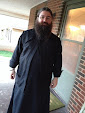
I don’t usually do terribly personal posts on this blog, but I just received the news that an American hieromonk from the Holy Mountain whom I had the blessing to get to know just reposed this morning. Hieromonk Barnabas of Karakallou was a warm, kind man, and even though I only met him four or five times, he made a tremendous, and quite unique impression on me. He seemed like such an ordinary, down-home American fellow complete with—I believe—a Texas accent, the sort of guy I could imagine being good friends with my parents and grandparents, that I was almost surprised that he was there spending his life on the Holy Mountain. The photo above shows us together at a brief meeting in Thessaloniki in the spring of 2007. He’s looking quite severe, but I don’t remember him that way at all. To me he was a very friendly, very personal face to the Holy Mountain.

Once I was walking from Philotheou to Karakallou, precisely to see Fr Barnabas and another American monk there, and I was under the tall trees on the dirt road, going around a bend and beginning to think I may have taken a wrong turn, when I saw a white-bearded monk a good way off wearing sunglasses and walking towards me. I thought that I would ask him whether I was going the right way to find Karakallou, but as I got closer, I saw that it was Fr Barnabas! He was wearing those over-sized sunglasses that old people wear over their spectacles and listening to a walkman (he told me it was an audiobook of St Theophan the Recluse). It turned out he had been anxiously anticipating my arrival and decided to go on a walk to get some exercise and pass the time! I’ll always remember the joy of seeing that familiar face there in the ancient forest of that spiritual centre. I'll always remember him complaining about the food at Karakallou—too much salt, if memory serves me.

Anyway, I’m told Fr Barnabas was in good spirits when it happened. He had been undergoing chemotherapy in Thessaloniki, and was actually already hospitalised when he had a sudden heart attack. In the words of Archimandrite Vasileios of Iveron, ‘He disappeared into the other life, the true life, into the abundance of glory which unites us all’ (Beauty and Hesychia in Athonite Life, trans. Constantine Kokenes [Montréal: Alexander, 1999], pp. 17-8). Please have him commemorated at your parishes this weekend. May his memory be eternal!

'A Lover of Books'—The Holy Great Prince Yaroslav the Wise


Today, 20 February on the Church’s calendar, we commemorate the Holy Great Prince Yaroslav the Wise. I first became acquainted with St Yaroslav through Bishop Kallistos’s brief account in The Orthodox Church, and I immediately took note of him (literally—I made a note in the margin). Unfortunately, I don’t have my copy of that book anymore and can’t quote it or cite the page number, but I do have something even better. There is a wonderful bit about St Yaroslav in the Primary Chronicle for the year 6545 (1037 AD). I shall quote the entire excerpt from Samuel H. Cross’s translation plus the introductory note given in Serge A. Zenkovsky’s Medieval Russia’s Epics, Chronicles, and Tales, rev. and enlarged ed. (NY: Meridian, 1974), pp. 71-3:

12. Yaroslav the Wise

Fratricidal warring among the sons of Vladimir ended in 1016 with the victory of Prince Yaroslav, who established a firm rule over Russia for nearly forty years, from 1016 to 1054. This was the ‘golden age’ of Kievan Russia, the age when material, intellectual, and artistic achievements were particularly brilliant. Prince Yaroslav, called ‘Yaroslav the Wise’ by his contemporaries because of the peace and prosperity that marked his reign, maintained lively relations with Byzantium and Western Europe, and his children and grandchildren married the royalty of various western European nations. His daughter, Ann, became queen of France, and ruled that country in the name of her son after the death of her husband, Henry I, the Capet. It is of interest to note that Ann was the only literate member of the French royal family, and signed most of the state documents for her husband and son.

6545 (1037) Yaroslav built the great citadel at Kiev, near which stand the Golden Gates. He founded there also the metropolitan Church of St Sophia, the Church of the
Annunciation by the Golden Gates, and also the Monastery of Ss George and Irene. During his reign, the Christian faith was fruitful and multiplied, while the number of monks increased, and new monasteries came into being. Yaroslav loved religious establishments and was devoted to priests, especially to monks. He applied himself to books, and read them continually day and night. He assembled many scribes, and translated from Greek into Slavic. He wrote and collected many books through which true believers are instructed and enjoy religious education. For as one man plows the land, another sows, and still others reap and eat food in abundance, so did this prince. His father Vladimir plowed and harrowed the soil when he enlightened Russia through baptism, and this prince sowed the hearts of the faithful with the written word, and we in turn reap the harvest by receiving the teaching of books. For great is the profit from book learning.

Through the medium of books, we are shown and taught the way of repentance, for we gain wisdom and continence from the written word. Books are like rivers that water the whole earth; they are the springs of wisdom. For books have an immeasurable depth; by them we are consoled in sorrow. They are the bridle of self-restraint. For great is wisdom. As Solomon said in its praise: ‘I (Wisdom) have inculcated counsel; I have summoned reason and prudence. The fear of the Lord is the beginning of wisdom. Mine are counsel, wisdom, constancy, and strength. Through me kings rule, and the mighty decree justice. Through me are princes magnified and the oppressors possess the earth. I love them that love me, and they who seek me shall find grace’ (Proverbs 8:12, 13, 14-17). If you seek wisdom attentively in books, you will obtain great profit for your spirit. He who reads books converses with God or with holy men. If one possesses the words of the prophets, the teachings of the evangelists and the Apostles, and the lives of the Holy Fathers, his soul will derive great profit therefrom. Thus Yaroslav, as we have said, was a lover of books, and as he wrote many, he deposited them in the Church of St Sophia, which he himself had founded. He adorned it with gold and silver and churchly vessels, and in it the usual hymns are raised to God at the customary seasons. He founded other churches in the cities and districts, appointing priests and paying them out of his personal fortune. He bade them teach the people, since that is the duty which God has prescribed them, and to go often into the churches. Priests and Christian laymen thus increased in number. Yaroslav rejoiced to see the multitude of his churches and of his Christian subjects, but the devil was afflicted, since he was now conquered by this new Christian nation.

Sir Dimitri Obolensky points out that the chronicler here is so gushing with (genuine) emotion, and so gratefully eager ‘to extol the virtues’ of St Yaroslav ‘in promoting the Slav vernacular culture that he fails, in this passage, to mention the fountainhead of this culture—the work of Cyril and Methodius’ (Byzantium and the Slavs [Crestwood, NY: St Vladimir’s Seminary, 1994], pp. 219-20). But it must be acknowledged that it was immediately through the bibliophilia of St Yaroslav that this culture was passed on to the chronicler, and his gratitude is thus not misdirected.

Of course, one of the many important achievements of St Yaroslav’s reign, which was not mentioned in this passage of the Chronicle, was the compilation of the first Russian code of laws, the Pravda Russkaia or Lex Russica. According to Thomas Riha, although it was formed in ‘the atmosphere’ of Byzantine law, the Pravda was ‘based upon customary law’ (Readings in the History of Russian Civilization, Vol. I: Russia Before Peter the Great, 900-1700, ed. Thomas Riha [Chicago: U of Chicago, 1966], pp. 33, 32). Riha also notes ‘a striking resemblance between some of its clauses and some of the provisions of King Alfred’s Wessex laws’ (p. 32). Eve Levin points out that a 'strong theme' of the whole Pravda 'was the protection of Orthodox Russian women' (Sex and Society in the World of the Orthodox Slavs [Ithaca, NY: Cornell U, 1995], p. 102). Nevertheless, among the more important articles of the Pravda, wonderfully illustrative of the vast wisdom and justice of the Great Prince, is the following: ‘Article 67. If anyone tears [another’s] beard, and [the offended either comes to the court] with the sign of it, or produces men [as witnesses], [the offender pays] a 12 grivna fine; but if there is a claim and no men [to support it], there is no fine’ (Riha, p. 43). A richly deserved 12 grivna fine, one feels!

Having been so impressed by the example of St Yaroslav as I encountered it in Bishop Kallistos's account as well as in the Primary Chronicle, I was thrilled when my father (an avid genealogist) showed me that we could trace one of our ancestors back to Anne of Kiev and Henry I Capet of France, and from her to St Yaroslav, St Vladimir, and St Olga, and thence to Rurik and eventually, of course, to Odin—according to Snorri Sturluson a descendant of King Priam of Troy (Edda, trans. and ed. Anthony Faulkes [London: Everyman, 2001], p. 3). So it is on behalf of an ancestor, fallen under 'Pyrrhus' bleeding sword', that I second the immortal words (preferably in a Charlton Heston impression):

Out, out thou strumpet Fortune! All you gods,
In general synod take away her power,
Break all the spokes and fellies from her wheel,
And bowl the round nave down the hill of heaven,
As low as to the fiends.