19 November 2009

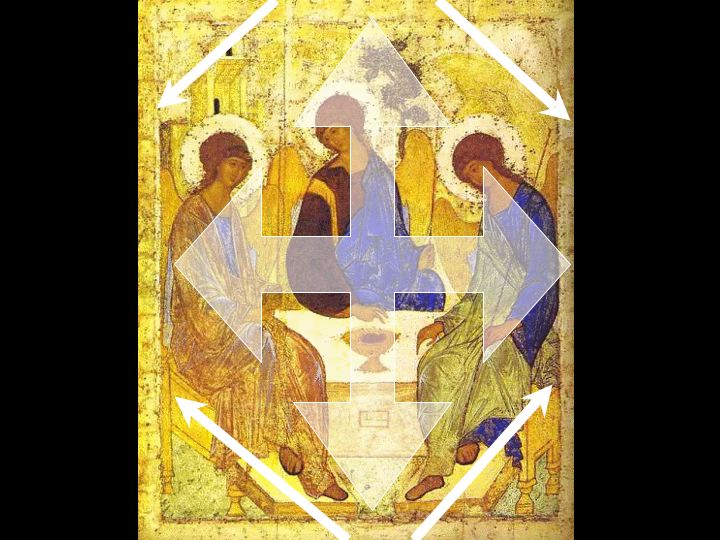
Torrance's Take on Inverse Perspective


There is a reference to iconography in Scottish theologian Thomas Torrance’s Space, Time & Incarnation (Edinburgh: T&T Clark, 1997), which I actually first saw quoted way back in college in Leonard Stanton, The Optina Pustyn Monastery in the Russian Literary Imagination: Iconic Vision in Works by Dostoevsky, Gogol, Tolstoy, & Others (NY: Peter Lang, 1995), p. 15. Stanton’s use of this passage made enough of an impression on me that during my college stint at Barnes & Noble I actually ordered Torrance’s book just so I’d have the source. Here is the full text cited by Stanton, taken from p. 18 of Torrance:

Space is here [in Nicene theology] a differential concept that is essentially open-ended, for it is defined in accordance with the interaction between God and man, eternal and contingent happening. It is treated as a sort of coordinate system (to use a later expression) between two horizontal dimensions, space and time, and one vertical dimension, relation to God. In this kind of coordination, space and time are given a sort of transworldly aspect in which they are open to the transcendent ground of the order they bear within nature. This means that the concept of space which we use in the Nicene Creed is one that is relatively closed, so to speak, on our side where it has to do with physical existence, but is one which is infinitely open on God’s side. This is why frequently when Byzantine art sought to express this ikonically it deliberately reversed the natural perspective of the dais upon which Christ was represented. The Son of God become man could not be presented as one who had become so confined in the limits of the body that the universe was left empty of His government. He could not be represented, therefore, as captured by lines which when produced upwards met at some point in finite space, but only between lines which even when produced to infinity could never meet, for they reached out on either side into the absolute openness and eternity of the transcendent God.


But I have always wondered what Torrance’s source for this notion was, and I would appreciate any suggestions from Logismoi readers. According to Victor Bychkov, in The Aesthetic Face of Being: Art in the Theology of Pavel Florensky, trans. Richard Pevear & Larissa Volokhonsky (Crestwood, NY: SVS, 1993), Fr Florensky gave some consideration to the ‘inverse perspective’ of iconography in an essay of that title, but his explanation of the phenomenon seems to be a more purely aesthetic and less a theological one (pp. 55-7, 60-1, 92-3). Furthermore, although I certainly admire both Torrance’s and Fr Florensky’s treatments of this issue, neither seems to be based on anything actually made explicit in Orthodox Tradition. I don’t recall seeing in the Fathers’ writings on iconography, for instance, anything quite like Torrance’s analogy between Nicene theology and the iconographic style and perspective per se.

It should be noted that the first chapter of this book, ‘The Problem of Spatial Concepts in Nicene Theology’, is my only first-hand acquaintance with Torrance. I wasn’t sufficiently interested in Reformed theology to keep reading after that, and since then my only other significant encounter with the Scottish theologian has been in the treatment of him in Fr Andrew Louth’s brilliant Discerning the Mystery: An Essay on the Nature of Theology (Wichita, KS: Eighth Day, 2007), pp. 48-54 (which I reviewed here). Although Fr Louth believes ‘there is . . . much to be learnt from the kind of considerations he raises in the course of his books’, he concludes that ‘Torrance is mistaken in the fundamental thrust of his enterprise’ (p. 53). This does not however effect his take on inverse perspective so far as I can tell.

Incidentally, the illustration above is from this helpfully illustrated post by Richard Beck on the subjective of inverse perspective in icons.

18 November 2009

The Raven in St Maximus & Jonathan Strange


Some time ago I did a post on ravens which ended up being one of my own personal favourites on this blog. I’d now like to add a couple of things to the ‘raven lore’ there. First of all, as I was reading through Despina Prassas’s introduction to her translation of St Maximus the Confessor’s Questions & Doubts (DeKalb, IL: Northern Illinois U, 2010), I came across a reference (on p. 26) to a question that deals with the incident of the Prophet Elijah being fed by ravens in III Kings 17:2-6 (LXX). Quite in keeping with the general thrust of human views of ravens, here is the question and answer in full:

Question 185
Why, ever, does a raven sustain Elias with bread in the morning and meat in the afternoon?

The raven represents nature blackened through disobedience, and Elias sitting in the gully represents the knowledgeable nous sitting in the gully of temptations and labors of askesis. He is nourished in the morning by bread from the blackened nature, that is, by gathering knowledge from the natural contemplation of the things that exist, and in the afternoon by meat. For he is initiated into the mystery of the incarnation of the Lord that will occur at the end times, because, certainly, the one who created nature out of nonbeing, will also restore it when it is corrupted. Or [to interpret this] in another way: Elias represents a type of the Lord. For when a spiritual famine held all hearts in captivity, he went into the gully, that is, into life, voluntarily accepting temptations and sufferings; and ‘when he came into his own house, his own people did not accept him’ (Jn 1:11), nor did they nourish him. But the nations that had been blackened by idolatry welcomed and nourished him through knowledge and action, knowledge being signified by the bread and action by the meat.

It is interesting to note that it is precisely in discerning the type of the Lord that St Maximus’s interpretation dovetails most closely with the apparently Semitic interpretive tradition outlined in the blog to which I link in my earlier post and expressed later by the commentary of Isho’dad of Merv that I quoted there.

The other thing I wanted to add is a brief bit of verse from Susanna Clarke’s Jonathan Strange & Mr Norrell, 3 vols. (NY: Bloomsbury, 2004) that I have wished to post for some time now and couldn’t find an excuse for. Anyway, it concerns the legendary ‘Raven King’, John Uskglass, and the ‘contract’ with England that I mentioned in my previous post:

The ivy promised to bind England’s enemies
Briars and thorns promised to whip them
The hawthorn said he would answer any question
The birch said he would make doors to other countries
The yew brought us weapons
The raven punished our enemies
The oak watched the distant hills
The rain washed away all sorrow

This traditional English saying supposedly lists the various contracts which John Uskglass, the Raven King, made on England’s behalf with the forests. (V. 2, p. 223, n. 4)
Incidentally, as I was formatting this post, my 4-year-old son was showing my wife a little raven perched on part of a mediæval playset he has and telling her that he calls it ‘the Halloween bird’.

17 November 2009

My Grandfather's Private Library


Last week, I travelled to Tulsa to visit the home of my paternal grandfather, a widower who recently turned 90, for what may be one of the very last times. The poor fellow is having to move in with my uncle so he can get a bit more assistance and less responsibility. This means that a lifetime’s worth of ‘stuff’—in fact, a good many things that I remember seeing on the walls or shelves ever since I can remember—is going to have to be disposed of in one way or another.

Even though my grandpa never went to college, he was always an avid reader, and more importantly, a devout lifelong Christian of the Pentecostal variety. So naturally, one of the things I took a good long look at was, sadly, all of the books that he won’t be reading anymore. I took a pretty good-sized stack, some for nostalgia, some for utility. I got the copy of The Orthodox Church by Metropolitan Kallistos (Timothy Ware)—the ‘New Edition’ reprinted with revisions in 1997—that I had given him for Christmas in 1997, when I’d been Orthodox for just under two years. He obviously read it, for it bears not only his copious underlining throughout, but also occasional dates, recorded, I suppose, to mark his progress (the earliest is 1-23-98, the latest 3-1-98). There are of course a few things in there that I now wish he had not had to see, but I’ve long been impressed and grateful that he actually took the trouble to read it, and indeed seemed genuinely interested.

I also claimed a large volume of The Life & Works of Flavius Josephus, the Learned and Authentic Jewish Historian & Celebrated Warrior, to Which Are Added Seven Dissertations Concerning Jesus Christ, John the Baptist, James the Just, God’s Command to Abraham, Etc., Standard Edition, trans. William Whiston, A.M., with an Introductory Essay by the Rev. H. Stebbing, D.D., Illustrated (Philadelphia: The John C. Winston Co., n.d.), inscribed:

J.C. Taylor [my grandfather’s name]
Presented by the Training Class of the
Mounds Assembly of God Church, March 1953.

In addition to the Jewish War, Antiquities of the Jews, Against Apion, and the Autobiography, the Appendix also contains a ‘Dissertation’ on and the Greek text of the Discourse to the Greeks Concerning Hades—a work now attributed to Hippolytus of Rome but long attributed to Josephus, and believed by Whiston to have been ‘preached or written [by the latter] when he was bishop of Jersualem [?!], about the end of Trajan’ (p. 987). At any rate, I was very excited to get this since of Josephus’s work I had previously only had an old Penguin edition of the Jewish War.

But the most unusual thing of all was a massive, four-volume set called New Self-Interpreting Bible Library with Commentaries, References, Harmony of the Gospels & the Helps Needed to Understand & Teach the Text, Illustrated & Explained (St Louis: The Bible Educational Society, 1917). It features ‘References, Reflections, Tabulated Statistics & Comments by John Brown, D.D., LL. D.’ (pictured above), an Introduction by Bishop John H. Vincent, D.D., LL. D., ‘References, Explanatory Notes, & Tabulated Statistics Edited & Revised by Rev. James W. Lee, D.D.’, ‘Geographical, Historical & Explanatory Comments by Josiah L. Porter, D.D., LL. D.’, ‘Expository Notes, Dissertations & Side Lights by Henry Cooke, D.D., LL. D.’, and Photographs by Prof. Robert E.M. Bain.

In case you are confused, as I was upon first opening Volume 1 and perusing it, there is a complete text of the Authorised Version of the Scriptures here distributed among the four volumes, copiously illustrated with Prof. Bain’s wonderful photographs of the Holy Land as well as regular maps. But the first volume also contains a staggering amount of reference information, including all kinds of charts and statistics. To name just a few, there are ‘Feasts and Festivals of the Jews’, ‘Books of the Old Testament in Their Narrative Order’, ‘A Glossary of Symbolic Words’, ‘Greek and Roman Deities’, and ‘The Parables of Our Lord’.

Though revised by Rev. James W. Lee, the original of the commentary proper, including extensive 'Reflections', is the work of Rev. John Brown of Haddington (1722-1787), a Scottish divine and minister in a small Presbyterian body which broke away from the main Church of Scotland over the acts of some General Assembly which had not taken the presbyteries into account (and later further divided into the ‘Burghers’ and ‘Anti-Burghers’, Brown belonging to the former). He was an autodidact, and according to the ‘Memoir’ on p. 14 of Vol. 1, while working for ‘a godly shepherd of Abernathy, he conceived the idea of one day becoming a shepherd of souls. He accordingly prosecuted his studies with increasing ardor and diligence, and soon acquired a considerable knowledge of Latin and Greek [as well as Hebrew and, later, modern languages].’ Chambers’s Cyclopædia of English Literature (here) gives a cute anecdote about the young scholar from a note his son had made in the senior Brown’s first Greek New Testament:

He (John Brown of Haddington) had now acquired so much of Greek as encouraged him to hope that he might at length be prepared to reap the richest of all rewards which classical learning could confer on him, the capacity of reading in the original tongue the blessed New Testament of our Lord and Saviour. Full of this hope, he became anxious to possess a copy of the invaluable volume. One night, having committed the charge of his sheep to a companion, he set out on a midnight journey to St Andrews, a distance of twenty-four miles. He reached his destination in the morning, and went to the bookseller’s shop, asking for a copy of the Greek New Testament. The master of the shop, surprised at such a request from a shepherd boy, was disposed to make a game of him. Some of the professors coming into the shop questioned the lad about his employment and studies. After hearing his tale, one of them desired the bookseller to bring the volume. He did so, and, drawing it down, said: ‘Boy, read this and you shall have it for nothing.’ The boy did so, acquitted himself to the admiration of his judges, and carried off his Testament, and when the evening arrived, was studying it in the midst of his flock on the braes of Abernethy.


Interestingly, in the same source John Brown’s grandson, also named John Brown, also refers to his grandfather having to defend himself ‘against the astonishing and base charge of getting his learning from the devil (that shrewd personage would not have employed him on the Greek Testament’. Indeed, according to this source, no less than the philosopher David Hume, whose scepticism has done much to serve ‘that shrewd personage’, liked ‘to hear Dr John Brown preach, because he preached as if he believed the Lord Jesus stood at his elbow.’

Bob Mattes, in his Reference Short List at Green Baggins, annotates a listing of the New Self-Interpreting Bible Library like so: ‘Excellent reference by a master Bible scholar. Besides the Bible notes, it holds an outstanding compendium of Bible information in the first volume. It’s way more than a study Bible. So good that it was updated and published until the early 20th Century.’ So, after that long disquisition on the original author of this commentary, here is a sample of his work, from the ‘Reflections’ on Numbers 10, where the Lord commands Moses to make the trumpets of silver:

In these trumpets I discern the pure and precious gospel of Christ, and hear its joyful sound proclaiming the sufficiency and suitableness of Jesus and his righteousness, calling sinful men to him and his ordinances, and encouragin them in their journey heavenward, and in their spiritual warfare with sin, Satan, the world, and death. Let me also observe, that even Sinai-visits, the most noted opportunities of intimacy with God, come quickly to an end; and that, in this world, we but remove from one wilderness to another. While, in the Hebrews’ orderly march I discern the ransomed of the Lord, directed by the Lion of the tribe of Judah, and having his Father’s presence among them, marching in goodly order to their heavenly Canaan, let me exert myself to gain others, particularly my relations, to God and glory. There is in him enough for us all. And happy are they, if grace make them forget their father’s house, and their own people, to go to the Lord! While, therefore, we have his ordinances with us, let us strive together in prayer for his presence therein; that it may be our effectual defence against enemies, and a source of every necessary comfort. (pp. 431-2)


It is interesting as well to note that in his ‘Reflections’ on Numbers 16, Rev. Brown writes:

Unsanctified honours often puff up men to their own destruction: and if God exalt them above most of their brethren, they can endure to be in subjection to none. Yea, God permits unsanctified professors, especially ministers and magistrates, to go often the most fearful lengths in sin. . . . How often have I, as these rebels, gone about to establish my own righteousness, and refused to submit to the laws of Christ; and thus attempted to thrust him from his office of priest and king over the people of God, in order that I might usurp his place! (pp. 440-1)


Would that more would-be interpreters of this chapter consulted Rev. Browns’s reflections beforehand, so that self-righteous pride might not infect their ponderings on Numbers!

16 November 2009

The Passage of the Soul in Modern Theologians


Continued from this post.

In his illuminating essay, ‘Our Warfare is Not Against Flesh and Blood: On the Question of the “Toll-Houses”’ (Selected Essays [Jordanville, NY: Holy Trinity Monastery, 1996], pp. 232-41), the great Jordanville theologian and product of the pre-Revolutionary Kiev Theological Academy, Fr Michael Pomazansky, quotes a passage from St John Chrysostom’s Homily 2, ‘On Remembering the Dead’:

If, in setting out for any foreign country or city we are in need of guides, then how much shall we need helpers and guides in order to pass unhindered past the elders, the powers, the governors of the air, the persecutors, the chief
collectors! For this reason, the soul, flying away from the body, often ascends and descends, fears and trembles. The awareness of sins always torments us, all the more at that hour when we shall have to be conducted to those trials and that frightful judgement place. (pp. 236-7)

More recently, one of the most well-known authors on the subject of these aerial demons is St Ignatius (Brianchaninov). Concerning St Ignatius, Met. Kallistos (Ware) writes (Foreword, On the Prayer of Jesus, trans. Archim. Lazarus [Moore] [Boston: New Seeds, 2006], p. xvi):

St Ignatius Brianchaninov was a prolific author, and the standard edition of his collected works, published at St Petersburg in 1885-1886, runs to five substantial volumes. Most of his writings are concerned with the monastic life, but he also wrote on the state of the soul after death, upholding the traditional Orthodox teaching on the twenty ‘toll-houses’.

In a footnote on this passage about what he calls ‘the traditional Orthodox teaching’, Met. Kallistos adds:

For a good discussion of St Ignatius’s teaching of this subject, see Fr Seraphim (Rose), The Soul After Death: Contemporary ‘After-Death’ Experiences in the Light of the Orthodox Teaching on the Afterlife, 5th ed. (Platina, CA: St Herman of Alaska Brotherhood, 1995), pp. 64-87, 250-52. As Fr Seraphim rightly observes, and as St Ignatius also believed, Patristic references to the ‘toll-houses’ are not to be interpreted in a crudely materialistic sense; proper allowance has to be made for the use of symbolic language. (pp. 142-3, n. 10)

Of course, despite this recommendation from one of the most respected of Orthodox bishops and theologians, there are still Orthodox who consider the toll-houses, and specifically Fr Seraphim’s presentation of this patristic teaching, ‘nonsense’ (see for example, the comment thread here). Others, while not going that far, find Fr Seraphim’s book a bit too dark and frightening, though of course, Fr Pomazansky observes, ‘If one is to complain of the frightening character of the pictures of the toll-houses—are there not many such pictures in the New Testament scriptures and in the words of the Lord Himself? Are we not frightened by the very simplest question: How camest thou in hither not having a wedding garment? (Mt 22:12)’ (p. 239).

Still, for such people, Hieromonk Alexander (Golitzin) has enthusiastically recommended (though not without a few rather minor criticisms), the book Life After Death, by the popular Greek theologian, Met. Hierotheos (Vlachos) of Nafpaktos, trans. Esther Williams (Levadia, Greece: Birth of the Theotokos Monastery, 1998). In his review in Divine Ascent: A Journal of Orthodox Faith, Vol. 1, Nos. 3/4 (The Entry into Jerusalem 1999), pp. 139-43 (published under the editorship of now Met. Jonah of the OCA), Fr Alexander writes:

In the last section, we are provided with, among other things, a valuable treatment of the demonic ‘tollbooths’ to which I referred above. The Metropolitan is inclined to take his widespread patristic image a little less literally than the works I complained about [including Fr Seraphim’s]. He sees it rather as an image, taken from the world of late antiquity, where tax-men functioned in effect as state-sanctioned Mafiosi, and a ‘tollhouse’ or tax station served as a natural image of unjust oppression (pp. 62 ff.). This is not to say that he accords the image no reality whatever, but that he is careful to not its symbolic force. It served to point toward, not describe, the trial that awaits the soul immediately upon dying, particularly if it enters death unprepared and without sufficient repentance. (pp. 141-2)

In light of the fact that, as Met. Kallistos notes, Fr Seraphim too acknowledges the non-literal nature of the ‘toll-house’ imagery (‘It is obvious to all but the youngest children that the name of “toll-house” is not to be taken literally’, qtd. in Hieromonk Damascene (Christensen), Father Seraphim Rose: His Life & Works [Platina, CA: St Herman of Alaska Brotherhood, 2003], p. 897), one wonders if Fr Alexander (as much as I love him!) may not have read Fr Seraphim’s book recently enough to have an entirely accurate impression of it. The sense one gets from his opening paragraph on p. 139 is that Fr Alexander is recollecting a 30-plus-year-old reading, one that took place before his own views were so strongly influenced by the life and teaching of the Holy Mountain.

At any rate, Fr Alexander urges us to read Met. Hierotheos’s book, ‘and be introduced to the sober, wholesome, and finally glorious teaching of the saints’ (p. 143). Following this advice, we see that His Eminence writes, concerning ‘the taxing of souls’:

We find this topic in the whole biblico-patristic tradition and it corresponds to a reality which we need to look at in order to prepare ourselves for the dreadful hour of death. What follows is written not in order to arouse anxiety, but to prompt repentance, which has joy as its result. For he who has the gift of the Holy Spirit and is united with Christ avoids the terrible presence and activity of the customs demons.

According to the teaching of the Fathers of the Church, the soul at its departure from the body, as well as when it is preparing to leave, senses the presence of the demons who are called customs demons, and is possessed with fear because of having to pass through customs. (p. 62)

Later, as if responding specifically to some of the more ridiculous criticisms of Fr Seraphim’s book, Met. Hierotheos writes:

Of course there are some who maintain that such notions as customs houses and aerial spirits have come into Christianity from Gnostic theories and pagan myths which prevailed during that period.

There is no doubt that such views can be found in many Gnostic texts, in pagan ideas which are found in Egyptian and Chaldean myths. However it must be emphasised that many Fathers adopted the teaching about the customs houses, but they cleared it of idolatrous and Gnostic frames of reference and placed it in the ecclesiastical atmosphere. . . .

. . .

. . . It is true that ancient traditions and heretical views spoke of ‘rulers of the astral sphere’, about ‘gates of an astral journey’, about ‘aerial spirits’, and so forth. We find several of these phrases in the Bible and in patristic texts. As we have mentioned in this chapter, many Fathers of the Church speak of customs houses and aerial spirits, but they have given them different content and different meaning. (pp. 77-8)

Of course, although Fr Alexander writes that Met. Hierotheos’s book ‘bears the marks of a man schooled in the ascetic and mystical tradition of the Church and someone who is an active pastor of souls’ (p. 140), His Eminence is, after all, only a popular theologian. Yet, perhaps the greatest Saint of the twentieth century, St John (Maximovitch) the Wonderworker of Shanghai and San Francisco, has also decisively upheld the teaching on the toll-houses. In a homily entitled ‘Life After Death’ (or here), St John writes:

At this time (the third day [after death]), it [the soul] passes through legions of evil spirits which obstruct its path and accuse it of various sins, to which they themselves had tempted it. According to various revelations there are twenty such obstacles, the so-called ‘toll-houses’, at each of which one or another form of sin is tested; after passing through one the soul comes upon the next one, and only after successfully passing through all of them can the soul continue its path without being immediately cast into gehenna.

Of course, I will just mention that the most detailed and systematic traditional account of the toll-houses is that in the Life of St Basil the New, who died in 944, according to St Nicholas (Velimirović) in the Prologue (The Prologue from Ochrid, Vol. 1, trans. Mother Maria [Birmingham: Lazarica, 1986], p. 331). St Nicholas writes, ‘The elder Theodora was his novice, the same Theodora who appeared after her death to Gregory, another of Basil’s novices, and described to him the twenty toll-houses through which every soul must pass’ (p. 331). I will not post from it here, since, as the ROCOR Synod points out, ‘no one can dogmatically establish the existence of the toll-houses precisely in accordance with the form described in the dream (of Gregory recounted in the life) of Basil the New’, but one can read the story as it appears in Eternal Mysteries Beyond the Grave by Archimandrite Panteleimon of Jordanville here (there is a whole book in Russian on this here).

In conclusion, Fr Pomazansky cites the statement of Met. Macarius of Moscow:

Concerning all the sensual, earthly images by which the Particular Judgement is presented in the form of the toll-houses, although in their fundamental idea they are completely true, still they should be accepted in the way that the angel instructed St Macarius of Alexandria, being only the weakest means of depicting heavenly things. (qtd. p. 238)

But Fr Pomazansky’s translator immediately adds in a footnote:

However, Met. Macarius does speak quite in detail on the subject of the toll-houses, devoting ten pages of his second volume to it (pp. 528-538), and giving extensive quotes from Ss Cyril of Alexandria, Ephraim the Syrian, Athanasius the Great, Macarius the Great, John Chrysostom, Maximus the Confessor, and a number of other sources, including many texts from the Divine service books, and concluding that ‘such an uninterrupted, constant, and universal usage in the Church on the teaching of the toll-houses, especially among the teachers of the fourth century, indisputably testifies that it was handed down to them from the teachers of the preceding centuries and is founded on apostolic tradition’ (p. 535). (pp. 238-9, n. 2)

15 November 2009

The Passage of the Soul in a Few Patristic Sources


In a post on the Holy Passion-bearers Boris and Gleb some time ago, I quoted an interesting prayer uttered by St Boris before his murder, a prayer that has come down to us in the so-called ‘Lesson on the Life and Murder of the Blessed Passion-Sufferers Boris and Gleb’ (The Hagiography of Kievan Rus’, trans. Paul Hollingsworth [Cambridge, MA: Harvard U, 1992], pp. 3-32), which Paul Hollingsworth dates between 1075 and 1085 (p. xxxv). According to the ‘Lesson’, St Boris prays:

My Lord, Jesus Christ, hear me this hour and vouchsafe me to share of the company of Thy saints. For, O Lord, even as once this day Zechariah was slaughtered before Thine altar, so now also am I slaughtered before Thee, O Lord. O Lord, Lord, remember not my former transgressions, but save my soul, so that the deceitful counsel of my adversaries may not block its way, and let Thy bright angels receive it. Because, O Lord, Thou art my Savior, do Thou forgive them that do these things, for Thou art the true God, and to Thee is glory forever. Amen. (p. 16)

Now, in an ordinary martyrdom, where those who put the Martyr to death often tried to persuade him to make some sacrifice to the pagan gods in order to spare his life, one might read the words ‘that the deceitful counsel of my adversaries may not block its way’ and think that they referred to the pagan questioners, blocking the way of the Martyr’s soul with their temptations. In the context of this story, however, the killers are determined on murdering St Boris no matter what he does or says, and the only voices calling for him to save himself are his own friends and retainers, who argue that he should fight for his life. Furthermore, when we note the petition which immediately follows this one in the prayer, ‘let Thy bright angels receive it’, it seems to me that there can be little doubt that when he refers to ‘my adversaries’ St Boris means the demons, and when he asks that they ‘may not block its way’, he is referring to possible attempts to hinder the passage of his soul to heaven.

Of course, there should be no surprise that he would ask such a thing. The writings of the Fathers and the Lives of the Saints are filled with references to such attempts by demons to hinder souls, and the opposing attempts by the angels of God to assist them. Merely in order to demonstrate that this is so, I would like to quote just a few of them.

First of all, as one example of this teaching, the Synod of Bishops of the Russian Church Abroad in its decision to forbid a certain former deacon from lecturing on the subject has classically cited Ode IV, troparia 4 of the canon chanted at the departing of the soul from the body—‘The prince of the air, the oppressor, the tyrant who standeth on the dread paths, the relentless accountant thereof, do thou vouchsafe me who am departing from the earth to pass [O Theotokos].’ Similarly, in the Prayer to the Most-Holy Theotokos from Compline, St Paul of the Evergetis Monastery (11th c.) refers in passing to this teaching when he begs the Theotokos ‘in the hour of my departure, to care for my wretched soul and drive far from it the dark countenances of evil demons’ (A Prayer Book for Orthodox Christians, trans. Holy Transfiguration Monastery [Boston: HTM, 1995], p. 26).

Furthermore, St Paul gathered several quite substantial passages from hagiographic and patristic writings on this subject in his 11th-c. collection, The Evergetinos, under Hypothesis X, ‘The soul, after its departure from the body, undergoes testing in the air by evil spirits which encounter it and attempt to impede its ascent’ (The Evergetinos: A Complete Text, Vol. 1, trans. Archbishop Chrysostomos, et al. [Etna, CA: Center for Traditionalist Orthodox Studies, 2008], p. 85). First among the passages under this Hypothesis is one from the Life of St Anthony by St Athanasius the Great (pp. 85-6), which can be found on pp. 78-9 of Robert Cregg’s translation (The Life of Antony and the Letter to Marcellinus, trans. Robert C. Cregg [Mahwah, NJ: Paulist, 1980]). St Athanasius writes:

. . . While he was standing there, he looked on himself, as though he had left his body, and his soul was taken into the air by several beings. After this, he saw a number of fearful and ugly creatures standing in front of him in the air, trying to keep him from passsing.

Those who were guiding his soul began to wrangle with these frightening creatures, who were asking for an account of the soul which they were accompanying and whether it was responsible to them for some debt. . . .

. . .

He was stunned when he reflected on how many temptations we must combat and what trials one must endure to pass by the air-borne demons. And he thought that this must be the meaning of the words of the Apostle Paul: ‘According to the prince of the power of the air’ (Eph. 2:2).

For this power alone belongs to the Enemy of our souls, that is, to war against us and try to impede those souls ascending into Heaven. (Evergetinos, p. 85)

St Paul also includes another passage from St Athanasius relating a vision St Anthony had of many other souls being similarly confronted by demons in the air (p. 86; p. 80 in Cregg). He then has a story from the Gerontikon (the Sayings of the Desert Fathers) about two monks who see, ‘The Angels of God coming to fetch me and my brother and to lead us into Heaven. As we were going up, we were met by hostile powers, countless in number and of fearful form. Though they bothered us a great deal, they nonetheless had no success against us’ (p. 87). This is followed by a passage from St Isaiah the Solitary, where he writes, ‘. . . [W]hen the soul of man departs from the body, the Angels go along with it. However, all of the powers of darkness then hasten to meet it and seek to take hold of it, thereby to examine it carefully and learn whether or not it was engaged in any of their own works’ (p. 87). Finally, it is interesting to note that the last passage included by St Paul (on pp. 88-9) is the one saying associated with Abba Theophilus the Archbishop where he seems to be teaching rather than learning something (Theophilus 4). I shall quote the key lines from Benedicta Ward’s translation, The Sayings of the Desert Fathers: The Alphabetical Collection, rev. ed. (Kalamazoo, MI: Cistercian, 1984), p. 81:

What fear, what trembling, what uneasiness will there be for us when our soul is separated from the body. Then indeed the force and strength of the adverse powers come against us, the rulers of darkness, those who command the world of evil, the principalities, the powers, the spirits of evil. They accuse our souls as in a lawsuit, bringing before it all the sins it has committed, whether deliberately or through ignorance, from its youth until the time when it has been taken away. . . . On the other hand, the divine powers stand on the opposite side, and they present the good deeds of the soul.

Τo turn to a source not included in the Evergetinos, St Macarius the Great, in perfect agreement with all of the foregoing, teaches in Homily 43.9 (St Macarius, The Fifty Spiritual Homilies and the Great Letter, trans. Fr George A. Maloney [NY: Paulist, 1992], p. 222):

Like the tax collectors who sit along the narrow streets and snatch at the passers-by and extort from them, so also the demons watch carefully and grab hold of souls. And when they pass out of the body, if they are not completely purified, they are not permitted to go up into the mansions of Heaven there to meet their Master. For they are driven down by the demons of the air. But if, while they still live in the flesh, they shall, because of their hard toil and much struggle, obtain from the Lord on high grace, they, along with those who through virtuous living are at rest, shall go to the Lord, as he promised.

Continued here.

14 November 2009

Recurring Names & the Scholarship of Anthony Esolen


When in the course of my life with books I begin to notice a name recurring—in favourable contexts of course—I typically take it as a sign from God that He is bringing something to my attention. A couple of months ago, three things happened in close chronological proximity to each other: 1) I noticed at Half Price Books a translation of Lucretius’s De rerum natura translated by one Anthony Esolen of Providence College, 2) I noticed on the classroom shelf of my science teacher friend (mentioned here) a book on irony in Christian literature—the author, the same Esolen, and finally, 3) the RC priest who leads the Chesterton Society of which I am a member chanced to mention that there was a recent translation of the Divine Comedy with notes he deemed remarkably good, by, you guessed it, Anthony Esolen, and published by the Modern Library.

I waited for a time, hesitant about spending money when our finances were more than usually strained. But at last I could not resist buying, first, the Lucretius translation (Lucretius, On the Nature of Things—De rerum natura, ed. & trans. Anthony M. Esolen [Baltimore: Johns Hopkins, 1995]), since it was the cheapest of the three and as a used book might not be available at that price again soon. To tell the truth, I was a bit surprised that an evidently Christian scholar would devote so much time to the De rerum natura as to translate it. Of course, I have never read the poem, and knew it only, on the one hand, from a reference to it as a kind of ancient expression of atheist materialism, and on the other, as a representative of the Epicurean philosophy which was the sworn enemy of the Stoics, whose works I have long loved. So I bought the translation for Esolen’s introduction as much as anything, to learn from a fellow Christian what I should appreciate about this work. This I learned indeed, but also how to handle that which I did not appreciate. Here was a significant passage for me—one of the few explicit references to Christianity in the whole introduction:

Again and again he reminds us why we study the teachings of Epicurus: to free our minds from the crush of superstition. The Christian God of love and consolation was unavailable to Lucretius. Greek and Roman gods were to be feared, propitiated. The Psalmist may behold the stars and wonder at the smallness of man and the unreasonable love of God, that He should not only give a passing thought to something so trivial but indeed should make man little less than an angel. Lucretius’s men look at the stars and are overawed; they cringe and worry that all the power that whirls the stars may be aimed squarely at them. . . . Before Epicurus, Lucretius said, religion thrust its monstrous head from the sky, grimacing upon us, menacing. Human life was abject. But Epicurus’s discovery of rational laws has set our spirits free. (pp. 8-9)

I for one couldn’t help but be a little more sympathetic to the poem after that, and the beauties and pleasures of Lucretius’s vision of life appear a bit more innocent, as in this passage (qtd. on p. 10):

When friends in the long grass will lie at ease,
In the shade of a tall tree at the riverside,
Their bodies refreshed and gladdened, at no great cost,
Most pleasantly when the weather smiles and the season
Sprinkles the meadow with fresh and lusty flowers.

I was, of course, not nearly so puzzled over Esolen’s work on the Divine Comedy, and though I delayed a bit longer than in my purchase of the Lucretius translation, I soon bought his translation of my favourite of Dante’s canticas, the Paradiso—Anthony Esolen, trans. & ed., Paradise, illust. Gustave Doré (NY: Modern Library, 2007). Although I have not yet read through his introduction, I quickly found a paragraph that has the virtue of recalling some ideas by two of my favourite commentators on things mediæval: C.S. Lewis and Umberto Eco. After considering possible interpretations of the common observation that the Paradiso is ‘the most medieval’ of the three canticas, Esolen concludes:

I would like to understand it, then, in this sense: the Paradise is indeed the most medieval of the three canticles, in that it most fully embodies the striving of the medieval mind to understand all of reality—material and intellectual, legal and moral and religious, earthly and heavenly, logical and supralogical—as one grand and harmonious whole. And more, if there be more to assert: the Paradise strives to show forth that whole in a work of art that is itself, like the playful and soaring cathedrals of France, a work of ineffable beauty and complexity. For it is Paradise that resumes and perfects the themes and motifs of the other two canticles. It is the work by which the unity of the whole Comedy must be judged. (p. xii)

As for Esolen’s handling of the verse, which is happily paired with the original Italian on the facing page, it appears to be a fairly regular iambic pentameter, with occasional rhyme increasing in frequency, as the translator points out, from one cantica to the next. Here are the last twenty-one lines to give readers a sample (keep in mind that in the book, the second and third lines of each terza are indented):

O Light that dwell within Thyself alone,
who alone know Thyself, are known, and smile
with Love upon the Knowing and the Known!
That circle which appeared—in my poor style—
like a reflected radiance in Thee,
after my eyes had studied it awhile,
Within, and in its own hue, seemed to be
tinted with the figure of a Man,
and so I gazed on it absorbedly.
As a geometer struggles all he can
to measure out the circle by the square,
but all his cogitation cannot gain
The principle he lacks: so did I stare
at this strange sight, to make the image fit
the aureole, and see it enter there:
But mine were not the feathers for that flight,
Save that the truth I longed for came to me,
smiting my mind like lightning flashing bright.
Here ceased the powers of my high fantasy.
Already were my all my will and my desires
turned—as a wheel in equal balance—by
The Love that moves the sun and the other stars. (pp. 357, 359)

I intend to look into the book on irony (Ironies of Faith: The Laughter at the Heart of Christian Literature [Wilmington, DE: ISI, 2007]—here), probably, at first, via loan from my science teacher friend. In the meantime, of course, I located Esolen’s personal site, and also tracked down a few of his articles in First Things and Touchstone (where he is an editor). I quite enjoyed these comments in a review of a translation of Petrarch in The Claremont Review of Books (here):

In short, you cannot interpret or translate Petrarch as if he were merely a modern man who had managed to shake free of the bulky, many-dimensional chrysalis of the medieval cosmos to flit along in our subjectivist world of three dimensions, me, myself, and I. You have to have an ear for theology and Scripture, not to mention Dante, and when you are translating you have to ensure that the echoes are heard. The task as I see it is not to make Petrarch familiar to us, but to familiarize us with him: to encourage us to look upon his work with wonder, inasmuch as it is rich and strange.

These lines are a wonderful response to one my pet peeves in much modern commentary on pre-modern thought and literature. To ‘look upon his work with wonder, inasmuch as it is rich and strange’ is one of my favourite things about reading the old books. In short (pardon the echo), I grow more intrigued with this Esolen with each new piece I discover.

13 November 2009

My Triumphant Return, & the Utility of Blogging


I am pleased to announce that thanks to the diligent assistance of my tech-savvy friend, Kevin Edgecomb, I am able once again to access the Internet from my laptop. Thus, my blogging efforts are hereby resumed! Furthermore, it is interesting to note that I have lately had two very gratifying examples of the possible utility of those efforts. First, I received an e-mail from a certain John Arnold, which read as follows:

Dear Aaron Taylor

I’ve just googled into your discussion of ‘stokkes and stones’ on your blog [see this post, and this follow-up]. It’s extremely helpful to me, because I'm currently looking at the language used by various people tried for Lollardy in fifteenth-century England, and the phrase ‘stokkes and stones’—very definitely in the sense of idolatry—pops up there quite frequently. (Lollard condemning what was then orthodox piety, regarding holy images, as a form of idolatry).

I hope that you won’t mind if I follow up your research for my own work—I had wondered if it might appear as a phrase in older English texts discussing idolatry; your blog provided a wonderful short cut...

With all best wishes
John Arnold

When I asked him for more information about the nature and purpose of his research, I received the following reply:

Dear Aaron (if I may)

The phrase pops up in various trial records, where people are questioned (following canon law procedures) as suspected heretics—‘Lollards’ appears to be the popular term for them. There is much debate about whether their ideas come from the late fourteenth-century radical theology of John Wyclif, or are more diffuse/popular.

So, you get various people saying things (or accused of saying things) such as ‘images of the crucifixe of our Lady and other seynts aught not to be worshipped bicause they were made with mannys hands, and that they were but stokkes and stonys’ (Joan Riche, of Wittersham, in a trial from 1511); that ‘Lucifer now has on Earth what he wanted in Heaven, namely the adoration of “stokkes and stones and ded mennes bones”’ (this alleged by another witness against one Margery Baxter, in a trial from 1428). There are various similar occurrences. Broadly speaking, the Lollards are against pilgrimage and images (thinking it more important to give money directly to the poor, and thinking of images as idolatry); do not believe in the sacrament of the Eucharist (Wyclif had a more complex theology; the trial records indicate a mixture of general scepticism and a sort of commemorative sense of that sacrament); and think that unworthy priests should be disendowed with worldly goods.

My interest is for an academic paper I'm currently working on (I’m a professor of medieval history, at the University of London), where my feeling was—rightly, as it turns out—that this turn of phrase was not specifically limited to Lollardy; the wider issue being how one thinks about ‘membership’ of a ‘sect’, in this time and place (and more broadly than that, how one thinks about the expression of belief via language).

Part of my research involves digging around in archives and manuscripts in the British Museum etc; but these days, googling anything you’re interested in is bound also to turn up some useful results—as your blog did! So, many thanks.

If you’re interested in learning more about Lollards, the trials from Norwich in 1428-31 are available in translation on-line, at [this page].

Best wishes
John

Subsequently, I googled Professor Arnold’s name in turn, and found his faculty page at the University of London’s Birkbeck College.

Shortly after this exchange with Professor Arnold, I received another e-mail from an acquaintance currently in the novitiate at St Herman of Alaska Monastery who has been assisting Hieromonk Damascene in some research for the revision of one of his articles. It turned out they had been similarly helped by this post on a small point of confusion I’d encountered in St Nicodemus’s use of St Maximus the Confessor. The serendipity initiated an exchange of e-mails, telephone calls, and even an attempted fax with Fr Damascene, who was kind enough to send me a pdf of a draft of the article in question and to promise the arrival of a few goodies in the mail!

I mention these events not simply to toot my own horn, but sincerely to share my joy at the discovery that some of these more pedantic posts have served not merely as a source of entertainment to myself or even to others, but have also proved useful to people who are working on serious things for publication! By all means, readers, keep me updated when you actually find something here useful for such endeavours. I find it highly encouraging!